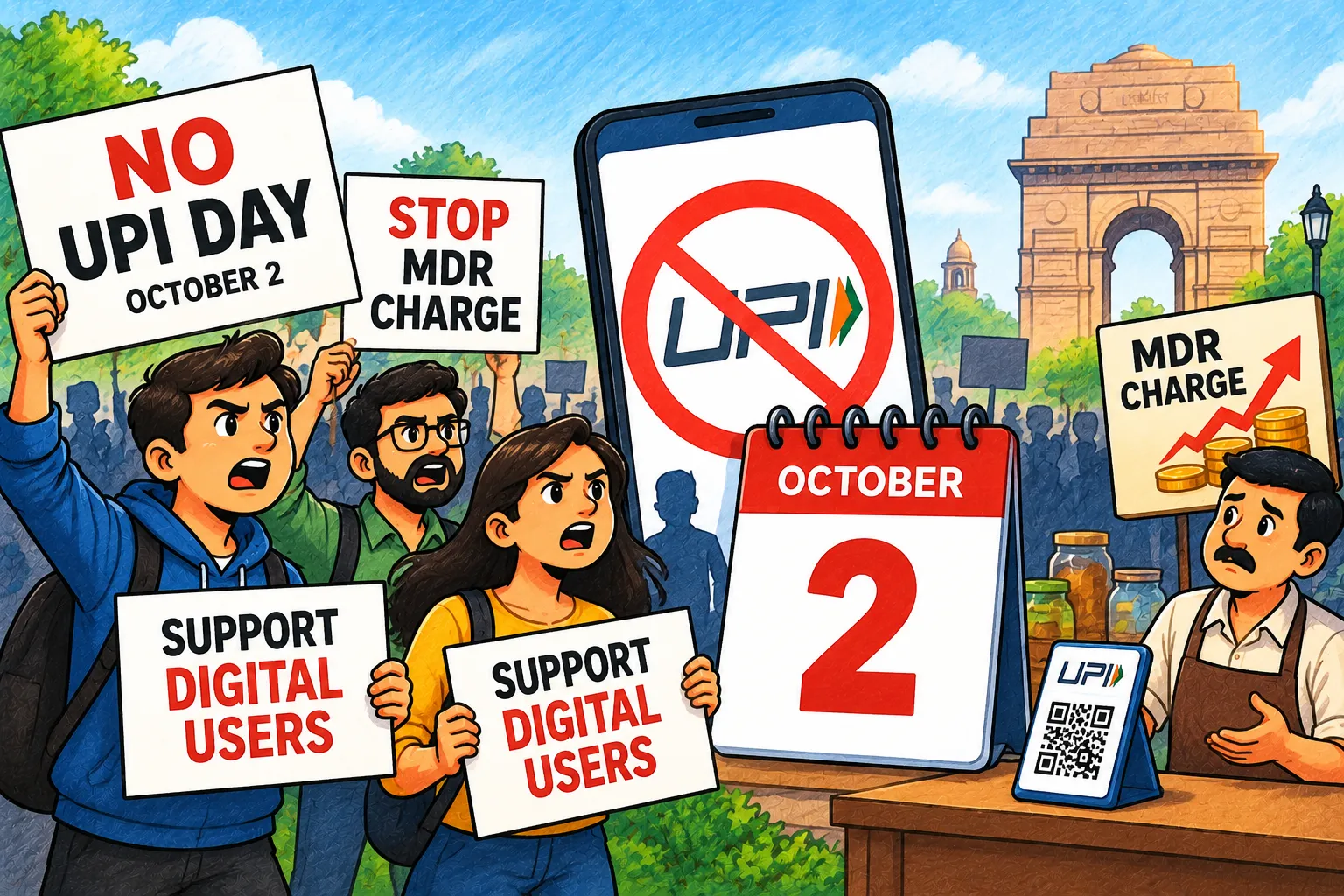
Trade associations across India, led by the Maharashtra Chamber of Commerce, will observe a "No UPI Day" on October 2, covering QR codes and payment devices in black cloth to protest a new 0.4% merchant discount rate on UPI payments above ₹2,000, effective October 15.
The Planned Protest
Traders and business associations across India have announced a "No UPI Day" on October 2, timed deliberately to coincide with Gandhi Jayanti. Participating businesses plan to cover UPI scanners, QR codes, sound boxes and related payment devices in black cloth as a mark of protest, a symbolic gesture organisers have tied to Mahatma Gandhi's own methods of demonstration.
The Maharashtra Chamber of Commerce, Industry & Agriculture (MACCIA) initiated the call. "We have spoken to all trader associations in India and have decided to follow the No UPI Day, not only in Maharashtra but in other states as well," said Ravindra Mangave, president of MACCIA, adding that the chamber and its roughly 500 affiliate associations plan to meet Maharashtra's chief minister to place their demands before him.
Other participating bodies include the Federation of Retail Traders Welfare Association, the All India Consumer Products Distributors Federation, the All India Mobile Retailers Association, the All India Jewellers and Goldsmith Federation, and the All India Edible Oil Traders Federation.
What The New MDR Rule Actually Charges
At the centre of the protest is a merchant discount rate, or MDR, a fee merchants pay for accepting digital payments, that will apply to a specific slice of UPI transactions from October 15.
- Peer-to-peer (P2P) UPI transfers between individuals: no fee, unchanged
- Peer-to-merchant (P2M) transactions of ₹2,000 or below: no fee
- P2M transactions above ₹2,000: 0.40 per cent fee, capped at ₹300
- Person-to-person-merchant (P2PM) payments, covering small vendors receiving up to ₹1 lakh a month via UPI: no fee, an exemption aimed at rural and semi-urban small businesses
The scale of what is affected is significant. In August alone, UPI processed 15.51 billion P2M transactions worth a combined ₹8.95 trillion, and payments above the ₹2,000 threshold accounted for about 67 per cent of that value, meaning the bulk of merchant transaction value by rupee terms will now attract the new fee.

Traders Push Back
Dhairyashil Patil, national president of the All India Consumer Products Distributors Federation, questioned why the cost should fall on traders alone. "Why should traders alone bear the additional cost of digital payments? Retailers and distributors operate on very thin margins and already contribute significantly to the growth of digital commerce. Imposing MDR on UPI transactions will only add another cost to their business," he said.
Shankar Thakkar, national president of the All India Edible Oil Traders Federation, argued the MDR effectively penalises businesses for using a transparent, traceable payment system, since every UPI transaction along the retail chain, from customer to retailer to wholesaler to manufacturer, is recorded. "Is the cost of making the system more transparent being imposed on small retailers?" he said, warning that the protest would intensify if the government does not reconsider.
Pressure From Other Quarters Too
The pushback against the new UPI charge extends beyond retail trade. Senior officials from the Ministry of Petroleum and Natural Gas met the All India Petroleum Dealers Association last week to discuss dealers' demand for an exemption from the MDR on their UPI transactions. Separately, Sebi Chairperson Tuhin Kanta Pandey said the regulator would examine concerns raised by stockbrokers over a related MDR of 0.02 per cent, capped at ₹300, that will apply to large UPI fund transfers to mutual funds, brokers, dealers and investment advisers.
Also Read: NSE Shares List At Under 1% Premium After India's Second-Largest-Ever IPO
Why It Matters
The October 2 protest signals that resistance to the new UPI merchant fee is not confined to one sector; retail traders, petroleum dealers and capital-market intermediaries have all raised objections through separate channels in the same week. Whether the government adjusts the rule before its October 15 start date, exempts specific categories, or lets it proceed as planned will shape UPI's merchant economics well beyond this one protest day, at a payment system that processes trillions of rupees in merchant transactions every month.