
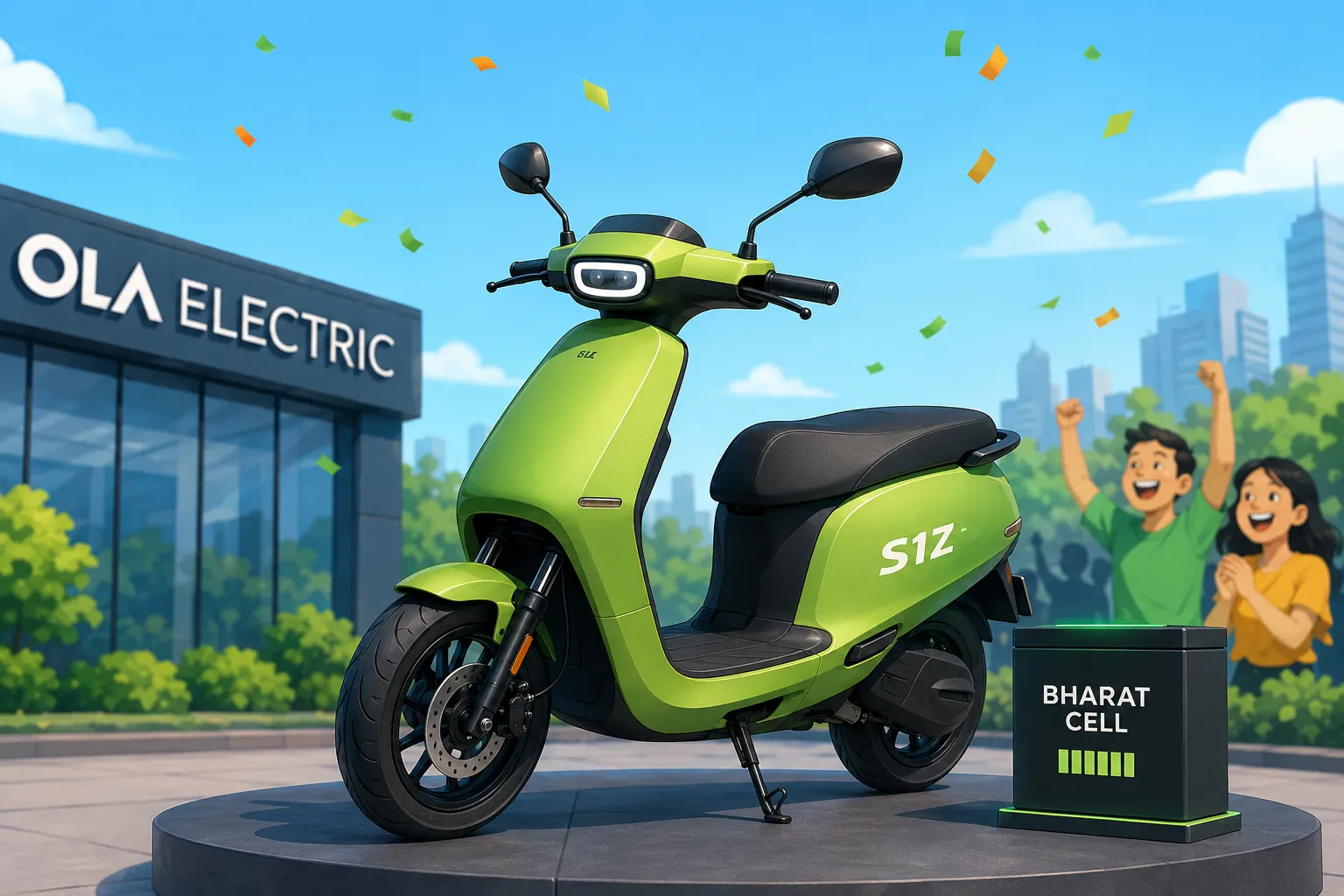
Ola Electric shares climbed 4-6% intraday on August 28, 2026, after Chairman Bhavish Aggarwal launched the S1Z scooter range powered by the company's indigenous Bharat Cell LFP battery, its first mass-market deployment.
Stock Surges After Product Launch
Ola Electric Mobility Ltd shares moved sharply higher during Friday's trading session, touching an intraday high near ₹39.77 on the NSE. At one point in early afternoon trade, the stock was quoted around ₹39.21, up roughly 4% from its previous close of ₹37.65, having opened at ₹37.78. The day's trading range spanned ₹37.45 to ₹39.77, according to data cited by Economic Times.
The company's market capitalisation stood near ₹18,106 crore at the time the rally was tracked. The move came against a broadly flat Sensex, which was trading around 77,087, up about 0.2% for the day, indicating the gain was specific to Ola Electric rather than a sector-wide rally.
What Triggered the Rally
The catalyst was the launch of the S1Z, an electric scooter range that Ola Electric says is the first in India to bring its indigenously developed Bharat Cell LFP technology to the mass market. The cell, built on a 46-series (46160) LFP platform, was developed at the company's Battery Innovation Centre and is manufactured at the Ola Gigafactory.
Bhavish Aggarwal, Chairman and Managing Director, framed the launch as a milestone for the company's in-house battery ambitions. "The true measure of innovation of our indigenous Bharat Cell LFP technology is how quickly it reaches everyday Indians... It is the first scooter range to bring our made-in-India LFP technology to the heart of the market," he said.
S1Z Variants, Pricing and Delivery Timeline
The S1Z comes in two configurations that differ meaningfully on price and range, giving buyers a tiered entry point into Ola's newest scooter lineup.
| Variant | Price (ex-showroom, introductory) | Range (IDC) | Delivery Start |
| 3.1 kWh | ₹79,999 | Up to 179 km | December 2026 |
| 5.1 kWh | ₹99,999 | Up to 301 km | March 2027 |
Both variants ride on 12-inch wheels and run MoveOS 5, Ola's onboard software that includes cruise control, regenerative braking, over-the-air updates, and geo, time and mode fencing features. The S1Z is available in four colourways: White, Anthracite, Sky Splash Blue and Matcha Green.
The launch also gives buyers a clear upgrade path from the earlier S1 Z+, which started at ₹64,999 with a shorter dual-battery range of 146 km. The new range's higher price points reflect the added range and the shift to Ola's own cell chemistry rather than third-party battery packs.

Also Read: Jefferies Sees 26% Upside in SBI Funds Management
Vertical Integration Strategy Behind the Cell
The Bharat Cell push fits into Ola Electric's broader vertical-integration strategy, under which the company has been building cells, motors and vehicle software in-house at its Ola Futurefactory and the upcoming Gigafactory in Tamil Nadu. Bringing cell manufacturing in-house is central to the company's cost and margin narrative, since battery packs typically account for a large share of an electric two-wheeler's total cost. Whether the S1Z's pricing proves competitive against rivals using imported or third-party cells will be a key data point for investors tracking Ola's margin trajectory in coming quarters.
Competitive Pressure From TVS Motor
The stock rally comes even as Ola Electric faces intensifying competition in the electric two-wheeler segment. According to Vahan registration data cited alongside the launch news, TVS Motor has overtaken Ola Electric in cumulative domestic e-two-wheeler registrations, with TVS at 11,27,873 units against Ola's 11,17,031 units a lead of 10,842 units.
TVS registered 3,42,958 electric two-wheelers in calendar year 2026 through the reporting period, up 75% year-on-year, while Ola registered 88,910 units between January 1 and August 24, 2026. This registration gap underscores why a differentiated product like the S1Z, built around proprietary cell technology, matters strategically for Ola as it looks to defend and rebuild market share.
Stock's Broader Recovery Context
Friday's move adds to a longer rebound for Ola Electric shares. The stock has climbed roughly 79% from its 52-week low, recorded in mid-March 2026, though estimates of the exact low level vary slightly across data providers. On a year-to-date basis, the shares are up about 4.5% in 2026, even as they remain down close to 28% over the trailing one-year period.
That combination a strong recovery from the March low alongside a still-negative one-year return suggests the S1Z launch is being read by the market as a positive product catalyst within an ongoing, gradual recovery rather than a standalone event reversing the stock's longer-term trend.
What Investors Should Track Next
For those following Ola Electric, the coming months carry several checkpoints. Delivery execution on the 3.1 kWh variant from December 2026, and the 5.1 kWh version from March 2027, will test whether the company can scale Bharat Cell production without the delays that have affected past launches. Registration data in the following months will also show whether the S1Z helps Ola narrow the gap with TVS Motor or whether the competitive slide continues. Finally, any commentary from management on Bharat Cell production costs and margins in upcoming quarterly updates will help clarify whether in-house cell manufacturing is translating into the pricing and profitability advantage the company has long pointed to.