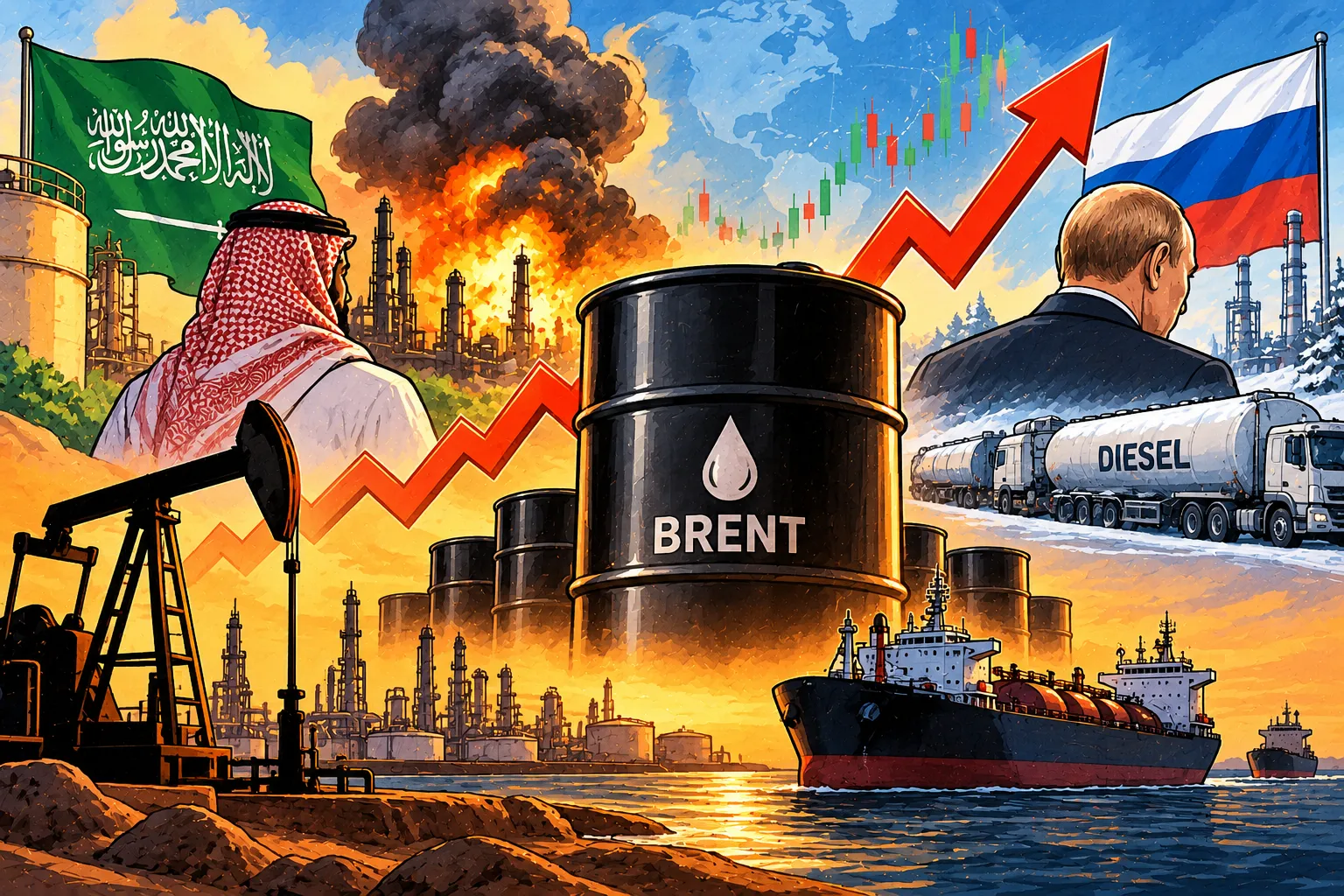

Brent crude fell about 1 per cent to $103.77 a barrel on Friday morning, a third straight session of losses, as traders judged that damage to Saudi Arabia's East-West pipeline may not cut supply for long.
Where Crude Prices Stand on Friday Morning
Oil extended its decline in early Asian trade on Friday, September 18, 2026, while staying in triple digits.
- Brent crude futures fell $1.01, or 1 per cent, to $103.77 a barrel by 0020 GMT
- US West Texas Intermediate futures fell $1.03, or 1 per cent, to $100.88 a barrel
- Both benchmarks had closed about 1 per cent lower on Thursday
- This is the third consecutive session of losses for both contracts
The fall came despite an escalation on the ground. Saudi Arabia and Yemen's Iran-backed Houthis exchanged fresh strikes across their border on Thursday, widening the West Asia war front, and markets largely looked past it.
The Pipeline Attack That Pushed Oil to Four-Month Highs
Prices had climbed to around four-month highs earlier this week for a specific physical reason rather than a sentiment shift. Crude loadings at Yanbu, Saudi Arabia's Red Sea export hub, were suspended, and Riyadh cancelled some deliveries to Europe after its East-West pipeline was damaged in an attack last week.
The scale of the damage was worse than first assessed. Three of the pipeline's pumping stations were damaged, one more than previously estimated, according to satellite imagery and three industry sources. Traders have said a prolonged closure of the pipeline to Yanbu could cut off as much as 4 per cent of global oil supply.
That is the number that explains the move above $100. The East-West pipeline is how Saudi crude reaches the Red Sea without passing through the Strait of Hormuz, so a long outage would leave more of the kingdom's exports dependent on a chokepoint that is itself under threat.
The Signs That Eased the Panic
Three developments this week pointed towards a shorter disruption than the market had priced.
Saudi Arabia is seeking to restore about half the capacity of the East-West pipeline within days, Bloomberg reported. US Energy Secretary Chris Wright has said crude should be flowing through the pipeline within days. And Saudi Arabia has been offering additional crude cargoes to Asian refiners through ship-to-ship transfers off Oman's Sohar port, a workaround that offsets part of the pipeline disruption.
Estimates still vary widely. Sources who spoke to Reuters gave differing assessments of how long it will take to reopen the pipeline and return crude flows to normal, which is why the market has given back only part of this week's gain rather than all of it.
What Triple-Digit Crude Is Doing to the Rupee
For India, which imports the bulk of its crude requirement, the currency is where oil at these levels shows up first.
The rupee breached the 96 level against the dollar on Thursday, hitting an intraday low of 96.10, its weakest since July 24. It recovered through the session to a high of 95.78 and settled 2 paise higher at 95.89, snapping a seven-session losing streak. Forex traders attributed the recovery to dollar selling by banks on behalf of the Reserve Bank of India.

Three pressures were working on the currency at once: high crude prices, sustained foreign fund outflows from Indian equities, and the US Federal Reserve rate decision. A slight correction in the dollar index and in crude prices supported sentiment later in the day.
The effect is not uniformly negative for Indian markets. India's petroleum exports rose 46 per cent year-on-year, helped by better terms of trade, recovering volumes and shipments to newer markets, according to Crisil, which means refiners capture some of what higher crude costs the wider economy.
The Fed Hike That Added to the Pressure
The Federal Open Market Committee raised the federal funds target range by 25 basis points to 3.75 to 4.00 per cent at its September 15 to 16 meeting. The vote was unanimous at 12-0, and it was the Fed's first rate increase since July 2023.
The Fed said inflation remains elevated while economic activity was expanding at a solid pace. Its projections were the more consequential part: 16 of 18 policymakers expect at least one further increase before the end of 2026. The hike pushed the dollar index above 100, its highest level in more than a month.
Gold moved the other way on Thursday, rebounding after three sessions of losses as the slide in oil eased inflation concerns and US Treasury yields retreated.
Also Read: India Secures 1.9 Million Tonne Duty-Free EU Steel Quota
The Risks That Have Not Gone Away
Two events on Thursday show why the market has not priced out the supply risk entirely.
Iran's Revolutionary Guards Navy said a Togo-flagged oil tanker was struck while attempting what it called an illegal passage through the Strait of Hormuz, according to Iranian state media early on Friday. And JPMorgan said on Thursday that it does not have a clear baseline view for oil markets for the first time since the start of the US-Israeli war on Iran.
The diplomatic track offers little near-term comfort. The United States and Iran have held no peace talks since an interim agreement reached in June collapsed within weeks. The war is due to come up at the United Nations General Assembly next week, and an Iranian delegation will be able to attend, according to the US State Department.