
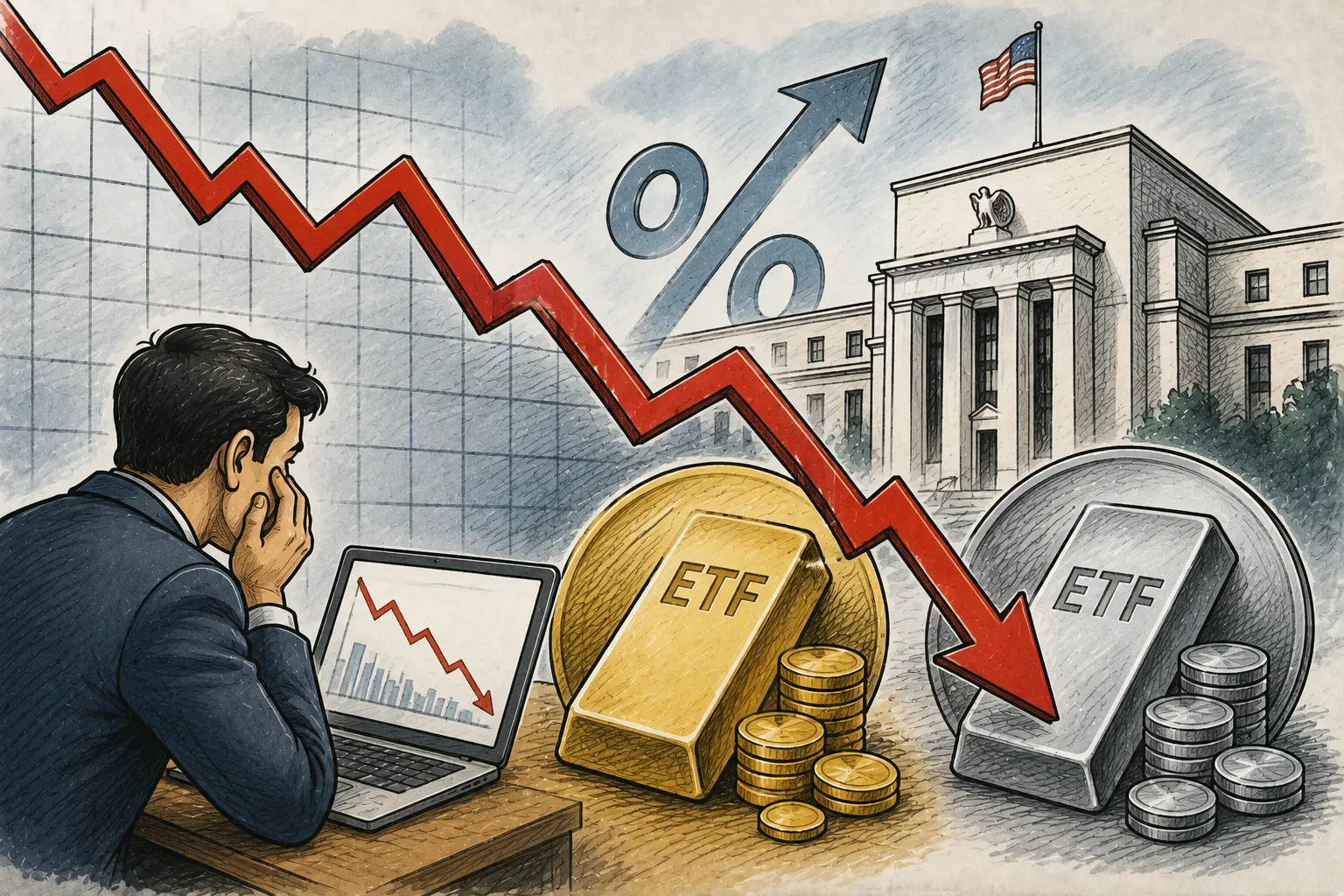
Gold and silver ETFs declined sharply in intraday trade on 31 August as lower bullion prices and higher expectations of tighter US monetary policy weighed on domestic precious-metals products. Silver ETFs recorded the steepest cited declines, falling by about 4%.
Indian gold and silver exchange-traded funds came under broad selling pressure during Monday’s session, reflecting weakness in domestic bullion futures and a shift in global interest-rate expectations.
The market reaction followed Federal Reserve Chair Kevin Warsh’s 28 August remarks at the Jackson Hole symposium, where he said policymakers would have work to do if they were not confident inflation was returning to the Fed’s 2% objective. Markets took the comments as a signal that further monetary tightening could remain possible.
The figures cited below are intraday observations from the NSE’s 31 August ETF market-data snapshot, rather than official end-of-day closing prices. They show a broad category-level move across several gold and silver ETF products.
Silver ETFs lead the decline on NSE
Silver ETFs were among the sharpest decliners in the available NSE snapshot. UTI Silver ETF fell 4.09% to ₹223.20, while HDFC Silver ETF declined 4.08% to ₹220.94.
SBI Silver ETF was down 4.04% at ₹226.59, and Nippon India ETF Silver BeES slipped 3.98% to ₹221.24. The similar movement across multiple products suggests that the decline reflected the underlying silver market rather than a fund-specific development.
| ETF | Intraday price on 31 August | Intraday change |
| UTI Silver ETF | ₹223.20 | -4.09% |
| HDFC Silver ETF | ₹220.94 | -4.08% |
| SBI Silver ETF | ₹226.59 | -4.04% |
| Nippon India ETF Silver BeES | ₹221.24 | -3.98% |
| ICICI Prudential Gold ETF | ₹130.74 | -3.60% |
| Tata Gold ETF | ₹14.87 | -3.19% |
| Mirae Asset Gold ETF | ₹148.97 | -3.12% |
Gold ETFs also weakened in the same market-data snapshot. ICICI Prudential Gold ETF declined 3.60% to ₹130.74, while Tata Gold ETF fell 3.19% to ₹14.87 and Mirae Asset Gold ETF was down 3.12% to ₹148.97.
Axis Gold ETF was quoted at ₹130.72 in the NSE data. Since ETF prices can change throughout the session, the price and percentage figures should be read as time-specific market observations, not final daily returns.
MCX futures mirrored the pressure on metals
The ETF sell-off coincided with lower domestic bullion futures. During 31 August trade, a market report showed MCX gold futures for October delivery down ₹2,045, or 1.31%, at around ₹1.54 lakh per 10 grams.
MCX silver futures for December delivery were reported lower by ₹1,955, or 0.81%, at roughly ₹2.40 lakh per kg. These are reported intraday levels and should not be treated as official settlement prices.
Gold and silver ETFs are designed to provide market-linked exposure to their underlying metals. A decline in domestic and international bullion prices can therefore influence both an ETF’s underlying value and its exchange-traded price.

The market price of an ETF, however, is not the same as its net asset value, or NAV. NAV represents the per-unit value of the underlying assets held by the fund, whereas the market price reflects live buying and selling activity on the exchange. In a volatile session, the two can move differently.
Jackson Hole remarks changed the macro backdrop
Warsh’s comments on 28 August did not announce an interest-rate increase. They nevertheless prompted markets to reassess the prospect of further US monetary tightening if inflation remains above the Federal Reserve’s target.
Reuters reported that market-implied odds of a September US rate increase rose to about 60% after the speech, from around 35% before it. The report also said Treasury yields rose in the post-speech market reaction.
This matters for bullion because gold and silver do not provide interest income. If investors expect higher returns from yield-bearing assets such as US government bonds, holding precious metals can become relatively less attractive. A stronger US dollar can also add pressure to dollar-priced bullion by making it more expensive for buyers using other currencies.
For Indian markets, the chain of influence can be direct: changing US rate expectations affect global bullion prices, domestic futures on MCX respond to those shifts, and gold and silver ETFs traded on NSE can then reflect the movement.
Also Read: Bernstein Rebalances India Model Portfolio, Drops DMart for Adani Ports, Eternal, Paytm
What the fall means for ETF investors
The broad decline in gold and silver ETFs was a market reaction to bullion prices and macroeconomic expectations, not a verified India-specific regulatory development, change in ETF structure or event at an individual asset management company.
Silver-linked funds posted larger declines than the cited gold ETFs in the NSE snapshot. This underscores that silver ETFs can experience sharper short-term movements when the price of the underlying metal changes.
Investors tracking the category through an online trading platform can consider the traded price, volume and fund NAV information together rather than relying only on the day’s percentage change. A market participant who wants to transact in listed ETFs must open demat account online or have an existing demat and trading arrangement with a registered intermediary.
The next relevant signals for gold and silver ETFs include developments in US inflation, changes in Federal Reserve policy expectations, US Treasury-yield movements, the dollar and domestic MCX price action. The 31 August moves show that these globally driven factors can quickly influence the price of precious-metals ETFs available to Indian investors.