
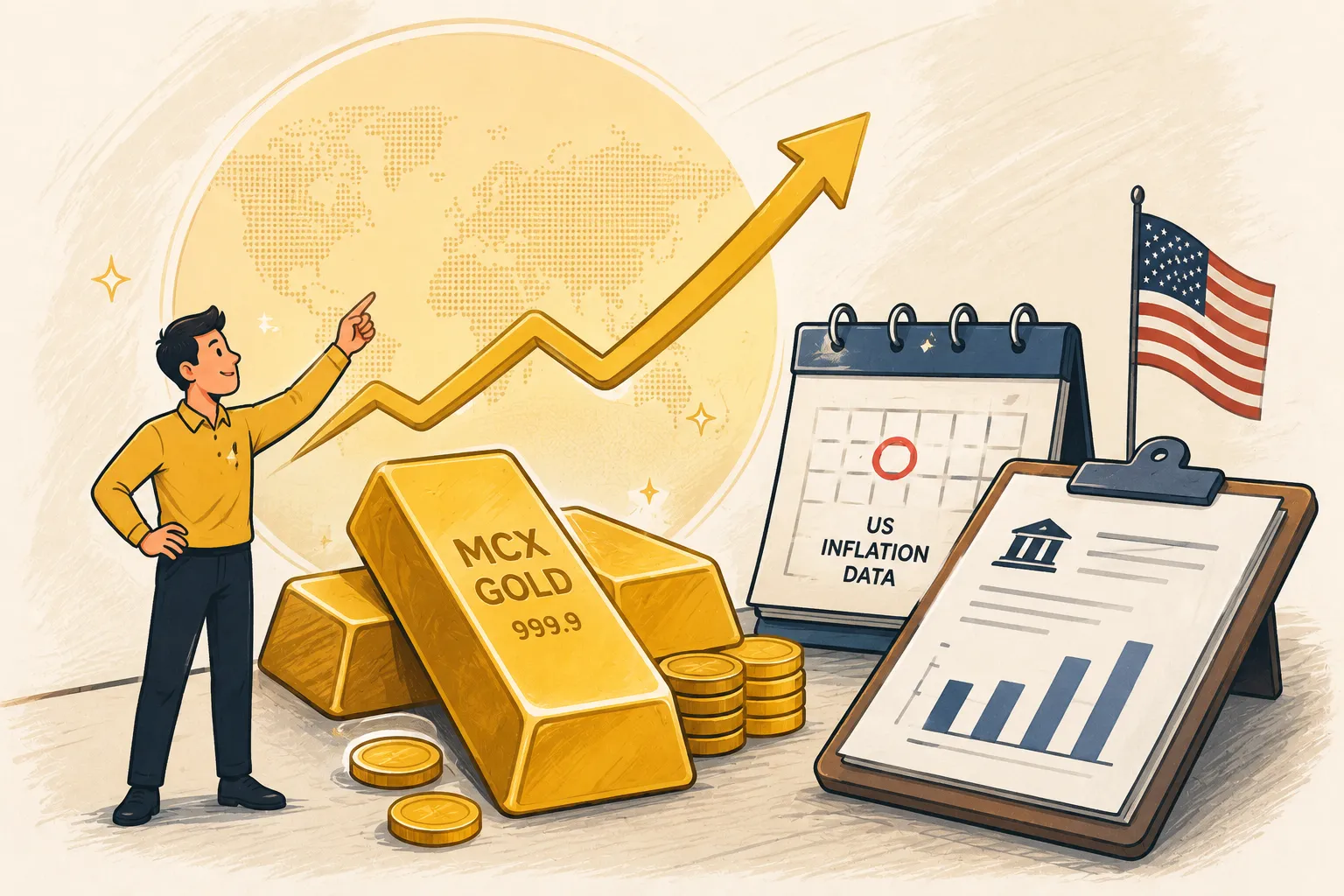
MCX gold futures rose in early trade on 24 August, following gains in global bullion. The move matters to Indian commodity-market participants as they await US PCE inflation data and Federal Reserve signals that could affect gold, the dollar and volatility.
MCX gold trades above ₹1.63 lakh per 10 grams
Gold futures on the Multi Commodity Exchange of India, or MCX, moved higher in early trade on Monday, 24 August. The domestic rise followed gains in international bullion prices as markets assessed a weaker US dollar and upcoming US economic data.
MCX gold futures for October delivery traded at ₹1,63,500 per 10 grams at around 9:10 am, up 0.65% for the session. This was an intraday quote, not the day’s official settlement price.
Global spot gold rose 0.8% to $4,641.27 per ounce at 04:27 GMT after reaching its highest level since 15 May. US gold futures were up 0.4% at $4,697.70 per ounce.
Global gold prices had gained more than 5% over the preceding week. The domestic MCX move therefore came after a strong run in overseas bullion rather than from an India-specific corporate or regulatory development.
Global drivers behind the MCX gold move
MCX gold prices are influenced by international bullion prices and the rupee-dollar exchange rate. A change in global spot prices may be reflected in domestic futures, although currency movement can affect the extent of that transmission.
The US dollar was hovering near multimonth lows, supporting gold’s global price movement. Since gold is generally denominated in dollars, a weaker dollar can make the metal relatively less expensive for buyers holding other currencies.
Falling crude oil prices also formed part of the broader commodity-market backdrop. Brent crude was reported below $93 per barrel after declining about 2%.
Gold does not offer interest income. Its relative appeal can shift when investors adjust expectations for interest rates, real yields and the US dollar. That relationship is one reason US inflation data and Federal Reserve communication can influence gold-market sentiment.
A higher MCX gold price in early trade, however, does not establish a direction for later sessions. Commodity futures can react quickly to data releases, policy commentary and moves in global currencies.
US PCE data is the next scheduled trigger
The US Bureau of Economic Analysis is scheduled to release the July 2026 Personal Income and Outlays report on 26 August at 8:30 am Eastern Time. The report includes the Personal Consumption Expenditures, or PCE, price indices.
PCE is closely watched by global markets because it is a key measure of US inflation and can shape expectations around Federal Reserve monetary policy. Any shift in those expectations can influence the dollar and international bullion prices.

Investors are also awaiting Federal Reserve Chair Kevin Warsh’s scheduled address at the Jackson Hole gathering. As the speech has not yet occurred, its policy implications cannot be known in advance.
For Indian market participants, the relevant point is potential volatility in MCX gold and silver contracts around these global events, rather than a confirmed future price direction.
Also Read: Indian IT Stocks Gain as Nvidia Server-Cost Report Emerges
Events on the calendar
- US July PCE inflation data: 26 August 2026, 8:30 am ET
- Federal Reserve Chair Kevin Warsh’s scheduled Jackson Hole address
- US dollar movement and its effect on international gold pricing
- Rupee-dollar movement and its potential effect on domestic gold futures
Gold and silver move in different directions
Gold and silver showed divergent early-session movement on MCX. MCX silver September futures traded at ₹2,46,269 per kg at around 9:10 am, down 0.13%.
International spot silver was broadly steady at $68.98 per ounce. The contrasting moves in gold and silver showed that the session was not a broad-based rally across precious metals.
| Indicator | Verified early-session data |
| MCX Gold October futures | ₹1,63,500 per 10 grams, up 0.65% at about 9:10 am |
| Spot gold | $4,641.27 per ounce, up 0.8% at 04:27 GMT |
| US gold futures | $4,697.70 per ounce, up 0.4% |
| MCX Silver September futures | ₹2,46,269 per kg, down 0.13% at about 9:10 am |
| Spot silver | $68.98 per ounce, broadly steady |
| US July PCE release | Scheduled for 26 August 2026 at 8:30 am ET |
What this means for Indian investors
This is primarily a precious-metals and MCX commodity-market development, not a direct Nifty or Sensex trigger. No listed-company announcement, SEBI action, RBI decision, IPO update or issuer-specific event was associated with the gold-price movement.
Indian investors following MCX contracts, gold ETFs and gold-focused mutual funds may track US inflation data, Federal Reserve communication, global bullion prices and currency moves. These factors can affect near-term market sentiment, but they do not provide a certain direction for future prices.
It is also important to distinguish MCX futures from retail jewellery rates. Retail quotations can differ because of purity, local premiums, taxes and dealer margins, whereas MCX contracts reflect exchange-traded futures pricing.
The World Gold Council reported global central-bank gold purchases of 288.9 tonnes in the second quarter of 2026. Total gold demand, including over-the-counter transactions, was 1,268.9 tonnes in the same period. These figures offer broader demand context but were not the immediate cause of the 24 August price move.
For readers considering online investing, the distinction between gold ETFs, other market-linked products and leveraged commodity futures is material. Investors who open a demat account online can access eligible market-linked products, but the structure, costs and risks vary across them.
The next confirmed macro event for bullion markets is the US PCE inflation release on 26 August. Its outcome, together with subsequent Federal Reserve communication, may influence the dollar and global gold pricing.