
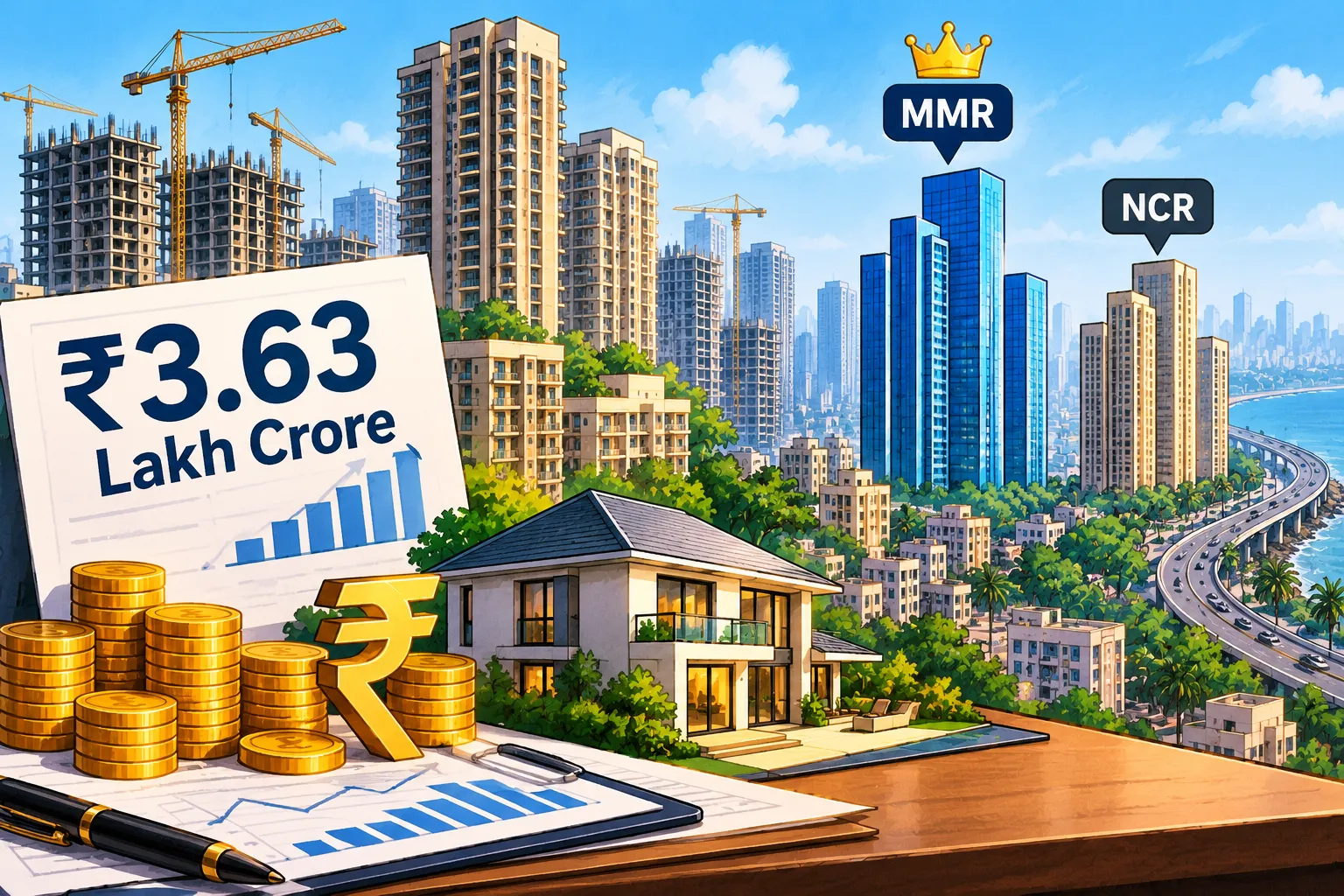
India's Tier-1 housing sales held at a record ₹3.63 lakh crore in H1 2026, but the number of homes sold actually fell 2%, as Mumbai Metropolitan Region overtook NCR as the country's largest housing market and Bengaluru posted 25% sales growth.
Steady Values, Falling Volumes
Primary housing sales across India's Tier-1 cities stood at approximately ₹3.63 lakh crore in the first half of 2026, virtually unchanged from the record level set in H1 2025, according to the September 2026 India Housing Report by CRE Matrix and the National Association of Realtors-India. But the headline sales-value number masks a more complicated underlying picture: the number of homes sold actually fell about 2 per cent to 2.58 lakh units, even as developers launched nearly 2.98 lakh new units, up 7 per cent year-on-year, meaning fresh supply is now running ahead of absorption.
The average ticket size across markets rose just 2 per cent year-on-year, the slowest increase in three years, according to CRE Matrix, which described the pattern as a consolidation of the premiumisation trend rather than a fresh acceleration.
MMR Overtakes NCR
The most significant structural shift in H1 2026 was in geographic leadership. Mumbai Metropolitan Region (MMR) accounted for 26 per cent of national housing sales value, overtaking NCR's 19 per cent share. MMR recorded approximately ₹93,800 crore in primary housing sales, up 8 per cent year-on-year, with sales volumes also rising about 9 per cent, meaning MMR's growth was genuinely volume-led rather than driven purely by rising prices. Roughly 83,600 homes were sold in MMR, with the average ticket size holding broadly stable at ₹1.12 crore.
Bengaluru's Standout Growth
Bengaluru was the strongest-performing large market tracked, with housing sales value rising 25 per cent year-on-year to ₹60,875 crore. Volumes rose 7 per cent to about 34,600 units, while the average ticket size climbed 17 per cent to ₹1.76 crore. The ₹2-5 crore price segment now accounts for 41 per cent of Bengaluru's sales value, up from 32 per cent a year earlier, while homes priced below ₹1 crore have fallen to a single-digit share, underscoring how far the city's housing mix has shifted upmarket. Developers responded with nearly 47,700 new launches, up around 22 per cent.

NCR's Sharp Correction
NCR, the strongest growth engine in the previous year, saw a significant reversal: sales value fell approximately 24 per cent to ₹68,217 crore, homes sold declined 9 per cent to around 24,600 units, and the average ticket size fell 16 per cent to ₹2.77 crore from ₹3.31 crore in H1 2025. The correction was concentrated at the luxury end, with homes priced above ₹5 crore falling to 45 per cent of sales value from 51 per cent. Gurugram specifically saw an even sharper reset: sales value fell 33 per cent to ₹37,726 crore even as unit volumes held broadly stable around 12,000, with the average ticket size dropping 32 per cent to ₹3.15 crore from a peak of ₹4.65 crore in H1 2025.
Other City Trends Worth Watching
Mumbai city itself grew 4 per cent to ₹58,362 crore, with growth primarily price-led rather than volume-led: sales volumes stayed broadly flat around 24,500 units while the average ticket size hit a record ₹2.38 crore. Hyderabad's sales value held flat at ₹56,966 crore even as volumes fell 11 per cent, with the average ticket size rising 13 per cent to a record ₹2.02 crore. Chennai showed a similar pattern: sales value rose 16 per cent to ₹13,722 crore despite a 12 per cent fall in units sold, as the average ticket size jumped 32 per cent to ₹1.31 crore. The Navi Mumbai-Raigad corridor bucked the broader premiumisation trend with the fastest genuine growth in the MMR cluster: sales value up 29 per cent to ₹12,292 crore, volumes up 20 per cent, and an average ticket size of just ₹71 lakh.
Also Read: At 43 Times Earnings, NSE Trades Well Above Its Global Exchange Peers
Why It Matters
The core signal in this data is that India's housing market is no longer simply expanding; it is increasingly being propped up by rising prices in fewer transactions rather than genuine volume growth, with launches now outpacing sales nationally. For homebuyers, this means the specific city and price segment matters far more than a national headline number: a Bengaluru buyer is entering a market genuinely shifting upmarket, while an NCR buyer, particularly in Gurugram's luxury segment, is entering a market undergoing an active price correction with rising supply. For developers, the launch-ahead-of-absorption gap, most visible in NCR and Hyderabad, is a signal worth watching for potential unsold inventory buildup in the coming quarters if the plateau in demand persists.