RBI Deputy Governor Shirish Chandra Murmu told non-bank lenders in Mumbai on 3 September 2026 that fast loan growth must not weaken credit standards, and asked them to use AI to spot borrower stress before it turns into defaults.
Murmu was speaking at the 7th CII NBFC and HFC Summit. NBFCs are non-banking financial companies lenders that give loans but cannot accept regular savings deposits like banks. HFCs are housing finance companies.
The sector is now too big to treat as a side player
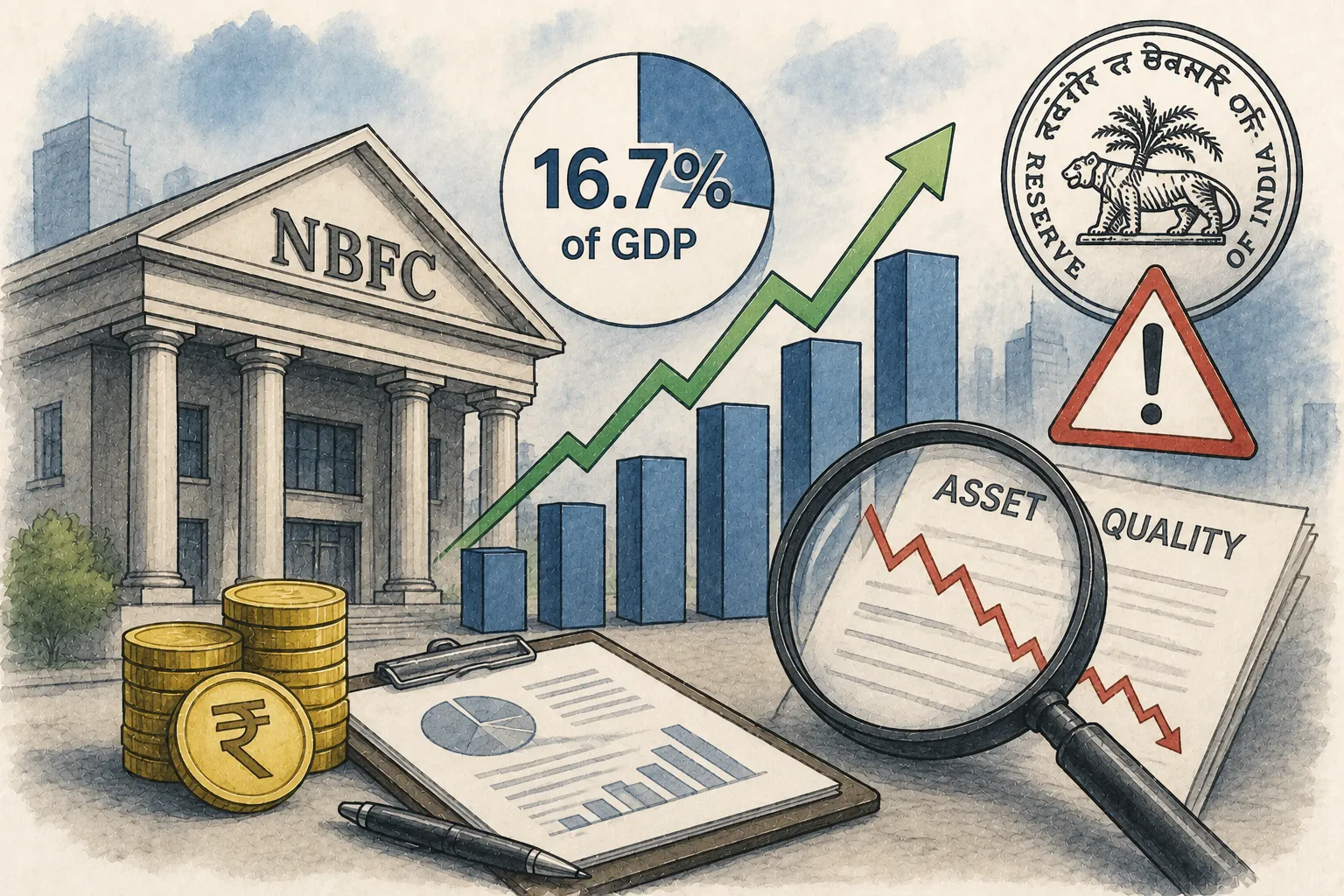
Murmu said NBFC credit is now equal to about 16.7% of India's nominal GDP, up from 15.9% a year earlier. Nominal GDP is the size of the economy at current prices, before adjusting for inflation.
Their lending is also worth about 27% of what scheduled commercial banks lend, compared with 26% a year ago.
| Measure | A year earlier | Now |
| NBFC credit as % of nominal GDP | 15.9% | 16.7% |
| NBFC credit as % of bank credit | 26% | 27% |
Source: RBI Deputy Governor S C Murmu, 7th CII NBFC and HFC Summit, 3 September 2026.
He said these lenders have shifted from being a fallback option to specialised institutions that work alongside banks, reaching remote areas, underserved borrowers and niche segments.
The warning attached to that growth
Faster lending also raises the risk that some of those loans go bad. Murmu was direct about the trade-off: "Growth must never come at the cost of underwriting standards," he said. Underwriting is the checking a lender does before approving a loan.
He asked lenders to run rigorous stress tests modelling how the loan book would hold up if the economy turned along with early-warning systems and dynamic provisioning, which means setting money aside for bad loans during good years instead of waiting for defaults.
Why the RBI wants AI on the risk desk
Murmu said AI and machine learning should be used more widely to pick up early signs of borrower stress. The idea is to catch a borrower slipping months before an EMI is actually missed.
He noted that technology has already changed how these lenders operate, through paperless onboarding, algorithmic credit scoring and cash-flow-based lending, where repayment capacity is judged from money moving through a borrower's account rather than from collateral.
But he added that innovation must not run ahead of customer protection. Conduct regulation, grievance redressal and responsible lending will stay priorities, and cyber resilience remains a key focus as technology use deepens.
Less dependence on bank borrowing
This is the part with the longest history behind it. Murmu said earlier liquidity shocks had exposed weak asset management and heavy reliance on short-term wholesale funding large sums borrowed for short periods from banks and money markets, which dries up fastest in a crisis.

"Strong liquidity risk management is not optional," he said, while calling for more diversified funding and a deeper corporate bond market.
He also wants securitisation used differently. It should move beyond being a liquidity tool and become a way to genuinely transfer risk and free up capital. Securitisation is when a lender bundles loans it has already given out and sells them to investors the RBI's point is that the risk should actually move off the books, not just the cash come in.
Where he sees the next leg of growth
Murmu named financial inclusion and last-mile credit as the first area where NBFCs can lead, supported by digital public infrastructure UPI, Aadhaar, the Account Aggregator framework and the Unified Lending Interface (ULI). Account Aggregator lets you share your financial data with a lender with your consent; ULI is a common digital pipe that lets lenders pull verified borrower data quickly.
He said these platforms can lower the cost of credit and speed up disbursals, and reduce the need for physical collateral when lending to MSMEs and microfinance borrowers. A large part of MSME credit demand still sits outside the formal system, which is the opportunity he was pointing at.
The second area was specialised expertise supply chain finance, infrastructure debt, affordable housing and vehicle financing with loans structured around a borrower's cash flows. He said co-lending arrangements with banks can widen the reach further.
Also Read: KFintech's ARYA Adds Mutual Fund Transactions to AI Chat
What this means if you track NBFC and HFC stocks
Several large NBFCs and housing finance companies are listed on the NSE and BSE, so the regulator's tone on the sector matters to how the market reads their growth and asset-quality outlook. To hold any of these shares you need a demat account, which stores them in electronic form with NSDL or CDSL.
Nothing changed in the rulebook today. This was a speech setting out supervisory expectations — any actual change in norms would come separately through an RBI circular, so it is worth following announcements on the RBI website rather than reacting to headlines. If you track the sector, a trading platform with live NSE and BSE quotes will show how these counters move during market hours, 9:15 AM to 3:30 PM IST.
What to watch next
Three things: whether the RBI's Department of Regulation, which Murmu heads, follows this up with anything formal on liquidity or securitisation norms; whether NBFC funding actually shifts towards bonds and securitisation over the rest of FY 2026-27; and what the coming quarters' asset-quality numbers show as credit growth continues.
Investments in securities are subject to market risks. This article is for information only and is not investment advice.