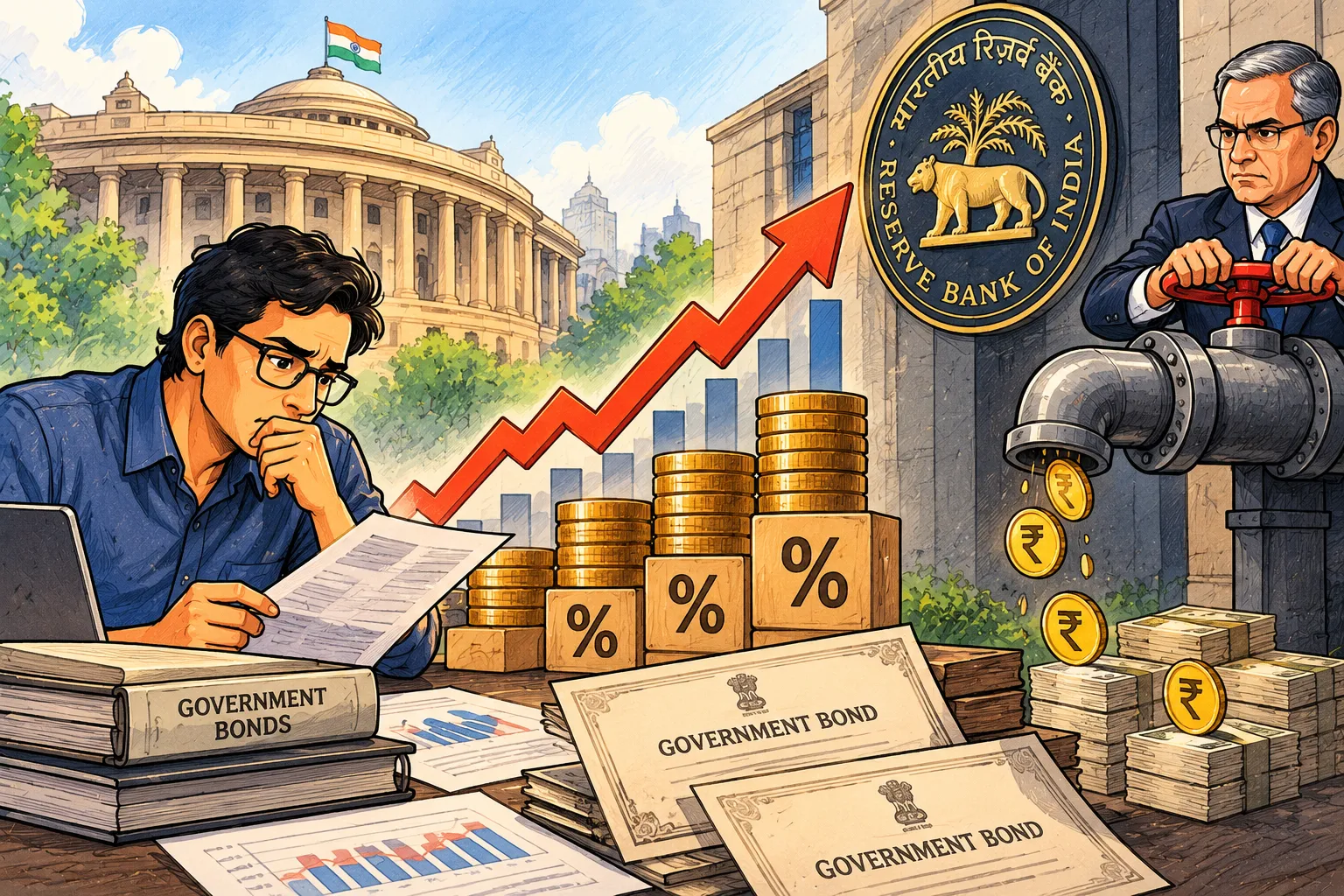
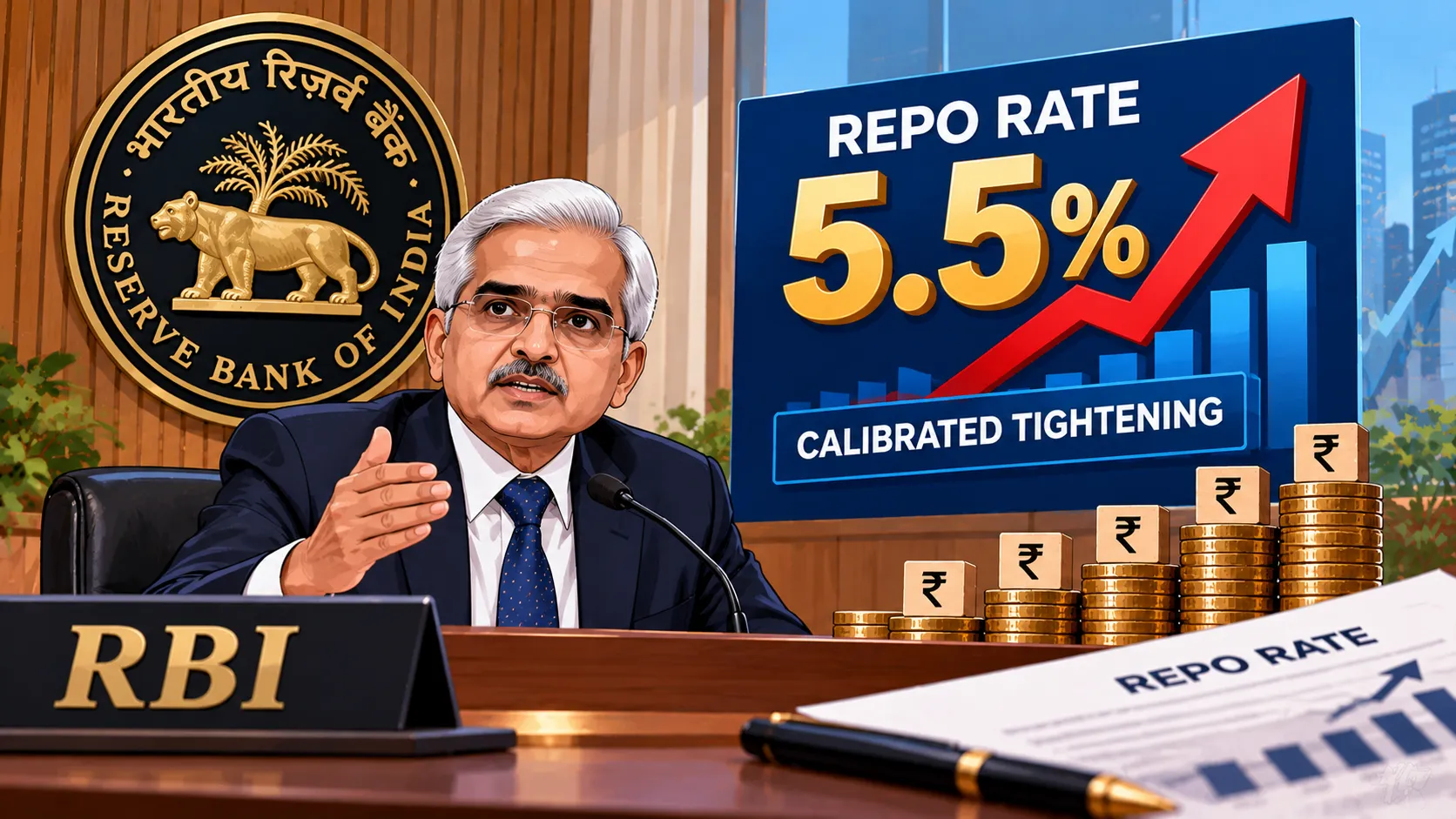
The Reserve Bank of India raised its repo rate by 25 basis points to 5.5% on Wednesday, October 7, 2026, and adopted a calibrated tightening stance, its first hike since February 2023, citing oil and inflation risks.
The Rate Decision in Numbers
The Reserve Bank of India's Monetary Policy Committee voted unanimously to lift the repo rate from 5.25% to 5.5%. The repo rate is the rate at which the RBI lends short-term funds to banks against government securities, so it sets the tone for borrowing costs across the economy. Before this meeting, the rate had stayed at 5.25% for four consecutive policy reviews, following 125 basis points of cuts through 2025.
The committee also moved its policy stance from neutral to calibrated tightening. Market reports say the stance change was decided by a 4-2 majority, which means the committee was split on language even though it agreed on the rate itself.
| Policy Rate | Before | After |
| Repo rate | 5.25% | 5.50% |
| Standing deposit facility (SDF) rate | 5.00% | 5.25% |
| Marginal standing facility (MSF) rate | 5.50% | 5.75% |
| Bank Rate | 5.50% | 5.75% |
| Policy stance | Neutral | Calibrated tightening |
Because the last increase came in February 2023, the October 2026 move ends a stretch of more than three and a half years without a hike.
Why the Committee Moved Now
RBI Governor Sanjay Malhotra said inflation and its outlook are "not benign as they were last year." Consumer price inflation rose to 4.8% in August 2026 from 4.5% in July, and the RBI raised its FY27 inflation forecast to 5.2% from 5.0%. The central bank pointed to elevated oil prices, tighter global financial conditions and food price risks from unfavourable weather.
The RBI's quarterly inflation projections show where the pressure is expected to build:
- Q2 FY27: 4.9%
- Q3 FY27: 6.0%
- Q4 FY27: 5.7%
- Q1 FY28: 5.6%
Growth gave the committee room to act. India's real GDP grew 7.8% in the April-June quarter, and the RBI raised its FY27 growth forecast to 7.1% from 6.7%. Its quarterly projections are 7.2% for Q2, 6.9% for Q3 and 6.8% for Q4. In other words, the RBI is tightening while it still sees the economy growing at a pace above 7% for the year.
Bonds, the Rupee and Stocks on Policy Day
The yield on India's 10-year government bond rose 5 basis points to 7.27% after the announcement, according to Bloomberg data cited by Business Standard. That was 8 basis points above Tuesday's close of 7.19%. The rupee also weakened after the decision.

Equity benchmarks ended lower on Wednesday. The BSE Sensex fell 429.11 points, or 0.59%, to 72,638.70, and the NSE Nifty 50 lost 173.05 points, or 0.76%, to 22,603.05. Both indices snapped a two-session winning run.
The weakness carried into Thursday. In early trade on October 8, the Sensex was down 264.97 points at 72,408.15 and the Nifty was down 87.50 points at 22,507.65, as expectations of tighter monetary conditions, higher crude oil prices and foreign fund outflows weighed on sentiment, according to ETV Bharat. By around 11 AM, the Nifty was at 22,452.25, down 0.75%, Business Standard reported.
What the Governor Signalled About the Road Ahead
Malhotra said rate cuts are off the table in the near term, and that the next action can only be a hike or a pause depending on how conditions evolve. That language is the main reason analysts are debating how many more increases could follow.
Forecasts differ. Dnyanada Vaidya, research analyst at Axis Direct, said she expects another 25 basis point hike at the next policy meeting. Garima Kapoor of Elara Capital said another 50 basis points of hikes is likely in this cycle. Goldman Sachs had earlier forecast increases in both October and December 2026. These are analyst projections, not RBI guidance, and the central bank has said its decisions will depend on incoming data.
For banks, Axis Direct's Vaidya noted that rate hikes will start reflecting in loans linked to external benchmarks, which could help margins in the second half of the year, while near-term margins remain under pressure from excess liquidity. For borrowers, a higher repo rate generally pushes up the cost of floating-rate loans linked to it, though the exact pace of repricing depends on each lender.
Going forward, Ajit Mishra of Religare Broking named crude oil prices, food inflation, the rupee and global monetary conditions as the key variables to watch.