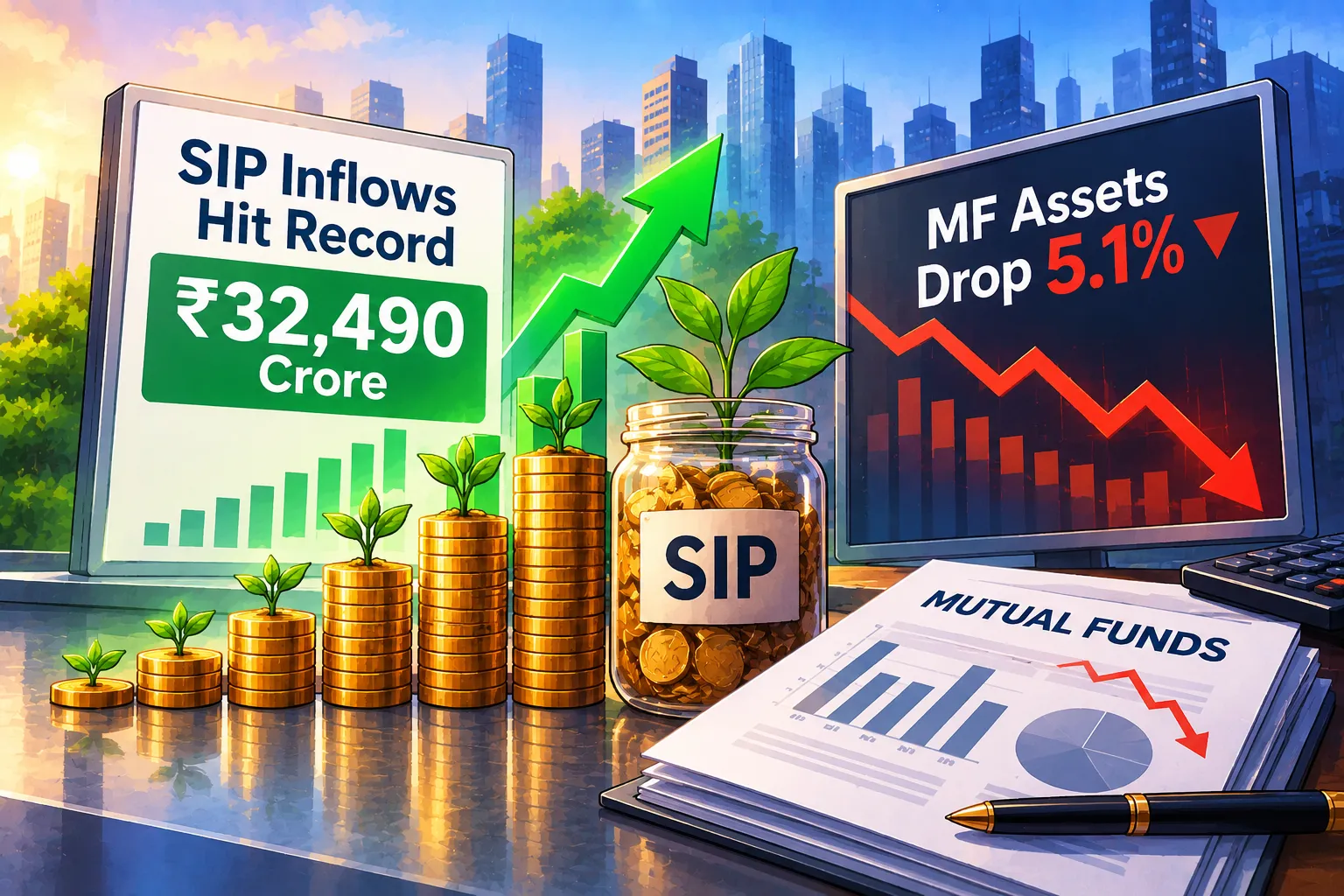
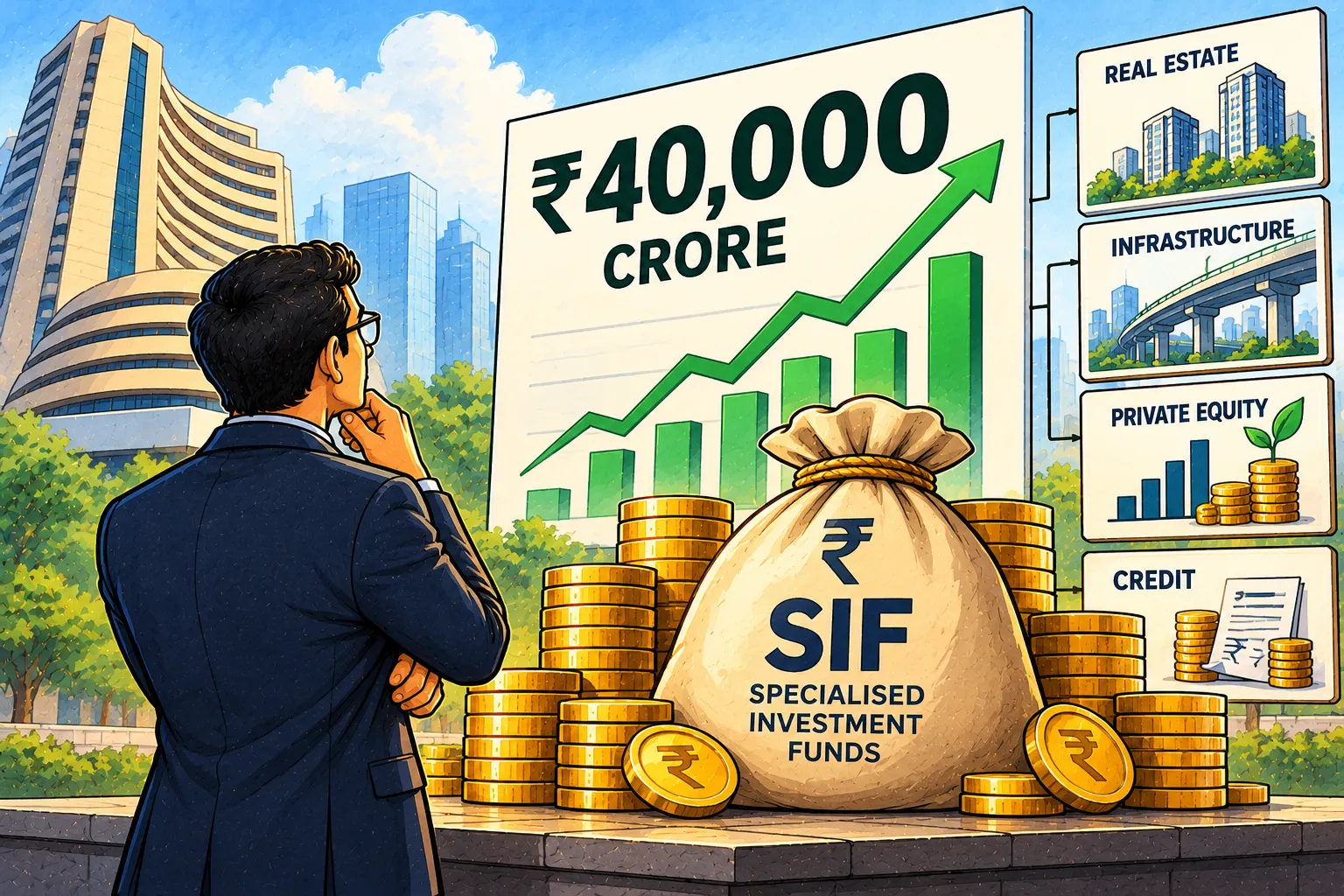
Specialised Investment Funds (SIFs) have grown from ₹2,010 crore to nearly ₹40,000 crore in assets by September 2026, AMFI data shows. SIFs sit between mutual funds and PMS and need at least ₹10 lakh to start.
SIF Assets Grow Almost 20 Times in About a Year
Data from the Association of Mutual Funds in India (AMFI) shows a sharp rise. SIF assets under management (AUM) went from ₹2,010 crore to nearly ₹40,000 crore by September 2026. AMFI recorded the lower figure in October 2025, when SIFs were new.
Here is how the climb looked on the way up:
- October 2025: ₹2,010 crore.
- February 2026: ₹9,711 crore.
- March 2026: ₹10,620 crore.
- August 2026: ₹31,175 crore.
- September 2026: nearly ₹40,000 crore.
In August, AMFI recorded ₹8,070 crore raised and ₹370 crore in redemptions. That left net inflows of about ₹7,699 crore. A Jefferies report cited by Business Standard says SIFs drew ₹7,600 crore in September. That equals nearly 20 per cent of total equity investment.
SEBI’s whole-time member Amarjeet Singh gave an earlier count in July. As of May 31, 2026, SIFs held over ₹13,500 crore across more than 56,000 investor folios. A folio is an investor’s account with a fund. He said 21 investment strategies had been launched.
Another count came in July. The SIF Intelligence Report for that month put the industry at ₹17,826 crore across 28 live funds from 15 asset management companies.
Radhika Gupta, chief executive of Edelweiss Mutual Fund, told Business Standard that investors increasingly want flexible strategies. She said they want ones that work across market conditions. She said the main challenge now is awareness. Investors need to set the right expectations and see how these funds fit their long-term goals.
What is a SIF, and How Did SEBI Set It Up?
A SIF is a product within the mutual fund system, but it has different rules from a regular mutual fund. SEBI announced the framework on February 27, 2025. It took effect on April 1, 2025.
SIFs aim to bridge the gap between regular mutual funds and high-ticket Portfolio Management Services (PMS). They allow fund managers to use advanced tools, such as derivatives and long-short equity strategies. A long-short strategy buys some shares and bets against others. A derivative is a contract whose value depends on another asset, such as a share or an index.
SEBI allows an SIF to hold unhedged short positions of up to 25 per cent of its net portfolio value through derivatives. It also caps exposure to a single AAA-rated issuer at 20 per cent of net assets. No single sector may take more than 25 per cent of net assets. Closed-ended and interval SIFs must be listed on stock exchanges.
Not every fund house can launch one. An asset management company must have run for at least three years with average assets of ₹10,000 crore. A second route lets a firm appoint a chief investment officer with at least 10 years of fund management experience.
The regulator has asked investors to stay grounded. Mr Singh said investment choices should follow financial goals, risk appetite and time horizon. He said they should not follow short-term trends that are in fashion.

SEBI and the National Institute of Securities Markets (NISM) are also building a combined exam. It would certify distributors who sell both mutual funds and SIFs.
How a SIF Differs from a Mutual Fund
A SIF is not the same as a mutual fund, though both sit under SEBI’s mutual fund rules. A SIF has a much higher entry amount. It can also use derivatives and long-short methods that regular mutual funds use less freely.
How SIFs Compare with Other Options
The entry ticket is a key difference. Here is how the minimums line up:
- Regular mutual funds: no regulatory minimum investment.
- SIFs: ₹10 lakh at the PAN level.
- PMS: ₹50 lakh.
- Alternative investment funds (AIFs): ₹1 crore.
How Does the ₹10 Lakh Rule Work?
The ₹10 lakh minimum is counted across all strategies of the same SIF at the PAN level. It does not apply to each strategy on its own. For example, ₹4 lakh in one strategy and ₹6 lakh in another meets the rule.
If an investor’s holding falls below ₹10 lakh, the investor gets 30 calendar days to bring it back above that level. SEBI also allows systematic investment plans (SIPs), transfers and withdrawal plans in SIFs. They work only after the ₹10 lakh threshold is met.
There is an exception for accredited investors, according to a summary of the rules.
Hybrid Strategies Hold Most SIF Assets
Hybrid strategies, which mix shares and other assets, dominated SIF assets in June 2026. They held ₹12,822 crore, or 72 per cent of the total. Equity-oriented strategies held ₹5,036 crore.
The Risks Behind the Growth
SIFs carry risk. Growth in assets shows that money is flowing in. It does not show returns. Business Standard reported that short-term returns are a weak guide because SIFs have a short track record. Strategies in the same category can give very different results. A fund house guide adds that industry asset and inflow figures do not point to future performance. It also says the ₹10 lakh minimum does not mean a SIF is less risky.
Financial planners quoted by Business Standard say investors should look at the fund manager’s record, the strategy, the expense ratio, derivative exposure and redemption terms. The report also suggests talking to a fee-only SEBI-registered investment adviser.
Also Read: Brent Crude Climbs to $106 as Saudi Attacks Meet Russian Diesel
Who Can Invest in a SIF?
Any investor who meets the ₹10 lakh minimum and completes KYC and onboarding can invest. KYC means the standard identity checks. Advisers quoted by Business Standard say SIFs suit high-net-worth people and experienced investors who already hold a mix of mutual funds. They also say that meeting the minimum alone should not decide the choice.