
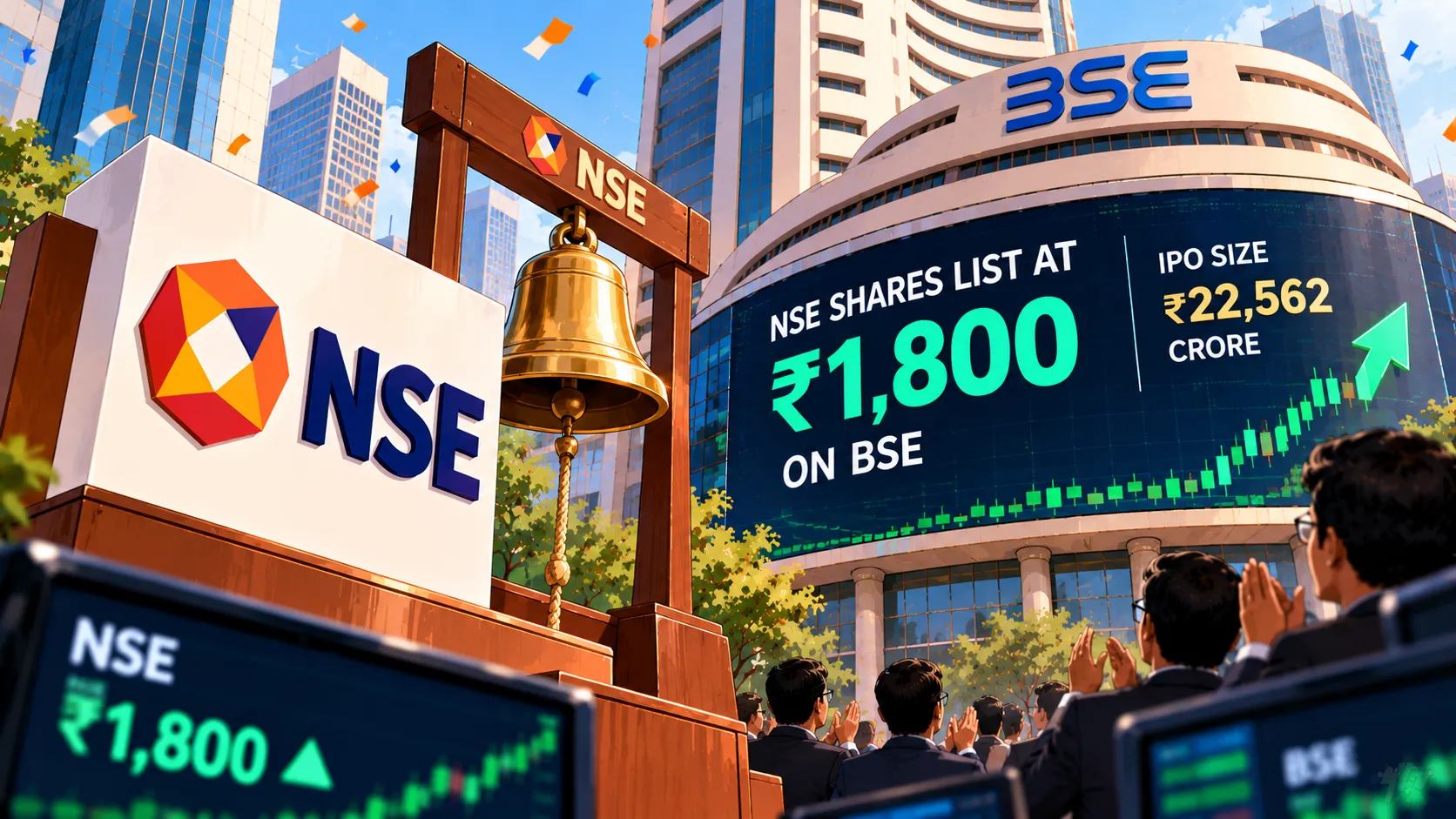
National Stock Exchange of India (NSE) shares listed on BSE on Thursday, September 24, 2026, at ₹1,800 each, a premium of 0.84% over the IPO price of ₹1,785. The muted start follows a 5.71-times subscription for India's second-largest public issue.
A Flat Opening Despite Heavy Institutional Demand
NSE made its stock market debut at ₹1,800 per share on BSE, just ₹15 above the final issue price of ₹1,785. For investors who received shares in the IPO, that works out to a listing gain of 0.84% before any trading costs.
The subdued opening was broadly in line with the grey market, where premiums had cooled in the days before listing. Grey market premium (GMP) is an unofficial, unregulated indicator of expected listing prices. Several trackers had pointed to only a low single-digit percentage premium by listing day.
NSE shares moved above the listing price in early trade on Thursday. The stock began life as a listed company on a weak day for the wider market, with the Sensex and Nifty 50 both trading lower in the morning session.
How the ₹22,562 Crore NSE IPO Was Subscribed
The NSE IPO drew bids for about 50.58 crore shares against roughly 8.86 crore shares on offer, taking the overall subscription to 5.71 times. Demand, however, was uneven across investor categories.
| Investor category | Subscription (times) |
| Qualified institutional buyers (QIBs) | 12.68 |
| Non-institutional investors (NIIs) | 6.55 |
| Retail individual investors | 1.39 |
| Overall | 5.71 |
The gap between the QIB and retail numbers is the most telling part of the data. Large institutions bid for more than 12 times the shares reserved for them, while retail investors only just covered their quota.
That split helps explain the flat listing. Listing-day gains usually depend on unmet demand spilling into the secondary market. With retail demand at 1.39 times, a large pool of unallotted small investors waiting to buy on day one was never likely to form.
Key Facts About the NSE IPO
- Issue size: about ₹22,562 crore
- Price band: ₹1,700 to ₹1,785 per share, with the final price fixed at the upper end
- Lot size: 8 shares, requiring a minimum retail investment of ₹14,280
- Issue type: entirely an offer for sale (OFS) of up to 12.64 crore equity shares
- Subscription window: September 17 to September 21, 2026
- Allotment finalised: September 22, 2026
- Listing date: September 24, 2026, on BSE
- Anchor book: about ₹6,746 crore raised from anchor investors before the issue opened
Because the IPO was a pure offer for sale, NSE itself did not receive any money from the issue. The proceeds went to existing shareholders who sold part of their holdings. No new shares were created, so the listing did not dilute existing ownership.
NSE Now Trades on Rival BSE and MSEI
NSE shares debuted on BSE, its long-standing competitor, rather than on its own trading platform. India's dominant exchange is now a listed company whose stock trades on the platform of its main rival.
The shares have also been admitted for trading on the Metropolitan Stock Exchange of India (MSEI) from September 24 under the "permitted to trade" category. Securities in this category can be traded on MSEI even though they are formally listed on another exchange.

For investors, the practical point is simple. NSE's share price can be tracked on BSE, and the stock can be bought or sold through any broker connected to BSE, using an existing demat and trading account.
One of India's Largest IPOs, Backed by Marquee Anchors
The NSE IPO ranks as India's second-largest public issue, behind only the Hyundai Motor India IPO of 2024. The size of the offer made it one of the most closely watched listings of the year.
Before the issue opened to the public, NSE raised about ₹6,746 crore from anchor investors. The anchor book included Life Insurance Corporation of India (LIC) along with several global sovereign and institutional investors, including Norway's sovereign wealth fund and the Abu Dhabi Investment Authority.
Strong anchor participation signalled institutional confidence in the exchange's business model. The QIB subscription figure of 12.68 times later confirmed that institutions were the main force behind the issue's demand.
Also Read: India's Russian Crude Imports Fall 26% as US Tariff Risk Looms
What the Muted NSE Debut Means for Investors
A 0.84% listing premium means allottees earned very little on day one, particularly after brokerage and other charges. For those who applied mainly for listing gains, the outcome fell short of the expectations that surrounded the issue in its early days.
For long-term shareholders, the listing price is only a starting point. NSE's stock performance from here is likely to be shaped by several factors:
- Trading volumes in the equity cash and derivatives markets
- Regulatory changes that affect trading activity
- The company's earnings trajectory
Market participants are also watching whether institutions that received only a fraction of the shares they bid for step in as buyers in the secondary market in the weeks after the debut.