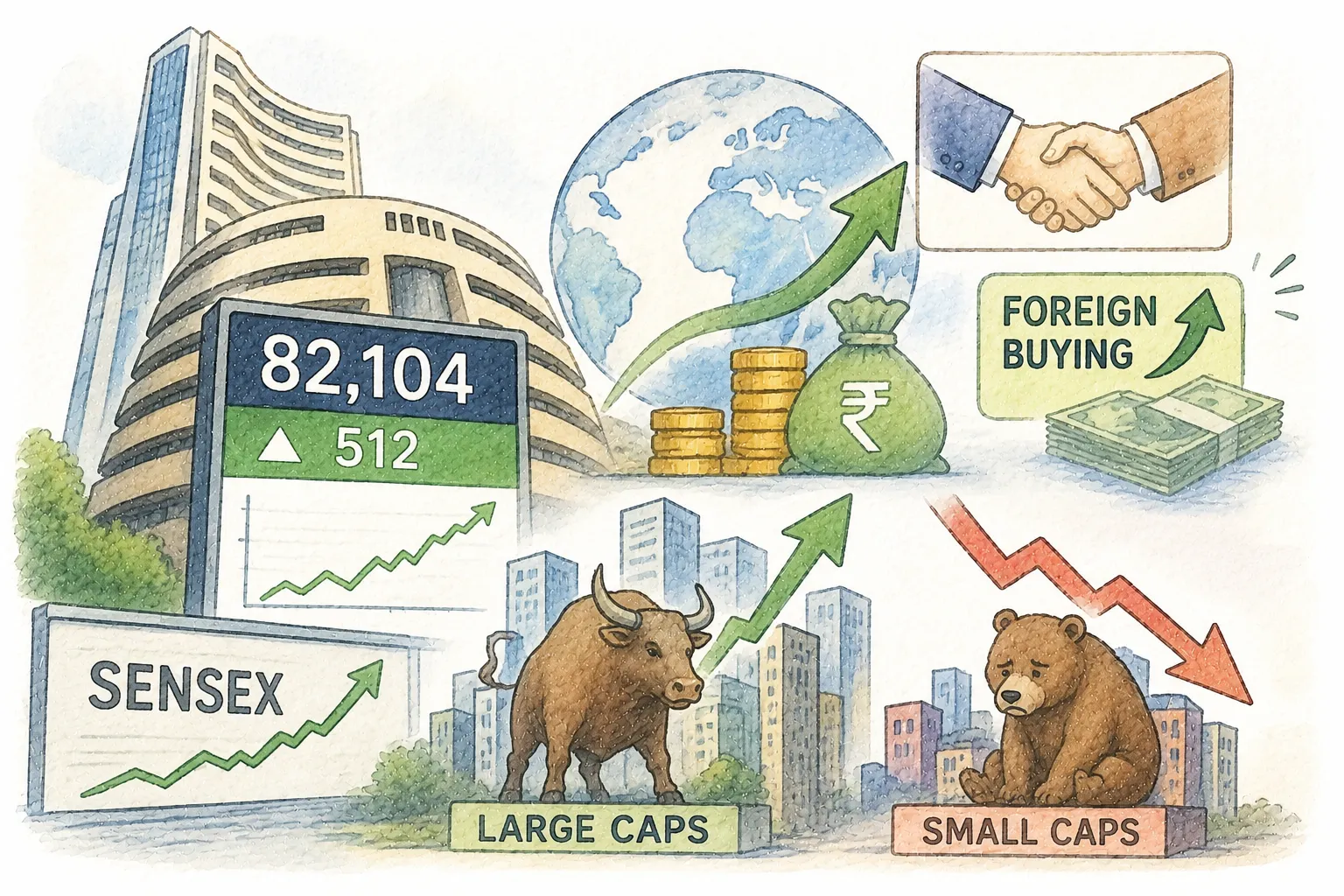
The Sensex gained 512.34 points to close at 82,104.79 on Monday and the Nifty rose 146.80 points to 25,291.10, as record foreign buying and softer crude lifted large caps while midcaps and smallcaps fell.
A Large-Cap Rally With Weaker Edges
Indian equity benchmarks rebounded on Monday, November 16, 2026, recovering the ground lost on Friday. The Sensex rose 0.63% and the Nifty 50 gained 0.58%. The gains were concentrated in large companies, and the broader market did not join in.
| Index | Monday’s move |
| Sensex | Up 512.34 points (0.63%) to close at 82,104.79 |
| Nifty 50 | Up 146.80 points (0.58%) to close at 25,291.10 |
| Nifty 100 | Up 0.11% |
| Nifty Midcap 100 | Down 0.7% |
| Nifty Smallcap 100 | Down more than 1% |
The contrast between the headline indices and the smaller companies stands out. The Nifty 50 gained more than half a percent, yet the Nifty 100 added only about a tenth of a percent and the Nifty Smallcap 100 fell by more than 1%. That spread shows the rally was carried by a narrow group of heavyweight stocks rather than by the whole market.
For an investor reading the day’s numbers, this matters because the headline index can overstate how most listed companies fared. A broad advance lifts large, mid and small companies together. Monday’s session did not look like that, and the gap between the indices is a useful reminder to look beyond the Sensex and Nifty when judging market conditions.
Foreign Investors Are Driving the Move
Foreign buying is a key force behind the market’s recent strength. Overseas investors had put a net $8.9 billion into Indian shares so far in November, already a monthly record in data going back to 2002, according to Reuters data. On Friday alone, foreign institutional investors bought a net ₹5,736.55 crore of Indian equities, based on exchange data.
Depository data shows the same shift. Foreign portfolio investors put a net ₹53,739 crore into Indian equities between November 2 and November 9, across six trading days. That is a sharp turn from earlier in the year. In the first nine months of 2026, foreign investors had pulled a record ₹3.08 trillion out of Indian equities.
Monday’s rise followed a third straight weekly gain for both benchmarks. The Sensex rose 0.7% last week and the Nifty added 0.5%, even though both indices fell on Friday.
Cheaper Crude Eases Pressure on Indian Markets
Brent crude fell 0.88% to about $95 a barrel in early trade on Monday. The decline came as shipments through the Strait of Hormuz improved, which eased concerns about supply.

India imports most of the crude oil it uses, so lower prices reduce pressure on the import bill. They also help companies that depend on oil-linked inputs. Softer crude has been one of the factors supporting sentiment alongside foreign inflows.
Bank Stocks Hold the Index Up
Buying in heavyweight financial stocks supported the benchmarks. Early in the session, the Nifty Bank index was up about 1% and the financial services index had gained 0.6%. These stocks carry a large weight in the Nifty 50, which helped the index hold up while metal shares came under pressure.
Overseas cues were also supportive during Asian trading hours. S&P 500 futures rose 0.3% and Nasdaq futures gained 0.5%, while Hong Kong’s Hang Seng traded higher.
Also Read: India’s Unemployment Rate Eases to 4.9% in October as Female Labour Participation Hits 35%
How the Session Moved
Both indices gave back part of their early gains before recovering toward the close. The Sensex touched an intraday high of 82,311.65 and the Nifty reached 25,337.60. At its lowest, the Nifty stayed above Friday’s close, with an intraday low of 25,172.10. The Sensex slipped briefly below 82,000 before the late recovery, yet it held above its previous close for the whole session.
That pattern matters for interpreting the day. A market that holds above its prior close through the session while giving up early highs suggests steady demand, although not a one-directional surge. Traders usually watch whether the indices can hold such levels over several sessions before reading much into a single day’s move.
Factors Still in Play
Several variables are likely to shape the next few sessions: whether foreign inflows keep arriving at the pace seen this month, the direction of crude prices, and whether the smaller companies catch up with the large-cap rally. The record foreign buying and the split between large and small companies are the two main features of the market this week, and both will be visible in the daily exchange data.