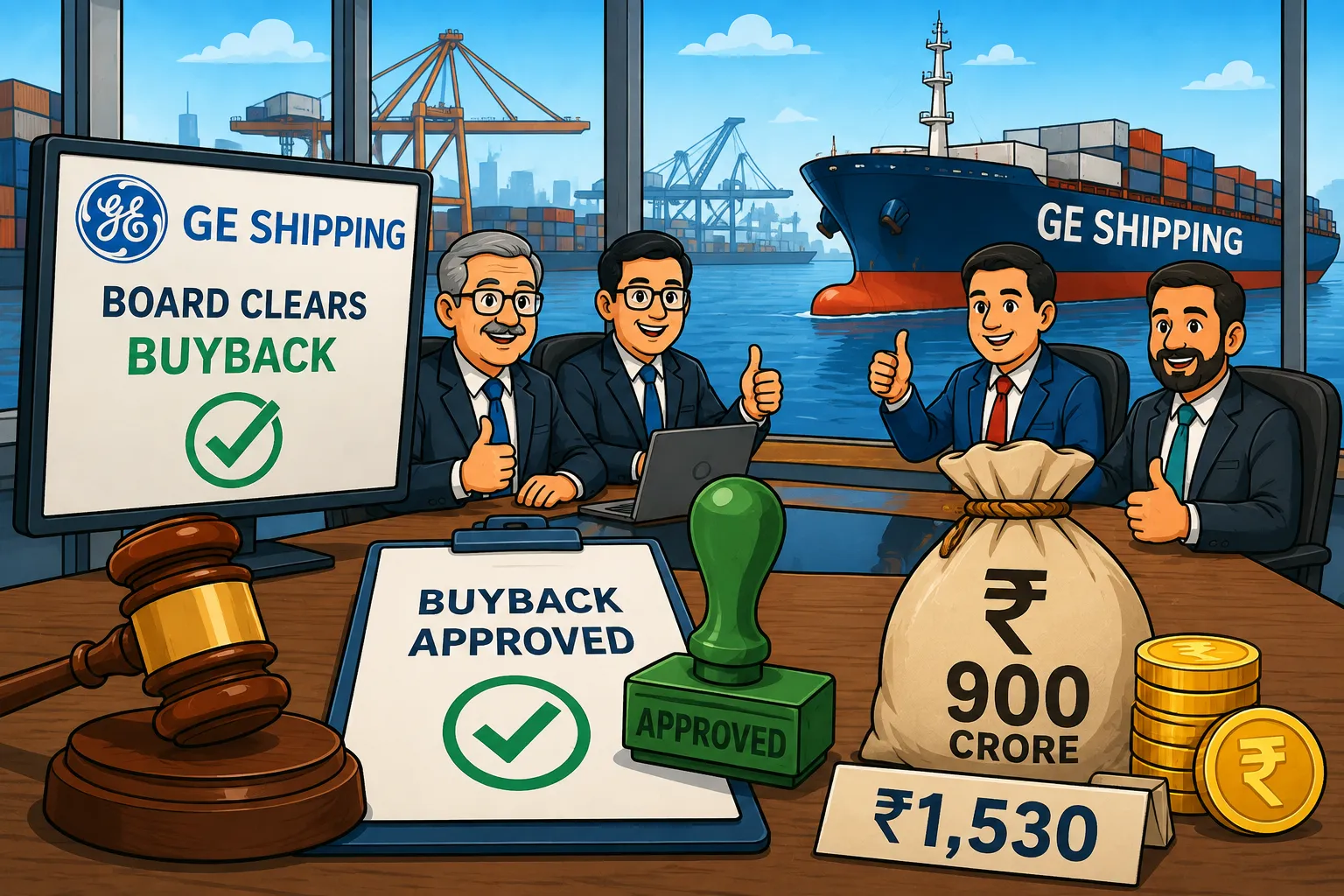
Great Eastern Shipping's board approved a ₹900-crore open-market buyback at up to ₹1,530 a share, sending the stock higher on August 28, 2026, as the move follows a sharp jump in Q1 FY27 profit.
Board Approves Buyback, Stock Reacts
The board of Great Eastern Shipping Company met on August 27, 2026, and cleared a share buyback of up to ₹900 crore through the open-market route on the NSE and BSE. The maximum buyback price has been fixed at ₹1,530 per share, translating into a premium of roughly 16% over the previous closing price of ₹1,317.20.
The stock responded positively once markets opened on August 28. Shares climbed as much as 2.2% at the open to ₹1,324.90 and touched an intraday high near ₹1,363, with one report noting a peak gain of about 3.3% to ₹1,373. By late morning, the stock was trading roughly 2% higher at around ₹1,341.70.
What the Buyback Covers
Under the approved plan, Great Eastern Shipping can repurchase up to 58,82,352 equity shares, equal to 4.12% of its total paid-up equity capital as of the board meeting date. The company is required to utilise at least 75% of the earmarked ₹900 crore, implying a minimum buyback of around 44,11,764 shares.
Importantly, the buyback excludes promoters and the promoter group, meaning only public shareholders will be eligible to tender shares. In value terms, the buyback size works out to 7.19% of the company's standalone paid-up capital and free reserves, and 6.34% on a consolidated basis, calculated using audited financials as of March 31, 2026.
| Buyback parameter | Detail |
| Buyback size | Up to ₹900 crore |
| Maximum price | ₹1,530 per share |
| Route | Open market (NSE, BSE) |
| Maximum shares | 58,82,352 (4.12% of equity) |
| Minimum utilisation | 75% (≈44.12 lakh shares) |
| Promoter participation | Excluded |
| Board meeting date | August 27, 2026 |
Record Quarter Sets the Stage
The buyback comes on the back of a strong start to FY27. Great Eastern Shipping reported a consolidated net profit of ₹1,308.84 crore for the first quarter, up 159.43% year-on-year, while revenue from operations rose 66.91% to ₹2,005.36 crore. That kind of profit jump gives the company the balance-sheet room to return cash to shareholders without straining its capital position, and it also explains why the board chose the open-market route, which allows purchases to be spread over time rather than executed as a single tender offer.
Great Eastern Shipping and its subsidiaries operate primarily in shipping and offshore oil drilling and exploration services, a business that has benefited from firmer freight rates and charter income in recent quarters. This tailwind in core shipping and offshore earnings appears to underpin management's confidence in committing ₹900 crore to a buyback rather than deploying the full amount elsewhere.

Also Read: Ather Energy Jumps 7% as Hero MotoCorp Ups Stake to 32.8%
How the Shareholding Pattern Shifts
Because promoters are barred from participating, a buyback of this kind mechanically increases their percentage stake even though the number of shares they hold stays the same, since the total outstanding share count shrinks. As of June 30, 2026, promoters held 30.07% of the company, equivalent to about 4.29 crore shares. If the full buyback goes through, that stake is estimated to rise to around 31.37%, still with the same 4.29 crore shares.
The rest of the shareholder base is fairly diversified. Foreign portfolio investors, NRIs and foreign banks together held 29.83% (about 4.26 crore shares), while mutual funds, financial institutions, banks, AIFs, NBFCs and insurance companies collectively held 12.49% (roughly 1.78 crore shares). The remaining public shareholders accounted for 27.60%, or about 3.94 crore shares. After the buyback, total public shareholding is estimated to settle near 68.63%, spread across roughly 9.39 crore shares.
Why the Timing Matters for Investors
For existing shareholders, the buyback creates a defined price ceiling of ₹1,530 for participation and offers a formal exit route at a premium to the pre-announcement market price. Since promoters are not eligible to sell into the buyback, the benefit accrues entirely to public shareholders who choose to tender shares, an important governance detail for minority investors evaluating the offer.
The stock's performance context adds further weight to the announcement. Great Eastern Shipping shares have gained approximately 20% in calendar year 2026 so far, even as the Nifty 50 has declined by around 8% over the same period. Over a one-year horizon, the stock is up about 43%, compared with a 1.7% decline in the benchmark index. This relative strength suggests the market had already been pricing in improving fundamentals ahead of the formal buyback disclosure, and the fresh gains on the announcement day reinforce that the capital-return signal was well received rather than already fully priced in.
The company's trading window for insiders had been closed from August 25 to August 29, 2026, in line with SEBI's insider-trading regulations, a standard procedural step ahead of board meetings that consider price-sensitive decisions such as buybacks or results. With the announcement now public, attention shifts to the buyback's execution timeline and how much of the ₹900-crore allocation is eventually deployed on the exchanges over the coming weeks.