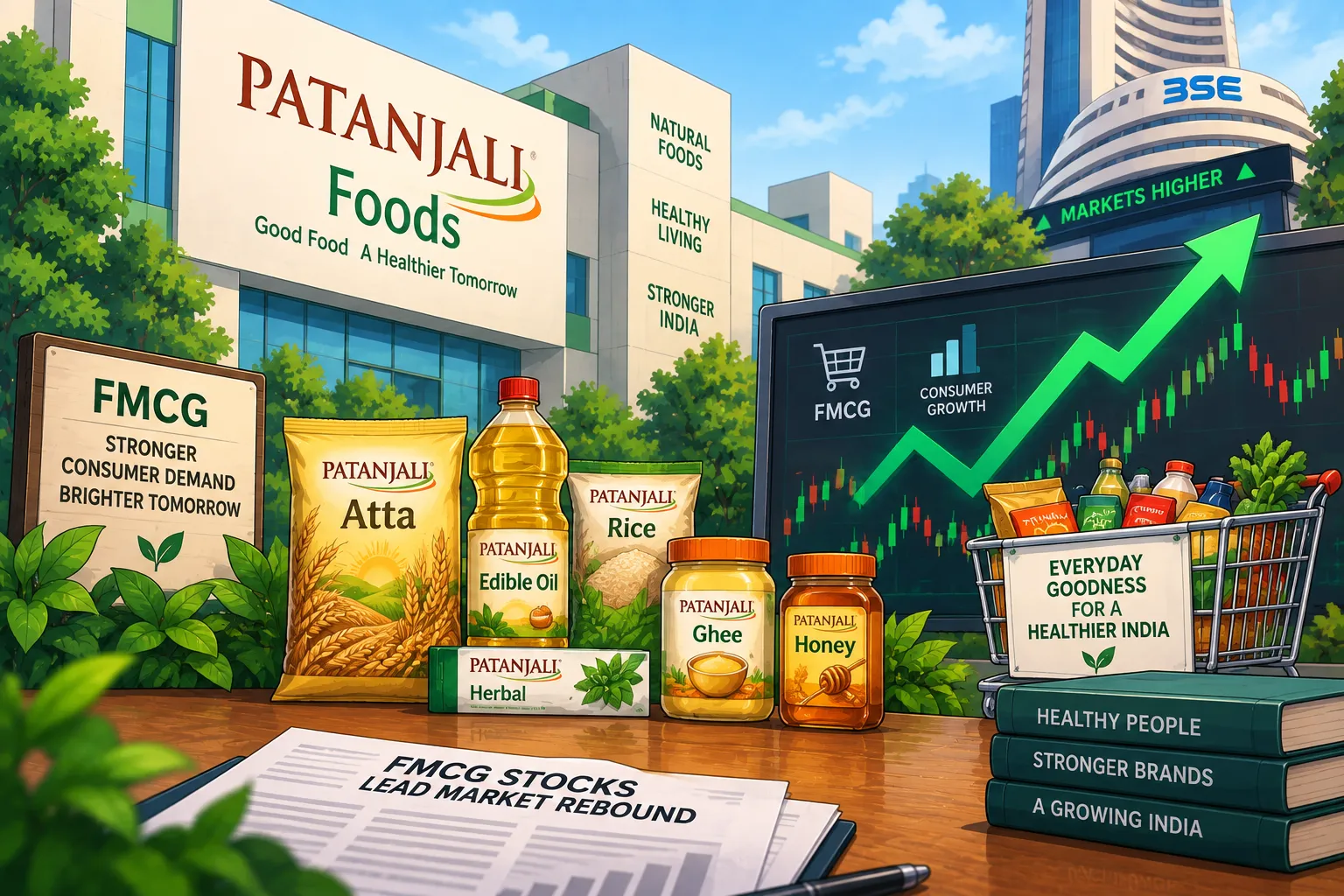
Patanjali Foods led Nifty FMCG gainers on Wednesday, rising 6.5% intraday as the sector rebounded broadly. The move came amid a Delhi High Court order involving promoter Patanjali Ayurved, but the judgment was not a ruling for the listed company.
Patanjali Foods gains as FMCG stocks advance
Shares of Patanjali Foods Ltd (NSE: PATANJALI | BSE: 500368) climbed to an intraday high of ₹360.50 on the NSE on 16 September 2026, compared with the previous close of ₹338.55. The stock was up as much as 6.5% during the session. Around 11:42 AM IST, it was trading at ₹356.20, up 5.21%.
Patanjali Foods was the top gainer in the Nifty FMCG index as the broader consumer-goods pack advanced. The Nifty FMCG index rose as much as 1.8% to 45,645.20, compared with Tuesday's close of 44,829.95. At around 11:42 AM, the index was 1.71% higher at 45,595.10.
The advance was broad-based, with 13 of the index's 15 constituents gaining. Marico, Colgate-Palmolive (India), Tata Consumer Products, Godrej Consumer Products and Hindustan Unilever were among the other stocks that advanced.
The broader market also recovered on Wednesday. The Sensex ended 333 points higher at 74,336, while the Nifty 50 gained 99 points to close at 23,218, snapping a two-day losing streak.
The Delhi High Court order is not a new development
The Patanjali-related court order that drew attention alongside the stock's move was delivered on 10 September 2026 and uploaded on 15 September. Therefore, the legal development itself was not new on 16 September.
A Division Bench of Justice Dinesh Mehta and Justice Rajneesh Kumar Gupta set aside seven Income Tax Appellate Tribunal (ITAT) orders in cross-appeals involving Patanjali Ayurved Ltd.
The case, Pr. Commissioner of Income Tax, Central-1, Delhi v. Patanjali Ayurved Limited (ITA 80/2026 & CM APPL. 6824/2026), relates to proceedings under Section 153C of the Income Tax Act for Assessment Years 2013-14 to 2015-16 and 2017-18.
Importantly, the High Court did not decide the underlying tax dispute on its merits. The seven ITAT orders were set aside on procedural grounds, and the matters will now be heard afresh by a different ITAT bench.
Why calling it a Patanjali tax win would be misleading
The earlier ITAT decisions had gone in favour of Patanjali Ayurved. The tribunal had treated the assessments as unabated, quashed four assessments, allowed four appeals filed by Patanjali Ayurved and dismissed three cross-appeals filed by the Revenue.
The Income Tax Department challenged four of those orders. The Delhi High Court ultimately set aside all seven ITAT orders.
The High Court also criticised the tribunal's handling of the matters. Four appeals had been heard and pronounced on 6 August 2025 and three on 13 August 2025, but all seven were disposed of through a single common order of fewer than seven paragraphs. The bench referred to procedural concerns including "non-application of mind and undue haste" and directed that its order be forwarded to the Secretary, Ministry of Law and Justice.
The court expressly made no observation on the merits of the tax dispute.
Patanjali Ayurved and Patanjali Foods are different entities
A key distinction is between Patanjali Ayurved Ltd and the listed Patanjali Foods Ltd.

Patanjali Ayurved is an unlisted company and the promoter of Patanjali Foods. Promoter holding in Patanjali Foods stood at 68.25% as of June 2026. However, Patanjali Foods Ltd is not named as a party in the tax appeals covered by the Delhi High Court judgment.
Patanjali Foods' recent exchange-announcement feed also did not show a filing relating to the Delhi High Court order as of the available Stage 1 verification. Recent announcements included an analyst and investor meet intimation, newspaper publication, a letter to shareholders, the Business Responsibility and Sustainability Report and the notice for the company's 40th Annual General Meeting.
There is therefore no verified company disclosure establishing that the court order caused Patanjali Foods' share-price movement on 16 September.
Strong Q1 numbers contrast with the stock's 2026 performance
Patanjali Foods' latest quarterly financial performance provides another important part of the picture.
For Q1 FY27, announced on 14 August 2026, revenue from operations stood at ₹11,337.45 crore, up 29.33% year-on-year from ₹8,766.03 crore. The company recorded profit after tax of ₹335.73 crore, an increase of about 86% from ₹180.36 crore.
Operating EBITDA increased 69.2% to ₹543.40 crore, while the operating EBITDA margin improved to 4.80% from 3.66%.
Edible oils generated revenue of ₹8,504.72 crore, up 27.28%, while the Food & FMCG segment recorded revenue of ₹2,937.75 crore, up 35.39%.
The company also declared a third interim dividend of ₹1.50 per share for FY26 and a first interim dividend of ₹0.80 per share for FY27. The record date was 21 August 2026. Its oil palm cultivation area stood at 1,15,861 hectares as of 30 June 2026.
Also Read: NSE IPO Opens Tomorrow: CEO Flags 'Unexpectedly Large' Demand
Patanjali Foods remains below its 52-week high
Despite Wednesday's intraday rebound, the stock remained significantly below its 52-week high.
Patanjali Foods' 52-week high was ₹614.90 on 19 September 2025, while its 52-week low was ₹328.20 on 15 July 2026. The stock was still down roughly 35% year-to-date based on the verified Stage 1 data.
| Patanjali Foods price snapshot | Level |
| Previous close — 15 Sep 2026 | ₹338.55 |
| Intraday high — 16 Sep 2026 | ₹360.50 |
| Price around 11:42 AM | ₹356.20 |
| 52-week high | ₹614.90 |
| 52-week low | ₹328.20 |
| YTD performance | Down roughly 35% |
Wednesday's move therefore came during a broader FMCG rebound, with Patanjali Foods recording the strongest intraday gain within the Nifty FMCG index. The available verified information does not establish a direct causal connection between the Delhi High Court order and the stock's rise.
The legal matter concerns Patanjali Ayurved and remains subject to fresh adjudication by the ITAT, while Patanjali Foods' latest reported operating numbers provide a separate backdrop for understanding the listed company's financial position.