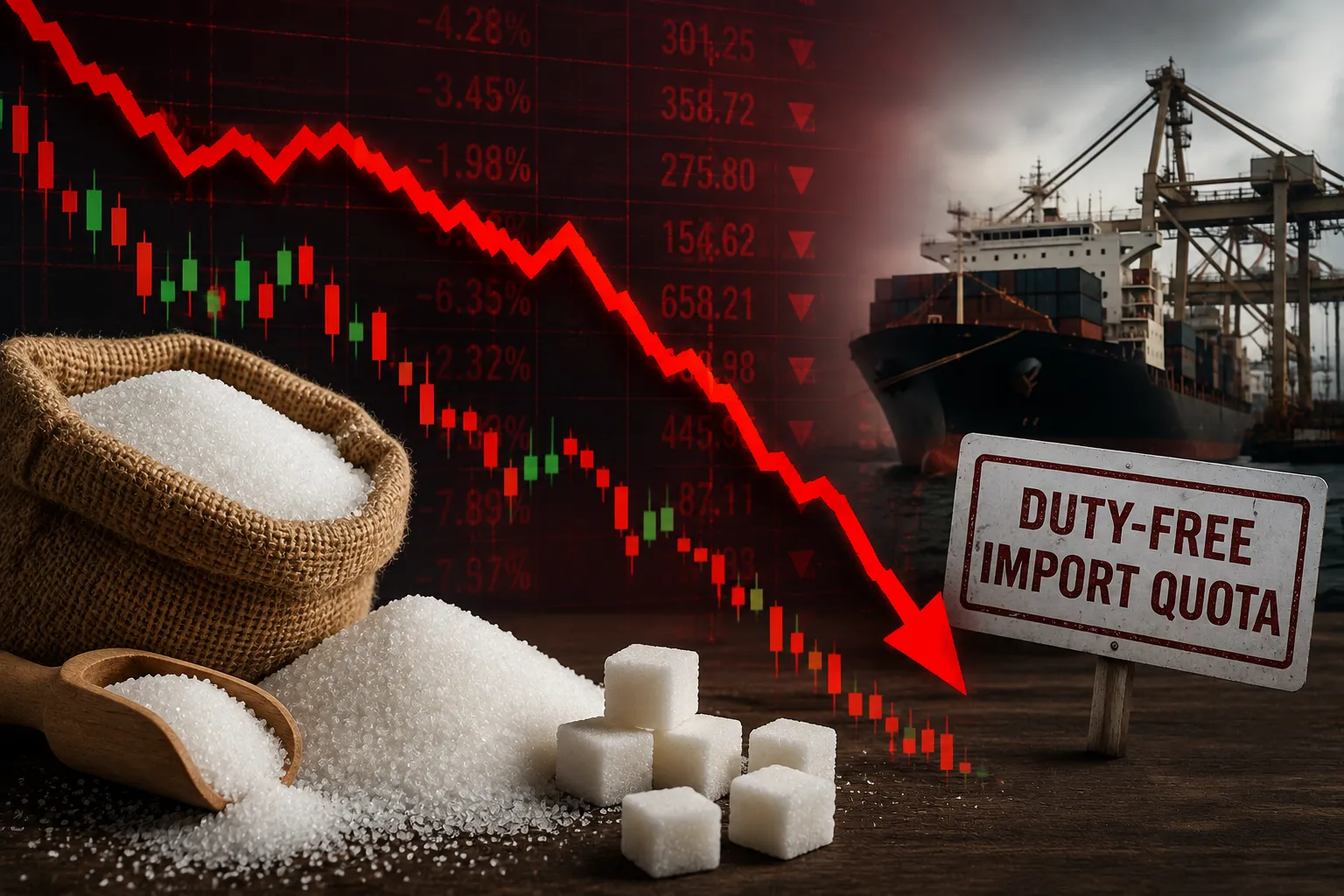
India’s sugar stocks came under pressure on 21 August after the DGFT allowed duty-free imports of up to 10 lakh metric tonnes of raw sugar until 31 October. The temporary quota could increase supply and influence domestic sugar-price expectations.
Why sugar stocks are falling
The Directorate General of Foreign Trade (DGFT), under the Ministry of Commerce and Industry, amended India’s raw-sugar import policy on 20 August 2026 through Notification No. 31/2026-2027.
The notification permits duty-free imports of up to 10 lakh MT, or 1 million MT, of raw sugar under a Tariff Rate Quota (TRQ). The import window is valid until 31 October 2026.
Sugar stocks declined in the following trading session as investors assessed the possible effect of additional supply on domestic sugar prices and mill realisations. Business Standard reported intraday declines in Dwarikesh Sugar Industries, Dalmia Bharat Sugar and Industries, and Balrampur Chini Mills on 21 August. These were intraday figures, not exchange-verified closing movements.
The policy is a limited, time-bound import measure. It does not represent an unrestricted or permanent opening of raw-sugar imports.
DGFT raw-sugar import policy: key details
A Tariff Rate Quota allows imports of a specified quantity under defined terms. In this case, the government has capped the duty-free quantity at 10 lakh MT and limited the arrangement to 31 October.
| Particular | Details |
| Regulator | Directorate General of Foreign Trade |
| Notification | No. 31/2026-2027 |
| Policy announcement | 20 August 2026 |
| Duty-free quota | Up to 10 lakh MT of raw sugar |
| Validity | Until 31 October 2026 |
| Product covered | Raw sugar |
| Import route | Tariff Rate Quota |
| Policy objective | Add supply and help ease high domestic prices |
The policy covers raw sugar rather than refined sugar. The product category has been reported under Exim Code 170114.
The DGFT notification also provides a one-time option for specified Advance Authorisations issued under SION E-52 to be converted to the TRQ mechanism, subject to conditions. This includes payment of GST exemption availed under the original authorisation.
Refined sugar made from raw sugar imported through this route must be supplied in the domestic market by 31 October. The condition places the emphasis on near-term domestic availability.
Sugar companies in focus
The import decision brought attention to listed companies in the Indian sugar and sugar-linked ethanol sector, including:
- Balrampur Chini Mills
- Dwarikesh Sugar Industries
- Dalmia Bharat Sugar and Industries
- Uttam Sugar Mills
- EID Parry (India)
- Dhampur Sugar Mills
- Avadh Sugar & Energy
- Bajaj Hindusthan Sugar
- Shree Renuka Sugars
The policy does not necessarily have the same financial effect on every company. Sugar businesses differ by regional exposure, production profile, sugar inventory, refining capability, debt position and ethanol-linked operations.

Market participants may watch whether the new quota changes domestic sugar-price trends. However, the 21 August share-price reaction alone does not establish the eventual earnings impact for individual companies.
Why the decision matters for sugar prices
India’s sugar sector is highly sensitive to policy decisions. Supply measures, cane costs, production levels, export rules, stock restrictions and ethanol policy can all influence prices and profitability.
Reuters reported that domestic sugar prices had risen nearly 40% over two months amid tight availability. The government’s duty-free import quota is intended to improve supply before the seasonal increase in demand around the festival period.
For sugar mills, domestic sugar realisations influence revenue and margins. If imported raw sugar adds meaningful supply, scarcity-led price strength could reduce. The scale of any impact will depend on actual import volumes, timing of arrivals, refining activity, regional demand and prevailing domestic price levels.
The 31 October deadline is material because it limits the period in which the quota can be used. Importers would need to arrange purchases, shipment, refining and domestic supply within the applicable policy framework.
Also Read: Turtlemint Stock Surges 5% on Jefferies Buy Initiation
What investors may track next
The impact of the duty-free raw-sugar import quota will become clearer as data on imports and domestic prices emerge. Important indicators include:
- Utilisation of the 10 lakh MT quota
- Timing of raw-sugar shipments and processing
- Wholesale and retail sugar-price movements
- Company disclosures on sugar inventory and operations
- Cane availability and cost developments
- Ethanol-related policy and operational updates
- Further government announcements on sugar supplies
The measure is significant because it introduces additional potential supply into a market where prices had risen sharply. Still, it should be viewed alongside broader sector variables rather than as the only factor affecting sugar-company performance.
For investors using a stock trading platform, the development highlights how a government policy decision can influence sentiment across multiple listed companies in one sector. Those planning to open a demat account online should review exchange-verified prices, official company disclosures and sector conditions instead of basing decisions solely on intraday volatility.