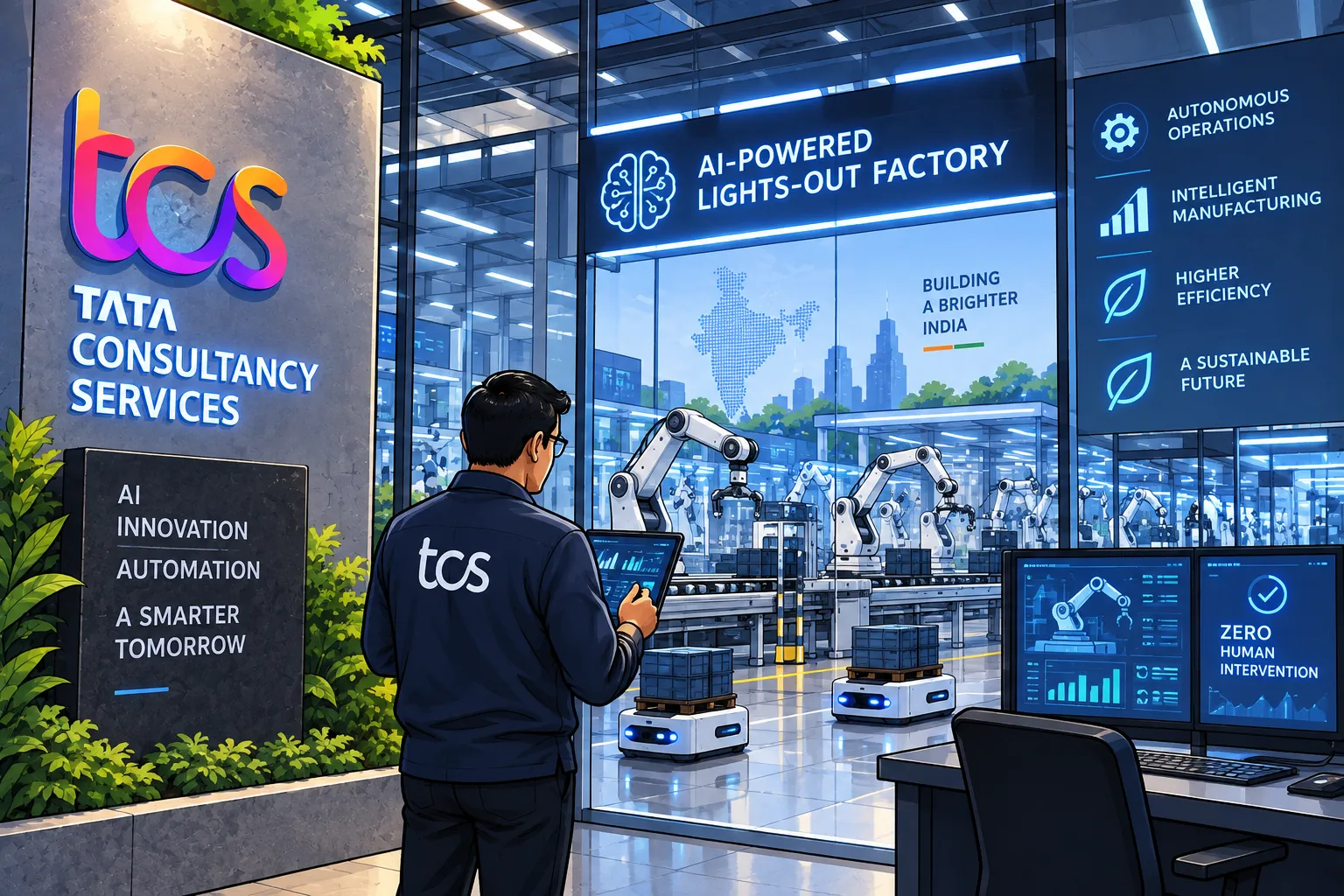
Tata Consultancy Services launched India's first AI-driven lights-out factory lab in Pune on September 9, 2026, featuring a fully robotic battery assembly line even as TCS shares slipped amid broader IT-sector weakness.
Tata Consultancy Services (TCS) has switched on the TCS Industrial Autonomy & Engineering Lab at its Sahyadri Park campus in Pune, marking what the company describes as India's first "lights-out factory lab." The facility went live on Wednesday, September 9, 2026, and centres on a fully robotic battery pack assembly line, the first of its kind for TCS in the country.
A lights-out factory refers to a manufacturing setup that can run production largely without human presence on the floor, relying instead on automation, sensors and software to keep operations moving. TCS's Pune lab is built to demonstrate this model live, using digital twins, robotics, industrial AI and factory control systems working together in real time .
What the new lab actually does
The lab is designed around what TCS calls its "Human+AI Service Autonomy Model," which combines automated machinery with AI-based decision-making layered on top of traditional factory systems . Rather than being a demonstration on paper, the battery assembly line inside the facility runs through multiple live production stages with robotic handling at each step.
TCS says the setup is built to showcase several practical use cases for manufacturers:
- Predictive maintenance to flag equipment issues before failures occur
- Automated quality inspection across production stages
- Real-time process optimisation using live operational data
- Human-machine collaboration models for supervised automation
- Fully autonomous factory operations for suitable production lines
These capabilities target manufacturers, particularly in sectors such as auto components, electric vehicle batteries and industrial equipment, that are trying to cut downtime and defects while scaling automation.
Executives frame it as a step toward AI-first manufacturing
Sreenivasa Chakravarti, TCS's Global Head and Vice President for Industrial Autonomy and Engineering, was quoted endorsing the lab as part of the company's broader push into AI-led manufacturing services. Joakim Landholm, SVP for Commercial and Operations Development at SKF, also offered on-record comments supporting the initiative, pointing to industry interest in autonomous production models.
The Pune launch is not TCS's first move in this space. Earlier in 2026, the company set up an Industrial Autonomy & Engineering Lab powered by NVIDIA in Bengaluru, which focuses on "Physical AI" for industrial and mobility applications. The Pune facility extends that same innovation track into a live, fully robotic factory environment rather than a research-only setup.

TCS remains India's largest IT services company, operating from delivery centres across dozens of countries, and posted consolidated revenue of more than US$30 billion for FY26, the year ended March 31, 2026 . That global scale is relevant context: a lab of this kind, once proven at Sahyadri Park, can potentially be replicated across TCS's wider network of engineering and manufacturing clients rather than remaining a single-site showcase. The Pune lab fits into the company's broader strategy of moving beyond traditional IT services delivery into AI-enabled industrial and engineering offerings, an area where global IT majors are competing for large manufacturing contracts.
Read More: ARCIL IPO Subscription Crosses 26% As Retail Bids Lead Day 1
TCS stock fell on the day of the launch
Despite the announcement, TCS shares did not rally. The stock was trading roughly 2.3–2.4% lower around midday on September 9, near ₹2,201–2,203 on the NSE, with most other IT stocks also trading in the red during the same session.
| Metric | Detail |
| Announcement date | September 9, 2026 |
| Location | Sahyadri Park, Pune |
| TCS share price (intraday) | ~₹2,201–2,203 |
| Intraday movement | Down ~2.3–2.4% |
| Sector trend | Broader IT stocks weak |
The decline suggests the move was tied more to sector-wide sentiment in IT stocks that day than to any reaction to the lab launch itself. This is a useful distinction for readers tracking TCS: a strategically significant product announcement did not translate into a positive stock reaction, reinforcing that near-term share price swings and long-term business strategy don't always move in the same direction on a given trading day.
Why this matters for the AI-manufacturing theme
For investors tracking India's Industry 4.0 push, the Pune lab is a concrete signal that large IT services firms are building live, working infrastructure around industrial AI rather than only offering advisory services. TCS positioning itself with autonomous, robotics-driven production lines has relevance beyond its own stock; it touches the broader ecosystem of auto components, battery manufacturing, robotics integrators and industrial automation vendors that could see increased demand as more Indian manufacturers explore similar automation.
It also underscores a pattern worth watching: TCS has now stood up two dedicated industrial-AI labs within 2026 alone, one in Bengaluru with NVIDIA focused on Physical AI, and now Pune's lights-out facility focused on live robotic manufacturing. Together, these signal a sustained, multi-city investment in AI-led manufacturing capability rather than a one-off announcement, even though the immediate stock market reaction on launch day was muted by sector-wide pressure on IT counters.