
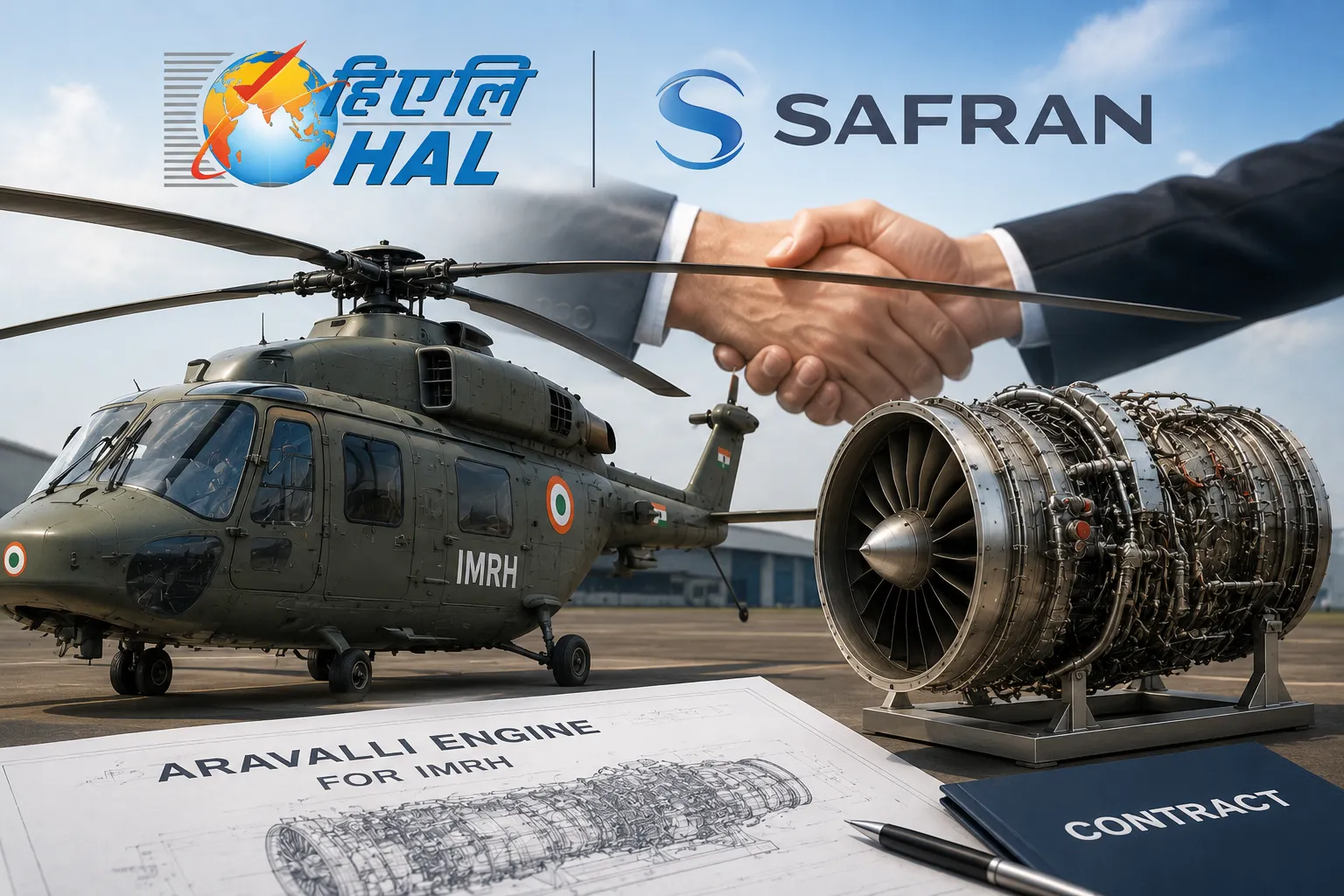
Hindustan Aeronautics Ltd. (HAL), Safran Helicopter Engines and their SAFHAL joint venture have signed a final contract for the Aravalli engine, a development milestone for HAL’s future Indian Multi-Role Helicopter and naval variant.
HAL disclosed on 26 August that it has entered into the final agreement with Safran Helicopter Engines and SAFHAL Helicopter Engines Pvt. Ltd. for the Aravalli high-power helicopter-engine programme.
The agreement spans the engine’s design, development, manufacturing, supply and lifecycle support. It takes the programme beyond an initial collaboration phase and establishes the work scope for a propulsion system intended for HAL’s future medium-lift helicopter platforms.
The disclosure is relevant to shareholders because HAL is a listed defence public-sector undertaking, traded on the NSE under the symbol HAL and on the BSE under code 541154. However, the company has not disclosed a contract value, engine output, production schedule, programme outlay or likely financial contribution.
Aravalli engine selected for IMRH and DBMRH
The Aravalli engine is being developed in the 3,500–4,000 shaft-horsepower range. HAL has identified it for the forthcoming 13-ton Indian Multi-Role Helicopter, or IMRH, and the Deck-Based Multi-Role Helicopter, or DBMRH, its naval version.
The final contract involves HAL, Safran Helicopter Engines and SAFHAL Helicopter Engines Pvt. Ltd. SAFHAL is the joint-venture entity through which the two companies are pursuing the Aravalli programme.
The agreement covers the complete operational chain envisaged for the engine from design and development through manufacture, supply and support across its lifecycle. That makes the 26 August signing a defined programme milestone, although it does not mean that the engine is already certified, in serial production or inducted into service.
HAL has not announced a confirmed procurement order for the IMRH or DBMRH through this filing. It has also not given any estimates of the programme’s potential revenue, profitability, order-book impact or delivery timeline.
A propulsion milestone, not a disclosed financial order
The market significance of the update lies in HAL’s longer-term helicopter and propulsion roadmap. A domestically developed and supported high-power engine could strengthen the aerospace manufacturing ecosystem around future HAL helicopter platforms.
HAL said the programme could support indigenous maintenance, repair and overhaul capabilities. The company also indicated potential civil uses over time, including offshore transportation, utility operations and VVIP transport.
These civil and MRO references should be viewed as prospective opportunities. The filing does not disclose a civil customer, commercial order, production volume or separate financial plan linked to those applications.
The announcement therefore should not be treated as evidence of an immediate addition to HAL’s order book or a confirmed improvement in earnings. Investors will need future disclosures on development progress, certification, programme approvals, procurement quantities, production plans and financial terms to assess the commercial scale of the project.

How the new contract fits HAL-Safran ties
The Aravalli agreement extends a pre-existing relationship between HAL and Safran Helicopter Engines. HAL’s exchange filing refers to Safran’s supply of Artouste engines for Cheetah and Chetak helicopters.
The companies also have a history around the Shakti engine family, which powers HAL’s Advanced Light Helicopter, Light Combat Helicopter and Light Utility Helicopter programmes.
That context matters because the 26 August development is not the beginning of HAL’s cooperation with Safran. The fresh event is the final contract for the Aravalli engine through SAFHAL, covering its development, manufacture, supply and lifecycle support.
For the defence manufacturing sector, the move keeps attention on the development of Indian aerospace propulsion capabilities. It also links the project to HAL’s planned IMRH and DBMRH platforms, both of which will require further programme and procurement milestones.
Also Read: NSE, BSE Open on August 26, but Settlement Will Pause
What HAL shareholders should track
HAL’s 26 August filing did not provide the financial details usually needed to assess a direct near-term impact on a listed company. The most relevant next developments would be updates on the engine’s development and certification path, the IMRH and DBMRH programmes, production arrangements and technology-transfer details.
Other disclosures to watch include possible capital expenditure, domestic MRO plans, engine production volumes, lifecycle-support arrangements and any formal commercial terms. Such details could clarify how the programme may ultimately contribute to HAL’s aerospace business.
The article’s relevance for stock market trading is primarily event-driven: a listed defence company has formalised an important long-term programme, while its direct financial outcome remains undisclosed. Readers should distinguish the news trigger from subsequent market-price movements or unannounced earnings assumptions.
Anyone seeking to transact in listed shares must open demat account online with a regulated market intermediary. That market-access requirement is separate from the assessment of any individual company announcement.
HAL’s final Aravalli agreement with Safran Helicopter Engines and SAFHAL is thus a fresh execution milestone for its future helicopter plans. Its eventual commercial importance will depend on future development, certification, manufacturing and procurement disclosures.