
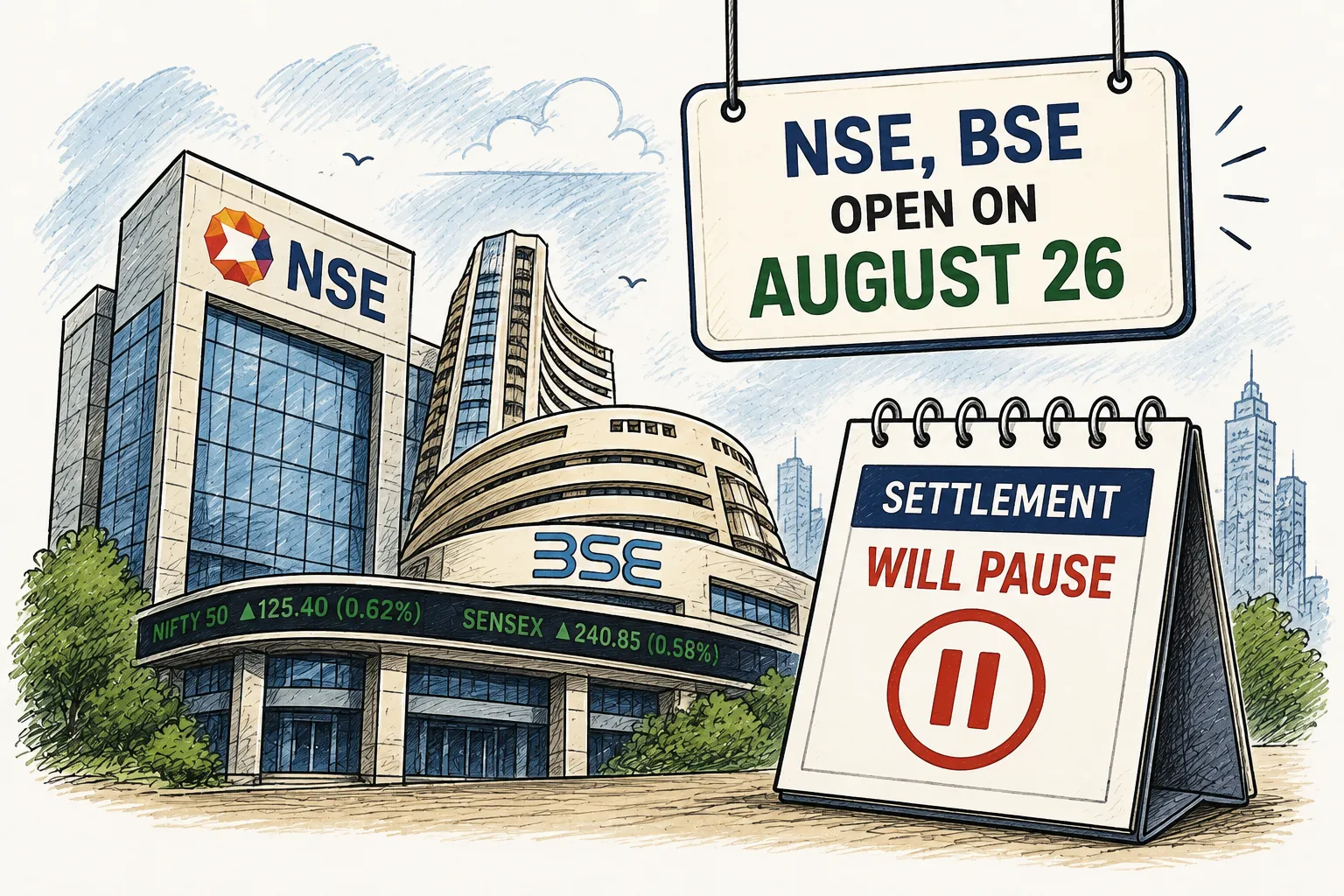
August 26, 2026 is not a trading holiday for the NSE and BSE equity markets. Investors can place orders in equities and derivatives as usual, but the day has been designated a settlement holiday for Id-E-Milad.
That distinction matters because trading and settlement are separate parts of the market process. A trade may be executed during the session, but the routine transfer of shares, sale proceeds and certain credits will not follow the usual timeline when clearing and settlement operations are unavailable.
The currency segment will remain closed on Wednesday. Investors planning currency-derivative trades or hedging activity will therefore need to account for the closure, even as equity-market transactions continue.
Equity trading continues, settlement does not
A trading holiday means the market remains shut and orders cannot be placed. A settlement holiday is different: the exchange can remain open for trading, while the post-trade transfer of securities and funds is deferred.
For August 26, NSE and BSE equity-market participants can continue trading. However, clearing and settlement-linked processes will be affected for the day. This can influence when investors receive sale proceeds, securities, realised profits and credits that would otherwise be reflected in their account balances.
The practical outcome is that investors should not treat August 26 as a normal liquidity day. A transaction completed before or during the settlement holiday may be visible in trade records, but the associated funds or securities may become available only after the settlement cycle resumes.
Sale proceeds and trading credits may be delayed
Broker advisories indicate that some credits from August 25 transactions may not be available in accounts on August 26.
Certain broker notices state that intraday equity profits from August 25, along with credits related to NFOs, currency derivatives and commodity derivatives from that date, may not be reflected in client balances on the settlement holiday. Eligible credits may become withdrawable by the end of August 27, depending on the broker’s operational process.
This timeline should not be treated as a uniform rule across all brokers. Settlement calendars may be common, but the way individual brokers display balances, permit withdrawals or handle product-specific credits can differ.
For traders using margin-sensitive strategies, that difference is important. A trader may have booked a profit, but may not be able to immediately reuse or withdraw the expected amount while settlement processes are paused.
The auction market will also remain closed, according to broker operational advisories.
Currency trading remains shut on Wednesday
The currency segment will be closed on August 26, unlike the equity and derivatives market.
This means currency traders will not be able to place trades in currency derivatives during the session. Investors or businesses using the segment for short-term hedging should check their exposure and order plans before the holiday.

The split in market status can otherwise create confusion: the stock market is open for equity trading, but that does not mean every market segment operates normally. For this reason, users of an online trading platform should check segment-specific schedules instead of relying only on the broad NSE and BSE trading status.
MTF and BTST rules can differ by broker
Margin Trading Facility and Buy Today Sell Tomorrow transactions deserve additional attention during a settlement holiday.
Broker-level rules indicate that BTST may not be available for stocks bought under MTF on August 26. In some cases, MTF shares purchased on August 25 and August 26 may be eligible for sale only from August 28, while delivery-based BTST trades may remain permitted.
These examples underline why investors should not assume that every broker will apply the same rule. Product restrictions can differ depending on whether a trade is delivery-based, funded through MTF or linked to a specific settlement obligation.
Before taking a short-duration position, traders should review their broker’s official notification on BTST eligibility, MTF exits, collateral treatment and withdrawal timelines. This is especially relevant for those who rely on quick turnover of sale proceeds to fund subsequent positions.
Also Read: Netweb Shares Slide as ₹1,200 Crore QIP Raises Dilution Focus
Mutual fund transactions face a separate schedule
NSE Clearing has also issued a revised settlement schedule for mutual-fund transactions placed through the NSE Invest Platform.
For normal mutual-fund subscriptions entered on August 25 or August 26, the unit pay-in and pay-out are scheduled for August 27. The holiday changes the usual processing sequence, even if the investor submits the transaction before or on August 26.
The treatment for liquid schemes is different. NSE Clearing has said that no liquid subscription order or settlement will take place on August 26. It has also stated that there will be no redemption-funds payout on the day, although the final redemption payout schedule depends on the applicable settlement guidelines for the relevant scheme category.
Investors using the NSE Invest Platform should therefore check whether their transaction involves a normal subscription, a liquid-fund subscription or a redemption request before expecting units or funds to be credited.
What investors should keep in mind
The August 26 settlement holiday is an operational event rather than a signal about Nifty, Sensex, corporate earnings or market direction. Still, it can affect a trader’s available liquidity for a day.
- Equity and derivatives trading can continue on August 26.
- Clearing and settlement of funds and securities will not follow the normal cycle.
- The currency segment will remain closed.
- Sale proceeds, intraday profits and derivatives-related credits may be delayed.
- MTF, BTST and withdrawal treatment can vary by broker.
- Mutual-fund settlement on the NSE Invest Platform will follow a revised schedule.
For new participants planning to open demat account online, the event is a useful reminder that access to the market does not always mean immediate availability of funds or shares. Trading days, clearing days and settlement timelines all shape how quickly a completed transaction translates into usable balances.