
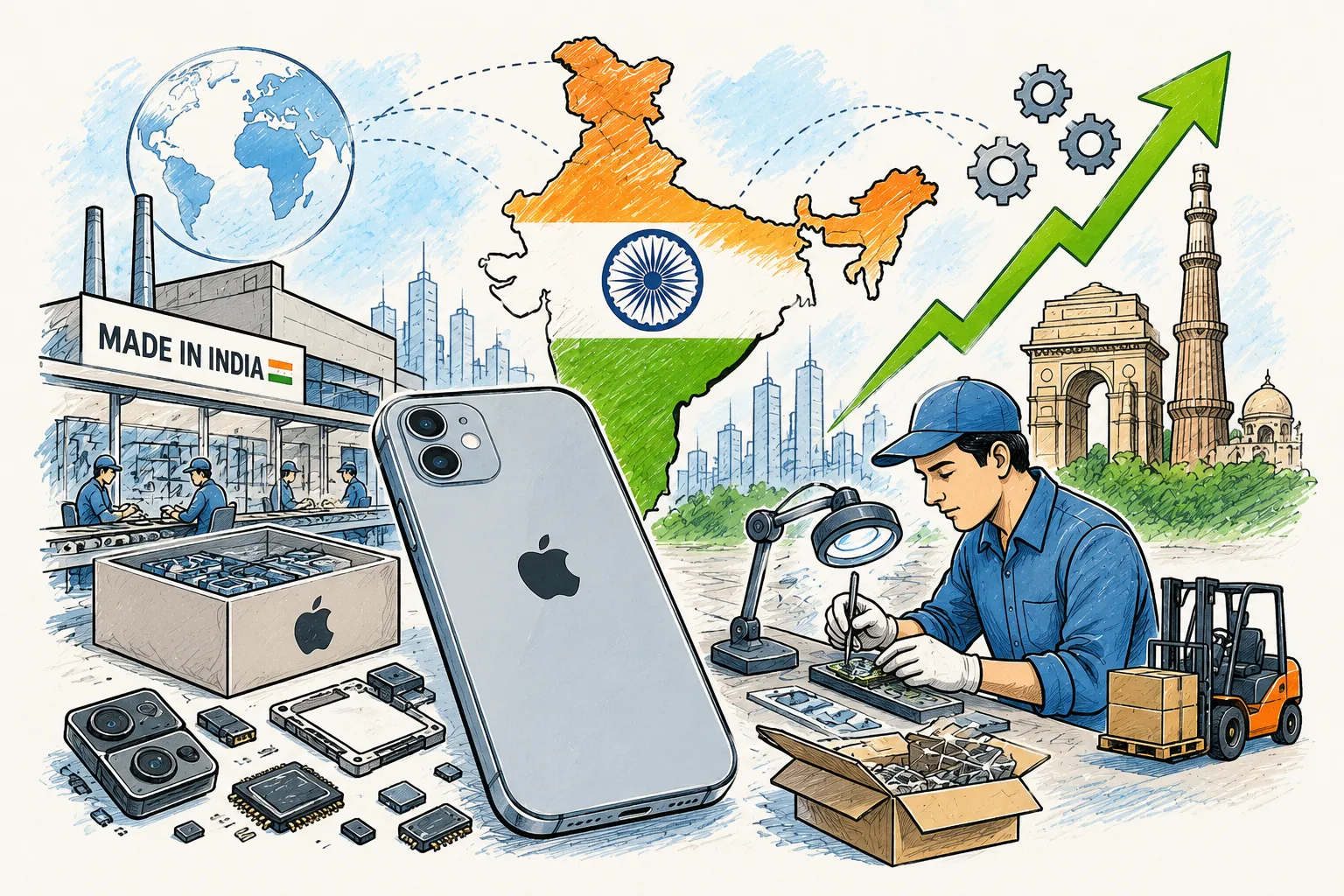
India is pushing Apple’s supplier network towards local component and sub-assembly production, backed by the new ₹62,500 crore Mobile Phone Manufacturing Scheme that rewards domestic sourcing and deeper electronics value addition.
India’s effort to expand its role in Apple’s manufacturing ecosystem is moving beyond final phone assembly towards the components and sub-assemblies that account for a larger share of value creation.
The policy backdrop is the Mobile Phone Manufacturing Scheme, or MPMS, notified by the Ministry of Electronics and Information Technology on 21 August. The scheme carries a ₹62,500 crore budgetary outlay and is designed to support manufacturing scale, domestic value addition, supply-chain depth and global competitiveness.
The current focus is not a confirmed announcement that Apple will begin making iPads, MacBooks, Apple Watches or another specific product in India. Instead, the reported push is for Apple suppliers to expand local production of parts that can serve both Indian facilities and Apple’s wider global manufacturing network.
MPMS adds an incentive for local sourcing
The MPMS will run for five years, from FY 2026–27 to FY 2030–31. Its first target segment covers mobile-phone manufacturing, including eligible registered electronics manufacturing services providers.
Under this segment, the scheme provides incentives ranging from 2.25% to 5%. It also offers an additional incentive of up to 1.5% for qualifying domestic sourcing of key components and sub-assemblies.
The added benefit has a specific localisation condition. The identified components and sub-assemblies must be locally sourced for at least 25% of the total mobile-phone units manufactured during a financial year.
That design is important because it rewards more than a rise in final assembly volumes. It creates a policy incentive for firms to build or procure more of the production ecosystem within India, including the parts and intermediate systems needed to assemble mobile devices.
The government has projected about ₹39 lakh crore in cumulative mobile-phone production during the scheme period and around 60,000 direct jobs. These are programme projections, not current outcomes and not estimates limited to Apple or its suppliers.
Apple supplier activity is the immediate focus
Reports indicate that India is encouraging Apple and its manufacturing partners to widen local component production before any broader expansion of final assembly for additional Apple product categories.
Foxconn, Tata Electronics, Motherson, Jabil, Salcomp, Aequs, TRIL Bangalore and Yuzhan Technology are among the companies referenced in reporting around the Apple supplier ecosystem in India. Their inclusion should not be read as confirmation of a fresh Apple contract, scheme approval or earnings benefit for any individual company.
According to the reports, some supplier facilities in India already produce components and sub-assemblies for export to Apple manufacturing hubs in China and Vietnam. The reported items include printed circuit-board assemblies, flexible PCBAs, mechanical parts, housing, conductive graphite buttons, wires and packaging materials.
This export-linked activity helps explain the policy emphasis on components. India’s role in a global electronics supply chain can increase not only through final-device assembly, but also by supplying intermediate inputs used across manufacturing locations.
However, the reports do not disclose Apple-specific order values, component volumes, investment commitments, production targets or a timeline for further localisation. Those details remain unavailable.

Beyond iPhones remains an expectation, not a commitment
Apple began assembling iPhones in India in 2017 and subsequently expanded its manufacturing presence through suppliers including Foxconn and Tata Group entities.
On 21 August, Electronics and IT Minister Ashwini Vaishnaw said the government expected Apple to broaden its India manufacturing footprint beyond iPhones. He did not identify the products, companies, factories, production start dates or investment amount involved.
That distinction matters for readers following Apple India manufacturing news. The government’s expectation of broader manufacturing cannot be presented as an Apple confirmation that a new product category will be assembled in India.
Similarly, the MPMS applies to mobile-phone manufacturing. Its notification should not be treated as a direct incentive programme for all Apple product lines. Any future expansion involving tablets, computers, wearables or other devices would require separate, verifiable company or government disclosures.
What the localisation push means for Indian markets
The immediate market relevance is sectoral rather than company-specific. A policy framework that rewards domestic sourcing could improve the operating environment for eligible electronics manufacturing and component suppliers, subject to customer demand, scheme eligibility and execution.
For share market investing, it is important to distinguish between policy support and a verified business outcome. The notification does not confirm that a specific listed company has secured a new Apple order, qualified for an incentive, raised production or improved its earnings outlook.
Motherson is referenced in supplier-related reporting and is a listed Indian company, but there is no verified disclosure in the available information tying the latest policy development to a specific contract, order value or revenue contribution for the group.
No share-price movement, trading volume or index impact should be inferred from the supplier reports. Such data would need separate verification from NSE or BSE at the time of publication.
Also Read: HAL, Safran Finalise Aravalli Engine Contract for IMRH
Local value addition is the key measure
The MPMS signals that India’s electronics policy is increasingly focused on the depth of domestic manufacturing, rather than only the number of finished devices assembled locally.
For Apple’s ecosystem, that could mean a wider opportunity for India-based facilities to supply components and sub-assemblies to domestic plants as well as overseas production centres. The actual scale will depend on supplier execution, technical capability, customer sourcing decisions and compliance with the scheme’s localisation conditions.
Readers who wish to access listed manufacturing and electronics stocks must open demat account online through a regulated market intermediary. That market-access step is separate from evaluating whether a policy change creates a direct business benefit for any particular company.
The latest development is therefore best viewed as a policy-supported push for deeper participation in Apple’s supply chain. It is not yet a confirmed announcement of new Apple product assembly, supplier contracts or near-term financial gains for named Indian companies.