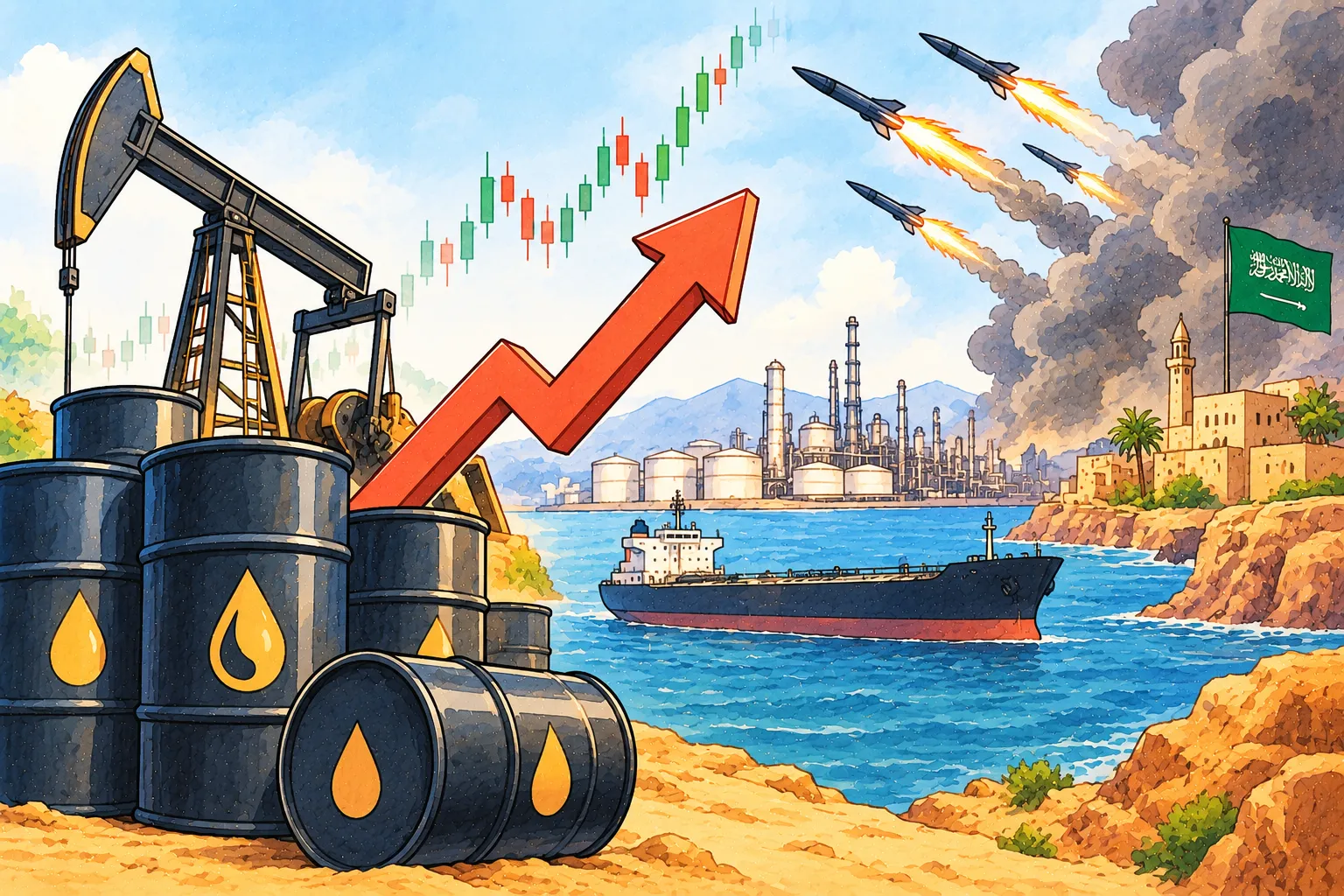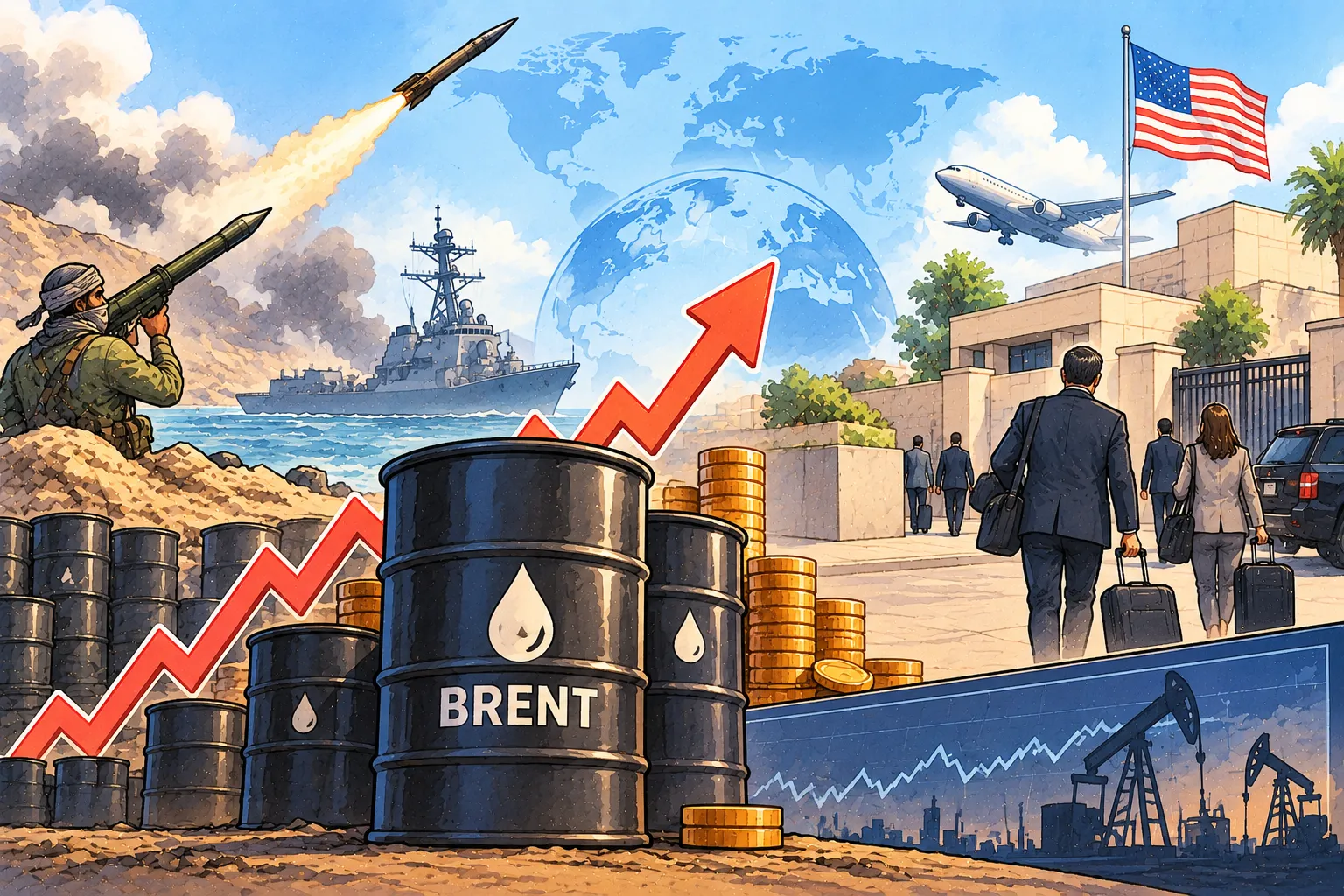
Brent crude rose 1.2% to $110.11 a barrel early Thursday after Houthi strikes in Saudi Arabia killed three people. Washington ordered some diplomats and families out of its Saudi missions, adding to supply risk worries.
Oil Price Moves on Thursday
Oil prices rose on Thursday, October 22, as more Houthi attacks in Saudi Arabia led the United States to order some diplomats and family members to leave its missions in the Kingdom. Brent crude futures rose $1.29, or 1.2%, to $110.11 a barrel at 00:34 GMT. US West Texas Intermediate crude gained 97 cents, or 1%, to $98.12.
| Benchmark | Thursday, 00:34 GMT | Change |
| Brent crude futures | $110.11 a barrel | Up $1.29, or 1.2% |
| US West Texas Intermediate | $98.12 a barrel | Up 97 cents, or 1% |
The gap between the two benchmarks was about $12 a barrel. Brent had settled largely unchanged on Wednesday, while WTI had eased 67 cents. On Tuesday, Brent touched a five-month high of $111.99 before settling lower.
Saudi Strikes and the US Response
The Houthis, an Iran-aligned group in Yemen, struck several targets on Wednesday. At least one person was killed and eight wounded at a civilian airport in Dammam, and two people were killed in a drone attack on a Saudi oil field. The US State Department plans to withdraw family members from a number of other US missions in the region, US officials told Reuters.
Separately, Iranian media reported explosions in Sirik in southern Iran on Wednesday, and said the nature and origin of the blasts were unknown.
Iran’s Position and Shipping Risk
Iran’s Foreign Minister Abbas Araqchi told the Financial Times that Iran was fully prepared to defend itself. President Masoud Pezeshkian told state media that the United States could not expect dialogue while it blockades and threatens Iran.
Kpler data showed at least 18 attacks on shipping over the past two weeks. LSEG analysts warned that Iran was targeting tankers well beyond the Strait of Hormuz, reaching into the Gulf of Oman. That puts Gulf crude loadings and the ship-to-ship transfers that support regional loadings at risk.
US Inventories and Policy Response
US government data on Wednesday gave a mixed picture for the oil market. Crude inventories fell by more than analysts expected, while diesel and heating oil stocks rose when a draw was expected.

| US Energy Information Administration data | Actual | Reuters poll expectation |
| Crude stocks | Down 3.06 million barrels to 412.5 million | Down 820,000 barrels |
| Distillate stocks | Up 1.68 million barrels to 104.3 million | Down 1.16 million barrels |
The US Department of Energy said on Wednesday that the Trump administration is offering to loan up to nearly a third of the 1-million-barrel US emergency heating oil reserve. The aim is to contain prices that have surged on diesel shortages linked to the wars involving Iran and Ukraine.
On the Ukraine front, Russian President Vladimir Putin hosted US Special Envoy Steve Witkoff in St Petersburg on Wednesday. The Kremlin said Putin had agreed to resume US-mediated peace talks with Ukraine as soon as next month.
How This Reaches Indian Markets
Indian markets open on Thursday against a weak global backdrop. Business Standard’s live coverage said the GIFT Nifty indicated a negative open on Thursday and that Asian markets were lower on concern over the AI trade. On Wednesday, the Sensex fell for a second day to end 143 points lower, with the Nifty at 22,811 and the volatility index up 6%.
Crude is also a factor in the bond market. Dealers told Business Standard that rising crude prices and US Treasury yields were putting government bonds under selling pressure, and that the benchmark 10-year yield closed at 7.44% on Wednesday. India imports nearly 85% of its crude oil requirement, according to ThePrint, so a sustained rise in Brent feeds into the import bill and the rupee.
Also Read: eMudhra Hits 20% Lower Circuit After Browsers Block 8 CAs
Developments to Track
Four items will shape the next moves in crude. These are whether Saudi Arabia and independent sources confirm the extent of damage at the targeted oil field, the count of attacks on shipping through the Gulf of Oman and the Strait of Hormuz, the take-up of the US heating oil loans, and whether the Ukraine peace talks resume next month as the Kremlin indicated.