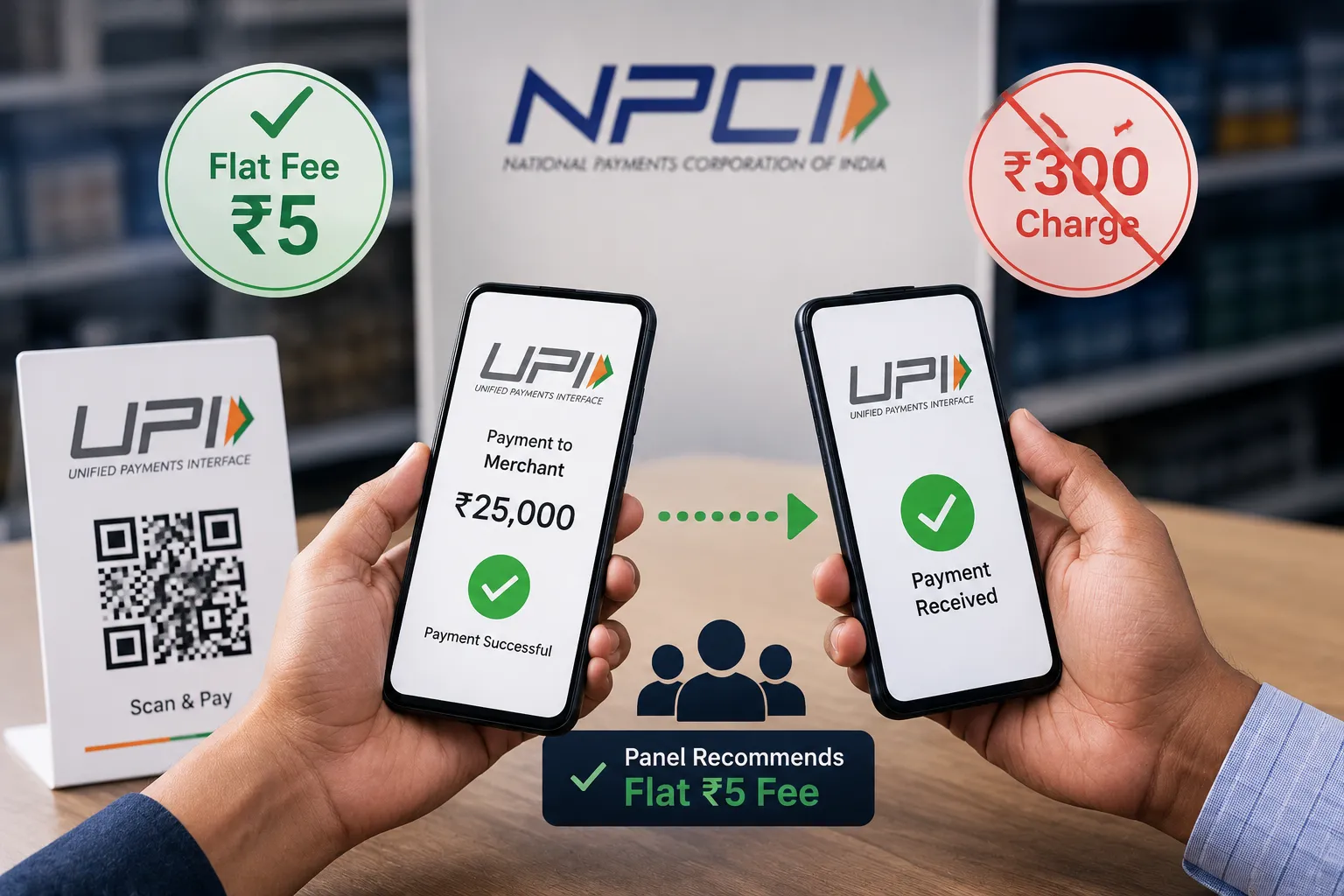
A flat ₹5 merchant discount rate is likely for merchant-to-merchant UPI payments, according to people aware of the matter. The fee is far below the up to ₹300 traders feared, and the start date is not fixed.
What Is Reported
Merchant-to-merchant (M2M) transactions on the Unified Payments Interface (UPI) are set to attract a flat fee of ₹5 under the new merchant discount rate (MDR) framework, according to two people aware of the matter. The charge is significantly lower than the amount of up to ₹300 that traders had feared. The decision was taken by the UPI and Services Steering Committee of the National Payments Corporation of India (NPCI), the people said.
The flat rate would apply to payments between merchants, such as those between wholesalers and retailers, on business-to-business (B2B) marketplaces and in B2B collections. Another report said the proposal was cleared by the steering committee about a month ago and has not yet been formally notified. NPCI has not publicly confirmed the ₹5 rate, so it remains a proposal that rests on sources until an official notification is issued.
What the Fee Would Have Been
The reason for the relief among traders is the arithmetic of the standard MDR. In September, NPCI announced a rate of 0.4% on person-to-merchant (P2M) payments above ₹2,000, capped at ₹300 per transaction for payments of ₹75,000 or more. That framework did not set a separate rate for merchant-to-merchant payments.
The average ticket size of payments between merchants on UPI is about ₹20,000 to ₹40,000. At 0.4%, these payments would have attracted charges of ₹80 to ₹160. A payment of ₹75,000 or more would have reached the ₹300 maximum.
| Payment size | Fee at 0.4% (capped at ₹300) | Reported flat fee for M2M |
| ₹20,000 | ₹80 | ₹5 |
| ₹40,000 | ₹160 | ₹5 |
| ₹75,000 or more | ₹300 | ₹5 |
Why Traders Pushed Back
The All India Consumer Products Distributors Federation (AICPDF) has written to Finance Minister Nirmala Sitharaman seeking an exemption for M2M transactions from the MDR framework. In its letter, the federation said that about 65% of consumer payments received by retailers, and 40% to 45% of payments made by retailers to distributors against credit bills, are settled through UPI.
The federation argued that additional charges at both levels would directly affect the financial viability of retailers and distributors. It also asked the government to examine the goods and services tax (GST) implications of MDR. A person aware of the discussions said the point is valid but that the decision rests with the GST Council, not with NPCI or the Reserve Bank of India.
Earlier, retail trader bodies had called for a “No UPI Day” on October 2 in protest, and AICPDF had estimated that the fee could add ₹7,000 crore to ₹9,000 crore in annual costs across the FMCG distribution and retail ecosystem. The protest was withdrawn after the bodies met the finance minister.
The Framework So Far
MDR is the fee a merchant pays to its bank or payment service provider for processing each digital payment. Consumers do not pay it. NPCI’s September framework set out three main categories:

- Standard P2M rate: 0.4% on eligible payments above ₹2,000, capped at ₹300
- Flat ₹5 rate: For payments above ₹2,000 in select categories such as railways, telecom, insurance and fuel
- Capital markets rate: 0.02%, capped at ₹300, for payments to mutual funds, securities and stockbrokers
UPI payments of up to ₹2,000 and person-to-person transfers remain free. NPCI said app providers will not be allowed to charge customers a platform fee on UPI transactions.
The framework was scheduled to take effect on October 15. On October 13, NPCI said the rollout would be deferred for the festive season and would start immediately after Diwali, on a date to be notified separately. No revised date has been announced.
Who Could Be Affected
A flat ₹5 fee on merchant-to-merchant payments would keep the cost of settling wholesale invoices over UPI very low, even for large tickets. Wholesalers and retailers that route a large share of their payments through UPI would face a cost that does not rise with the size of the payment.
Payment companies such as Paytm and Pine Labs were among the stocks flagged in market previews on Thursday after the report. How the MDR is shared among banks, payment service providers and apps is decided under the framework’s fee-distribution mechanism, and the reports reviewed do not describe the split for the ₹5 fee.
What Remains Unclear
Several points are still open. The formal notification of the ₹5 rate has not been issued, and the implementation date for the wider MDR framework has not been announced. The earlier reporting also said the steering committee was considering exempting businesses with annual turnover of up to ₹40 lakh from MDR, and the final position on that has not been confirmed in the reports reviewed.
Until NPCI issues a notification, merchants and payment companies are working with a reported figure and not an official one. The reported ₹5 rate narrows the gap between what traders feared and what the committee is said to have decided, but the formal rules will determine who pays and from when.