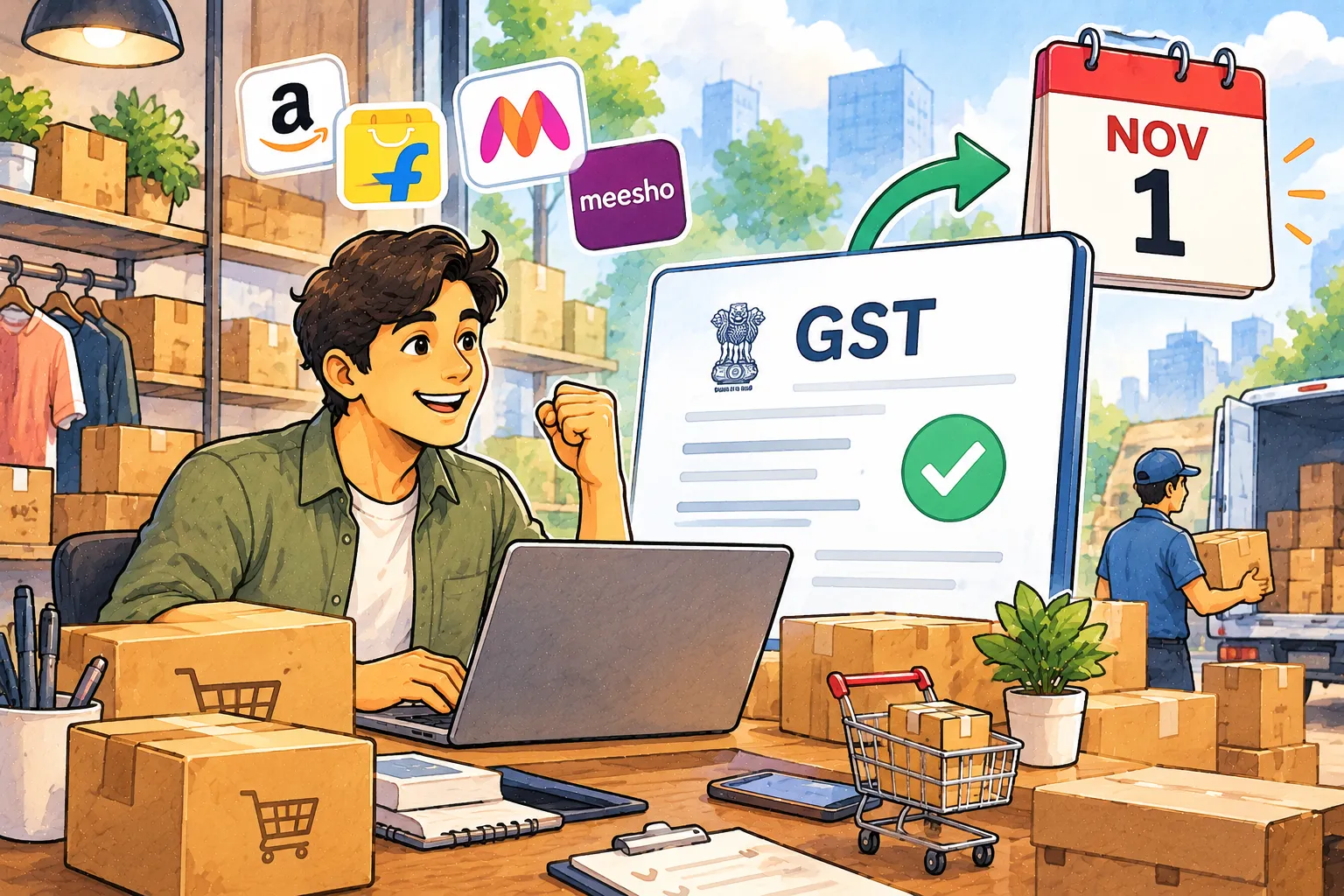
Small e-commerce sellers will get a simplified GST registration route from November 1, a finance ministry official said on October 22. Eligible sellers can register in other states using the platform’s warehouse as their business address.
What the Government Announced
A senior finance ministry official said on Thursday, October 22, that the simplified goods and services tax (GST) registration facility for small e-commerce sellers will be enabled from November 1. The facility was recommended by the 57th GST Council meeting held on October 8, and detailed notifications are expected soon.
The Council proposed an optional registration mechanism under a new Rule 14B of the Central Goods and Services Tax (CGST) Rules, 2017. The reform is part of a wider package of GST process changes covering registration, returns, refunds and adjudication, which will be rolled out in phases.
How Rule 14B Works
Under the new route, small sellers of goods who supply exclusively through electronic commerce operators (ECOs) can register in other states by declaring the e-commerce platform’s warehouse as their principal place of business. In plain terms, a seller does not need to rent or set up its own premises in each state where its stock is stored.
The conditions attached to the facility are specific:
- Optional route: sellers can choose it rather than being required to use it
- Goods only: it is meant for small sellers of goods supplying exclusively through e-commerce operators
- Credit cap: it is available only to sellers who pass on input tax credit of not more than ₹2.5 lakh a month
- Limited use: the registration can be used only for supplies made through e-commerce platforms
- Platform consent: the consent of the e-commerce operator will be obtained through the system
Input tax credit is the tax a business has already paid on its purchases, which it can set off against the GST it collects on sales. The ₹2.5 lakh monthly limit on the credit a seller passes on is the main eligibility test the reports describe.
Why Small Sellers Hesitate to Expand
The problem the rule is meant to solve is a compliance barrier. Small e-commerce sellers are generally reluctant to expand beyond their home state because of the compliance requirement, especially the registration process. Selling into another state through a platform typically means holding stock in that state, which in turn calls for a registration there.
Prashanth Agarwal, a partner at Price Waterhouse & Co LLP, described the move as a significant reform that could benefit the wider economy by encouraging small sellers to expand beyond their home states. He said registration requirements had discouraged many small sellers from selling nationally, and that enabling e-commerce platforms to support sellers through the GST Network (GSTN) portal could simplify the process and encourage wider adoption.

Agarwal also suggested that the government monitor how widely the scheme is adopted, track the expansion of small sellers, and assess and publish its benefits over time.
Other Process Reforms in the Same Package
The e-commerce registration rule is one of several process reforms the 57th GST Council approved. Others reported as likely from November 1 include faster refunds, standardised documentation for registration, and a minimum threshold of ₹10,000 for issuing show-cause notices.
| Reform | Reported Timing |
| Simplified registration for small e-commerce sellers | From November 1, 2026 |
| Faster refunds | Likely from November 1, 2026 |
| Standardised registration documentation | Likely from November 1, 2026 |
| ₹10,000 minimum threshold for show-cause notices | Likely from November 1, 2026 |
| Reforms needing GST law amendments | April 1, 2027 |
An official said reforms that can be carried out through administrative measures are expected to take effect from November 1, 2026, while those that need amendments to GST law are slated for April 1, 2027. A comprehensive circular is also expected to specify the documents and information needed for GST registration, and the GST portal is to offer a more user-friendly interface with drop-down lists and tooltips. The aim is to reduce rejections and queries on registration applications and speed up processing.
Also Read: Brent Crude Holds Near $113 After Five-Month High as Houthi Attacks on Saudi Arabia Rattle Supply
What It Means for the E-Commerce Ecosystem
For small sellers, the practical change is that the registration burden of selling across states becomes lighter. For platforms, the mechanism gives them a role, since the operator’s consent is part of the process and the platform’s warehouse becomes the declared place of business.
The reform is also a reminder of how tax administration shapes online retail. Rules on where a seller must register decide how easily a small business can reach customers in other states, so changes of this kind can affect how many sellers choose to sell nationally.
Several details are still to come. The official said detailed notifications will follow, so the exact procedures and forms will become clear only once they are issued. Sellers and platforms should wait for those notifications and check the GST portal before acting, because the final mechanics may differ in detail from the summary of the Council’s recommendation.