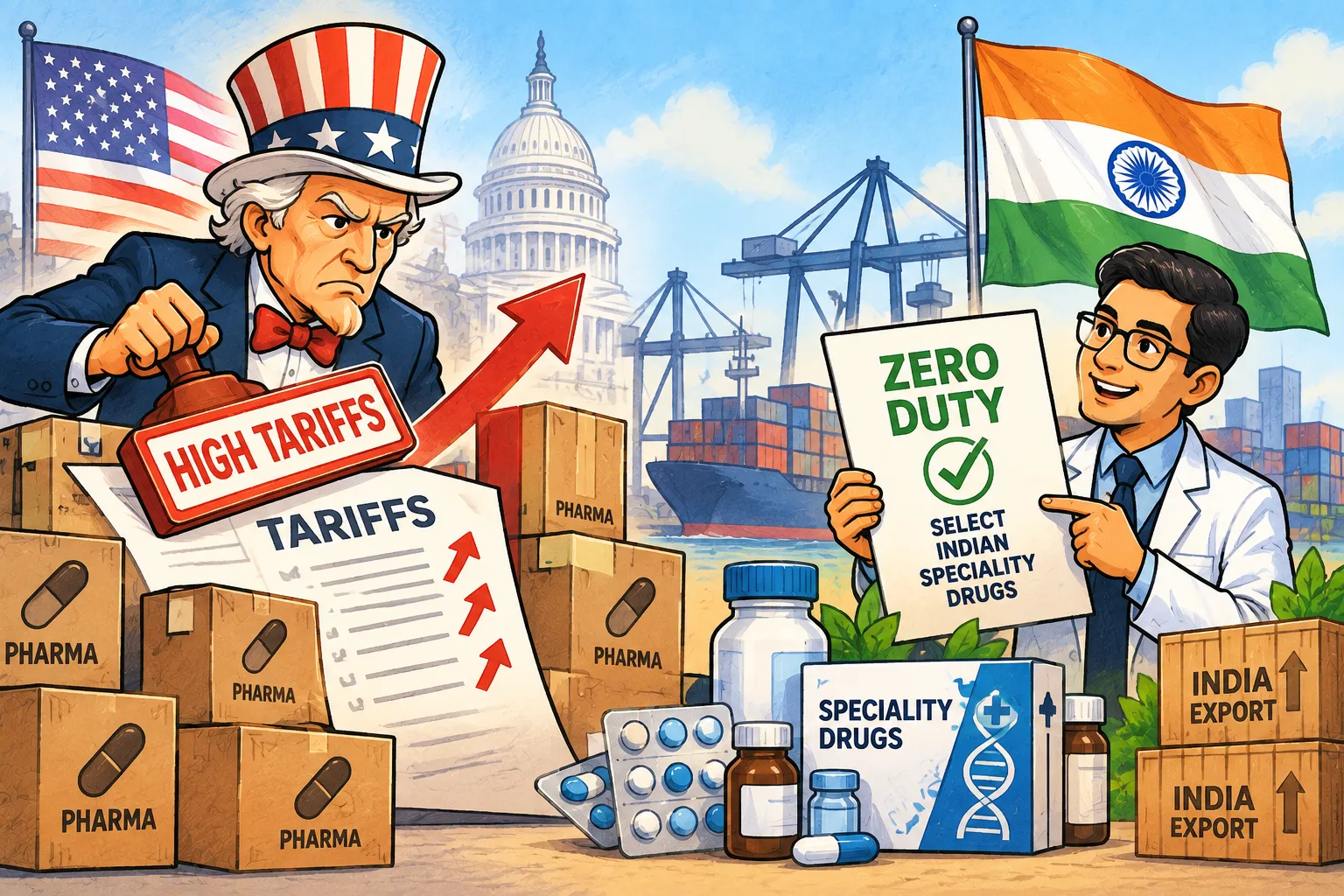
The US's 100% tariff on patented pharmaceutical products expands to more companies from Tuesday, but India is among 20 jurisdictions granted zero-duty treatment for a specific list of speciality medicines, while ordinary generic drugs remain outside the tariff entirely.
What Changed Today
The US's 100 per cent tariff on specified patented pharmaceutical products and their associated ingredients took effect for more companies on Tuesday, under Section 232 of the US Trade Expansion Act of 1962. The tariff was first announced by President Trump in April to encourage domestic pharmaceutical manufacturing; it took effect on July 31 for companies covered under one annex to the proclamation, and now extends from September 29 to other companies within the regime's scope.
The US Department of Commerce's Bureau of Industry and Security, in a September 23 Federal Register notice, listed India among 20 jurisdictions eligible for zero-tariff treatment on qualifying speciality pharmaceuticals. The other 19 are Argentina, Bangladesh, Cambodia, Ecuador, El Salvador, the European Union, Guatemala, Indonesia, Japan, Jordan, Malaysia, North Macedonia, South Korea, Switzerland and Liechtenstein, Taiwan, Thailand, the UK, and Vietnam.
What Qualifies For Zero Duty
The exemption is narrowly scoped to specific speciality categories rather than pharmaceutical exports broadly. It covers rare-disease drugs where all approved uses are orphan indications, nuclear medicines using safe amounts of radioactive substances, plasma-derived therapies, fertility drugs, cell and gene therapies, and antibody-drug conjugates. It also extends to medical countermeasures for chemical, biological, radiological and nuclear threats, plus animal health products, and the ingredients used to make any of these.
The zero rate itself is conditional: the Commerce Department can apply it only if the products originate from a jurisdiction with a current or forthcoming trade and security framework agreement with the US, or if the products are deemed necessary to meet an urgent US health need.

Also Read: India's Housing Market Plateaus As Sales Hold At ₹3.63 Lakh Crore, MMR Overtakes NCR
What Still Faces The Full Tariff
This is not a blanket waiver for Indian pharma exports. Patented medicines that fall outside the specified zero-tariff categories continue to face the full 100 per cent tariff, unless they separately qualify for another exemption. Generic medicines, however, are treated quite differently: the Commerce Department notice explicitly states that generic pharmaceutical products and their associated ingredients are not covered by the Section 232 tariffs at all, whether or not they fall into the specified categories. Companies with approved arrangements to shift manufacturing to the US may also receive separate tariff treatment under the original April proclamation.
Why It Matters
Since India's pharmaceutical exports to the US are overwhelmingly generic drugs rather than patented speciality medicines, the practical bite of today's tariff expansion on Indian pharma exporters is likely to be limited, generics were never in scope to begin with, and India's most tariff-exposed patented categories now get a zero-duty carve-out rather than facing the full 100 per cent rate. That said, the relief is conditional on India's ongoing trade and security relationship with the US remaining intact, and it applies only to the specific categories listed, meaning any Indian company exporting patented medicines outside those categories still faces the full tariff with no relief in sight.