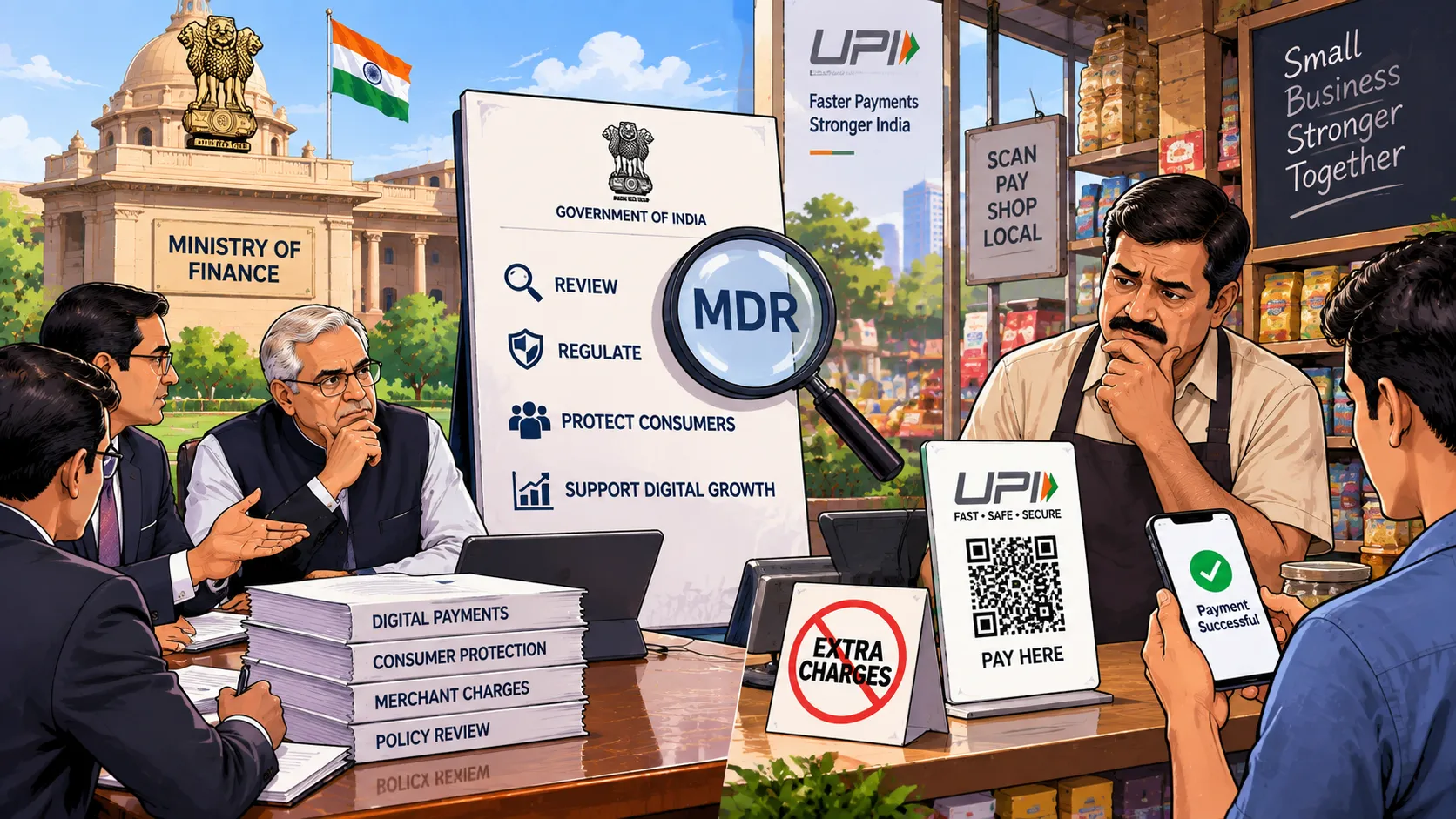
The finance ministry is considering a mechanism to monitor whether merchants pass the new UPI merchant discount rate on to customers when the 0.4 per cent charge takes effect on October 15.
What the Finance Ministry Is Considering
The government is examining a mechanism to monitor and ensure that merchant discount rate charges applicable on some UPI transactions from October 15 are not transferred to the consumer, a finance ministry official has said.
The concern being addressed is straightforward. Since the announcement of the merchant discount rate rollout, there have been fears that merchants will raise prices to recover the fee they pay to banks on eligible UPI transactions. Monitoring will be done to check that merchants are not passing on the charge to consumers, the official said, speaking on condition of anonymity.
Two gaps stand out in that plan. The official did not specify what mechanism the government is likely to implement. And by the official's own admission, no legal framework currently exists to curb anti-profiteering of this kind, which means any monitoring would start without a statutory basis to act on what it finds.
The Charges That Start on October 15
The National Payments Corporation of India issued its circular and a detailed FAQ document on the framework on September 15, 2026. The Department of Financial Services has published the FAQs on its website. The rates are as follows:
| Transaction type | Charge from October 15, 2026 |
| Person to person transfers, any amount | Nil |
| Person to merchant, up to ₹2,000 | Nil |
| Person to merchant, above ₹2,000 | 0.4 per cent |
| Person to merchant, ₹75,000 and above | Capped at ₹300 per transaction |
| Merchants receiving up to ₹1 lakh a month via UPI | Fully exempt |
On those rates, a ₹3,000 eligible payment carries a charge of ₹12 and a ₹50,000 eligible payment carries ₹200. Above ₹75,000 the cap takes over, so a ₹2 lakh payment also carries ₹300 rather than 0.4 per cent of the value.
The merchant discount rate is a processing fee that sits inside the payment ecosystem and is distributed among participating entities such as banks, payment service providers and payment application providers. Operational parameters, fee distribution and category-wise caps are to be decided by the UPI and Services Steering Committee, which the National Payments Corporation of India heads.
The framework also carries an effective date gap of one month between the circular and implementation, which the payments industry has been given to make the operational changes at the bank, aggregator and application level.
An 18 Per Cent GST Applies on Top of the MDR
The government will charge 18 per cent Goods and Services Tax on the merchant discount rate, the finance ministry official said. Businesses registered under GST should then be able to claim input tax credit on the tax paid.
That distinction matters for who actually bears the cost. A GST-registered merchant can set the tax component off against its output liability. A merchant outside the GST net cannot, so for that category the tax is an absolute cost rather than a pass-through entry.

The GST Council may take up the matter later if required, the official said, without confirming whether it will feature on the agenda for the Council's meeting on October 7.
Why the Government Says the USTR Report Is Not the Reason
The rollout has drawn allegations that it was introduced to address United States concerns about access to India's payments market. The official rejected that, and the Department of Financial Services also addressed it in a post on X on Thursday.
The department said allegations in the media referencing the United States Trade Representative report of 2026 were being used to claim external pressure. The USTR report had raised two issues: that US electronic payment services suppliers cannot participate in the UPI ecosystem, and the 30 per cent market share limitation the National Payments Corporation of India applies to third-party application providers.
On the first, the department said the September 15 circular does not permit credit transactions on UPI through any card network other than RuPay. On the second, it said the 30 per cent cap was introduced in November 2020 and its implementation was deferred because smaller companies lacked a self-sustaining revenue model to compete with market leaders. The introduction of the merchant discount rate, the department said, is intended to let more domestic companies expand their operations.
Also Read: RBI Drains ₹50,000 Crore in First of Three Bond Sales
What Does Not Change
For the ordinary UPI user, the official position is that nothing changes. Consumers will continue to transact free of cost, and person-to-person transfers remain free regardless of amount.
The government expects a major portion of merchant transactions to remain free of the charge because of the exemptions attached, and says roughly 96 per cent of person-to-merchant transactions fall outside its scope. The official also said UPI transaction volumes are not expected to fall after the rollout.
That expectation is being tested in the market already. Delhi retailers have said publicly that the new charges on high-value merchant payments squeeze their margins, and some have said they may push customers towards cash. Separately, cash in circulation has grown 12.5 per cent even as UPI volumes have expanded, which is the counterfactual the ministry's monitoring plan will have to contend with.