
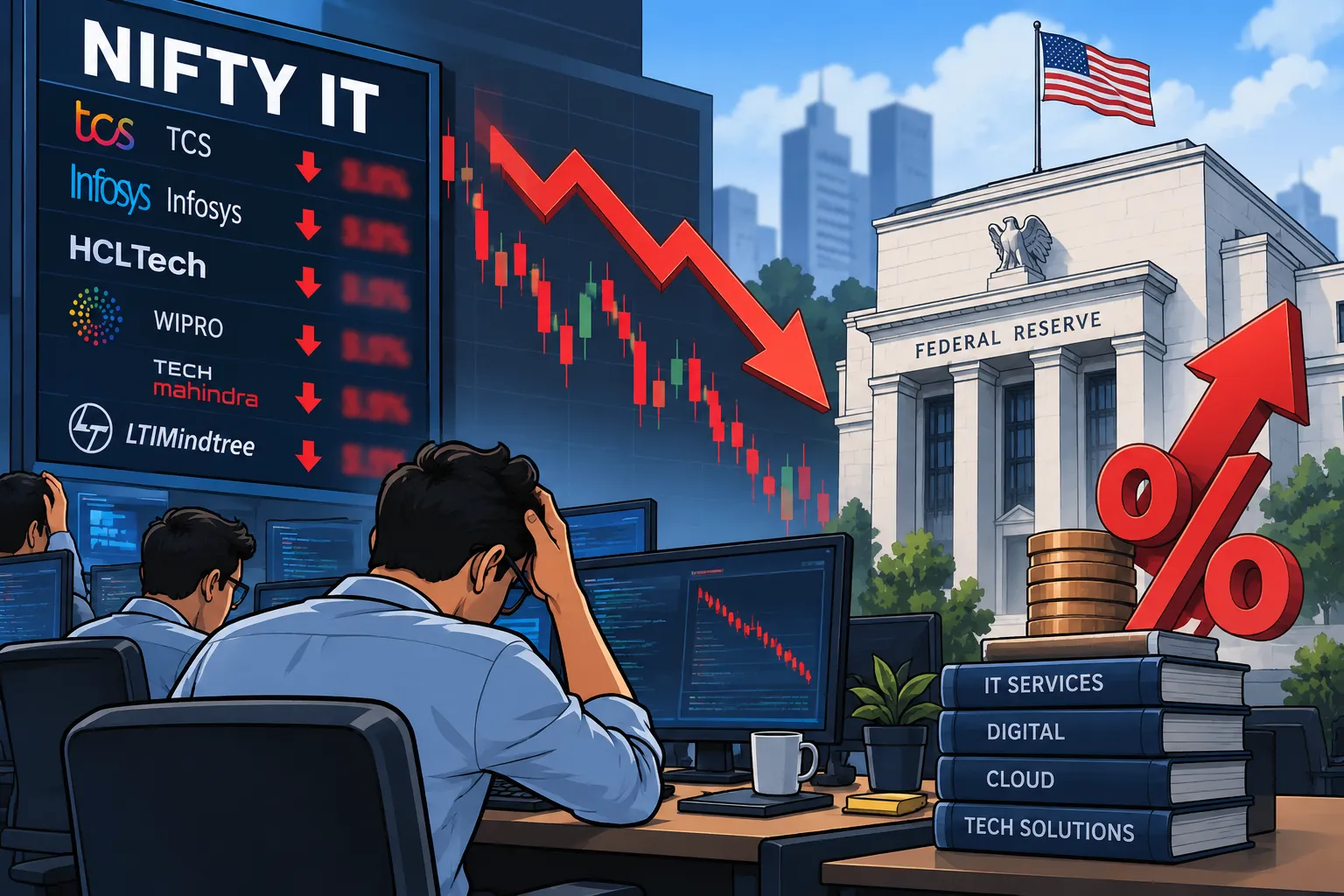
Indian technology shares faced sharp intraday selling on September 7, with the Nifty IT index falling as much as 2.36% to 29,979 by around 11:32 am.
The decline was steeper than the broader market’s move. At the same time, the Nifty 50 was down 0.55% at 23,765, pointing to selling pressure concentrated in information-technology stocks.
The immediate macro trigger was stronger-than-expected US employment data released on September 4. The report lifted market expectations that the US Federal Reserve could raise interest rates at its September 15–16 policy meeting, reviving concerns about global technology valuations and discretionary spending by US clients.
The Federal Reserve has not announced a rate increase. The September 7 reaction reflected changing market expectations, rather than a confirmed policy action.
US payroll surprise changes rate expectations
The US Bureau of Labor Statistics reported that non-farm payroll employment rose by 162,000 in August, while the unemployment rate remained unchanged at 4.1%.
The payroll increase was higher than the 56,000 jobs forecast in a Reuters poll of economists. The data prompted investors to reassess the likelihood of a near-term Federal Reserve rate increase.
Reuters reported that short-term interest-rate futures implied about a 59% probability of a US policy-rate increase at the September meeting after the jobs report. That was up from around 55% before the employment data was released.
The 59% figure is a futures-market estimate, not a confirmation of what the Federal Reserve will decide. It can change before policymakers meet on September 15 and 16.
US equity markets had already turned lower after the August payroll release. On September 4, the Dow Jones Industrial Average fell 0.51%, the S&P 500 declined 0.38% and the Nasdaq Composite lost 0.29%.
Infosys and Tech Mahindra lead IT-sector weakness
The selling extended across large-cap and mid-cap technology stocks.
Infosys fell as much as 2.61% to ₹1,100.50 in intraday trade. Tech Mahindra declined 1.92% to ₹1,566.20, while HCLTech, Tata Consultancy Services and Wipro also traded lower.
Among other IT names, LTM fell as much as 2.25% to ₹4,451.10. Mphasis declined 2.18% to ₹2,369.10, while Oracle Financial Services Software dropped 2.04% to ₹11,812.
Persistent Systems was down 1.67% and Coforge declined 1.80% in intraday trade. These are time-specific market figures, not closing prices or final daily percentage changes.
Earlier in the session, Nifty IT was down 1.27% at 30,306.15 around 9:18 am. At 9:40 am, the index was down 1.87% at 30,122.25 before it fell further in late-morning trade.

Why higher US rates weigh on IT sentiment
Indian IT-services companies have substantial exposure to US clients. As a result, shifts in US rate expectations can influence investor assessments of technology valuations and the outlook for spending on discretionary digital projects.
Higher interest-rate expectations can push up bond yields and weigh on technology valuations globally. Technology companies are often viewed as more sensitive to discount-rate changes because a larger share of their perceived value is linked to future earnings.
For Indian IT exporters, tighter US financial conditions can also raise concerns about client spending. This remains a sentiment risk, however, not evidence that US clients have already reduced budgets or that Infosys, TCS, HCLTech, Wipro or Tech Mahindra has revised guidance.
The September 7 session shows how global rate expectations can affect stock market trading in export-oriented Indian IT companies, even when there is no new earnings release, deal announcement or regulatory disclosure from the affected firms.
Other concerns remain background factors
The stronger US jobs report was the immediate macro trigger behind the rate-expectation shift. Indian IT sentiment has also been influenced by technology-spending visibility, AI-led changes in traditional services work, currency movements and profit booking after a recent rally.
These are background considerations, not confirmed explanations for the precise movement in every IT stock on September 7. No new India-specific earnings update, contract announcement, guidance revision or regulatory development was identified as the main trigger for the sectoral fall.
India VIX rose 1.69% to 10.86 in intraday trade, showing higher market volatility. Yet market breadth was marginally positive, with 1,514 stocks advancing, 1,356 declining and 254 unchanged.
That contrast suggests the sell-off was concentrated in IT stocks rather than spread evenly across the Indian equity market.
Also Read: Maruti Suzuki Raises Select Car Prices by Up to ₹20,000
Inflation data and the Fed are next checkpoints
The next important macro event is US August inflation data, due later in the week. The release may influence futures-market expectations before the Federal Reserve’s September 15–16 policy meeting.
For investors holding IT shares in a demat account, it is important to distinguish a short-term reaction to changing US-rate expectations from company-specific operating disclosures. The immediate rate-probability shift does not establish a change in individual IT companies’ revenue, margins, deal conversion or client demand.
The Nifty IT decline therefore represents a macro-driven repricing of rate expectations. Further clarity will depend on incoming US data, the Federal Reserve’s eventual decision and subsequent disclosures from Indian IT companies.