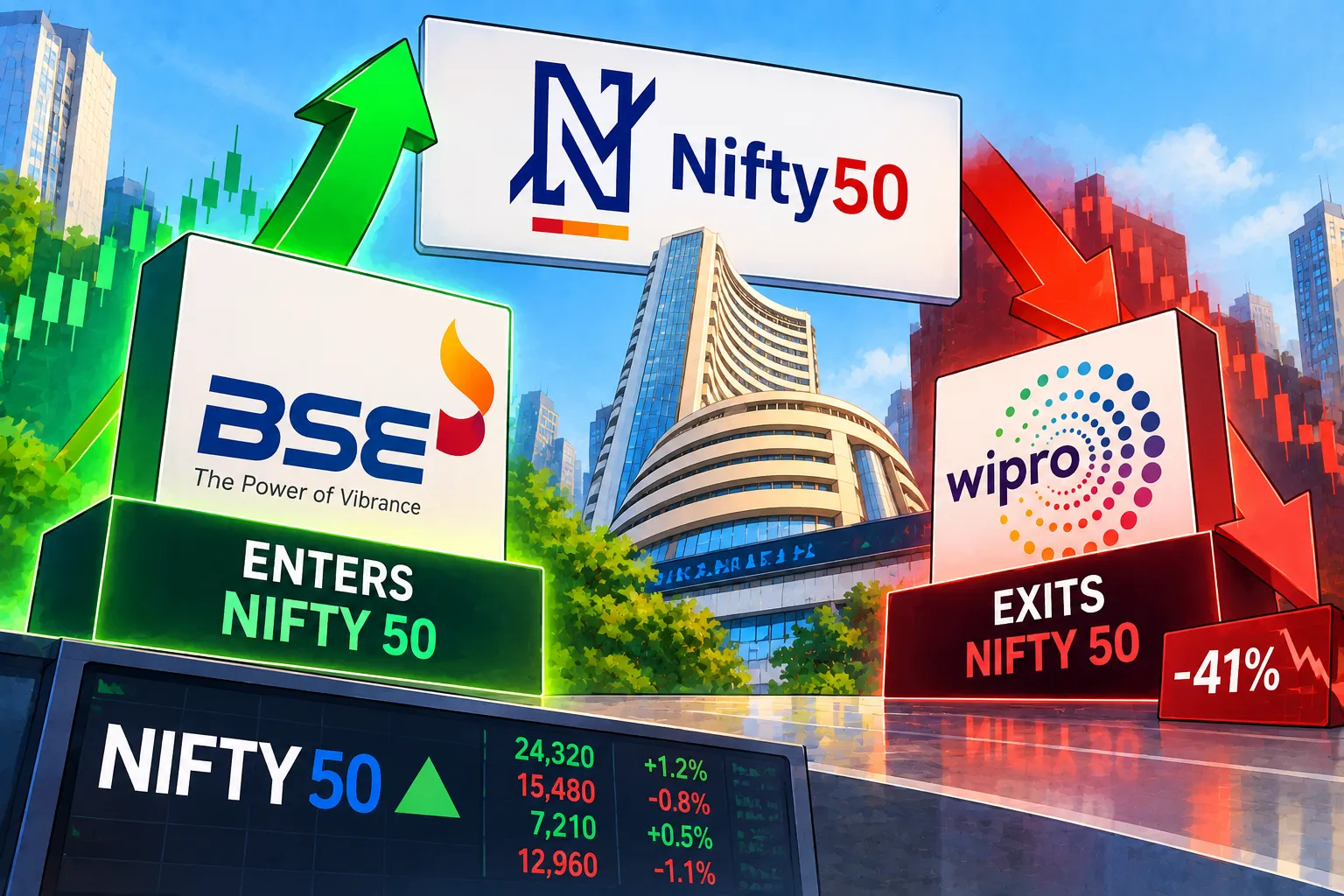
BSE has entered the Nifty 50 index in place of Wipro as part of NSE's semi-annual rejig effective today, with Nuvama estimating $668 million in passive inflows for BSE against Wipro's 41% year-to-date decline, even as brokerages remain sharply split on BSE's own valuation.
The Swap And Why It Happened
As part of NSE's semi-annual index rejig effective September 30, BSE, India's oldest stock exchange, has replaced IT major Wipro in the flagship Nifty 50 index. NSE said in an August communication that BSE's six-month average free-float market capitalisation of ₹1.4 trillion is at least 1.5 times that of Wipro, the smallest existing constituent, whose free-float market cap stood at ₹55,930 crore, triggering the automatic swap under NSE's index methodology.
According to Nuvama Alternative & Quantitative Research estimates, the rejig could bring passive inflows of $668 million into BSE and $230 million into Wipro despite its exit, reflecting how index funds rebalance around the changeover date itself. Ahead of the rejig, BSE closed 3.3 per cent higher on Tuesday, while Wipro fell 2.9 per cent.
The Stock Stories Behind The Swap
Wipro shares have lost 41 per cent so far this year, hit hard by the broader tech-stock selloff driven by AI-led deflation fears and the risk of a sustained high-interest-rate environment. BSE, by contrast, has gained 20 per cent year-to-date as of September 29, even after losing 7 per cent over just the past month.
Brokerages are notably split on BSE's outlook. Macquarie recently initiated coverage with an "outperform" rating and a ₹4,000 target price (a 40x FY29E EPS multiple), ranking BSE above NSE in its capital-market stock pecking order and describing it as a "challenger" gaining share in a market with 12 per cent total-addressable-market CAGR, projecting 16 per cent FY26-30E revenue growth and margins moving toward 70 per cent. Jefferies and Nuvama take the opposite view: Jefferies rates BSE "underperform" with a ₹2,940 target, and Nuvama downgraded it to "hold," cutting its target from ₹4,090 to ₹3,240, both citing risks from a higher Securities Transaction Tax, new RBI bank-guarantee norms, and falling options volumes following the rollout of the closing auction session (CAS). Jefferies noted that options average daily turnover for both NSE and BSE fell 14 per cent and 12 per cent respectively month-on-month in August, with the decline steepening to 20-23 per cent in the second week after CAS took effect versus the first week.
Disclaimer: Views, ratings and price targets cited from Macquarie, Jefferies and Nuvama belong to those firms and are not endorsed by this publication; investors should conduct their own due diligence.

Beyond The Nifty 50: Wider Index Changes
The rejig also affects other Nifty indices. Within the existing Nifty 50, Adani Enterprises, Adani Ports, Bajaj Finance and JSW Steel gain weight, with estimated inflows of $71 million, $35 million, $10 million and $10 million respectively, while 16 stocks face weight-reduction outflows, led by Reliance Industries (an estimated 89millionoutflow) and HDFCBank(56 million).
In the Nifty Next 50, Vedanta Aluminium, Polycab, Wipro, Hitachi Energy India and Vodafone Idea exit, replaced by Indian Hotels, United Spirits, REC Limited, Lodha and Shree Cement. The Nifty Midcap 150 sees 13 entrants, including Aster DM, Embassy Office Parks REIT, Meesho and Narayana Hrudayalaya, while 3M India, ACC, Apollo Tyres, Honeywell Automation and others exit. The Nifty 500 and Nifty Smallcap 250 see 27 and 33 entrant-exit changes respectively, per NSE's circular.
Also Read: Blockbuster IPOs, Lacklustre Returns: 7 Of 11 Mega Issues Trade Below Issue Price
Why It Matters
A stock exchange itself, BSE, entering the flagship index of its rival exchange, NSE, is a notable symbolic moment on top of the mechanical passive-flow implications, underscoring how much BSE's own market performance has recovered even as questions persist about its near-term earnings trajectory under CAS-related volume pressure. The scale of disagreement between Macquarie's bullish call and Jefferies/Nuvama's bearish stance, a roughly ₹1,060 gap between the highest and lowest price targets, signals genuine uncertainty about how much of BSE's recent rally reflects durable structural share gains versus a rebound that could reverse if the volume and regulatory pressures both brokerages flagged persist.