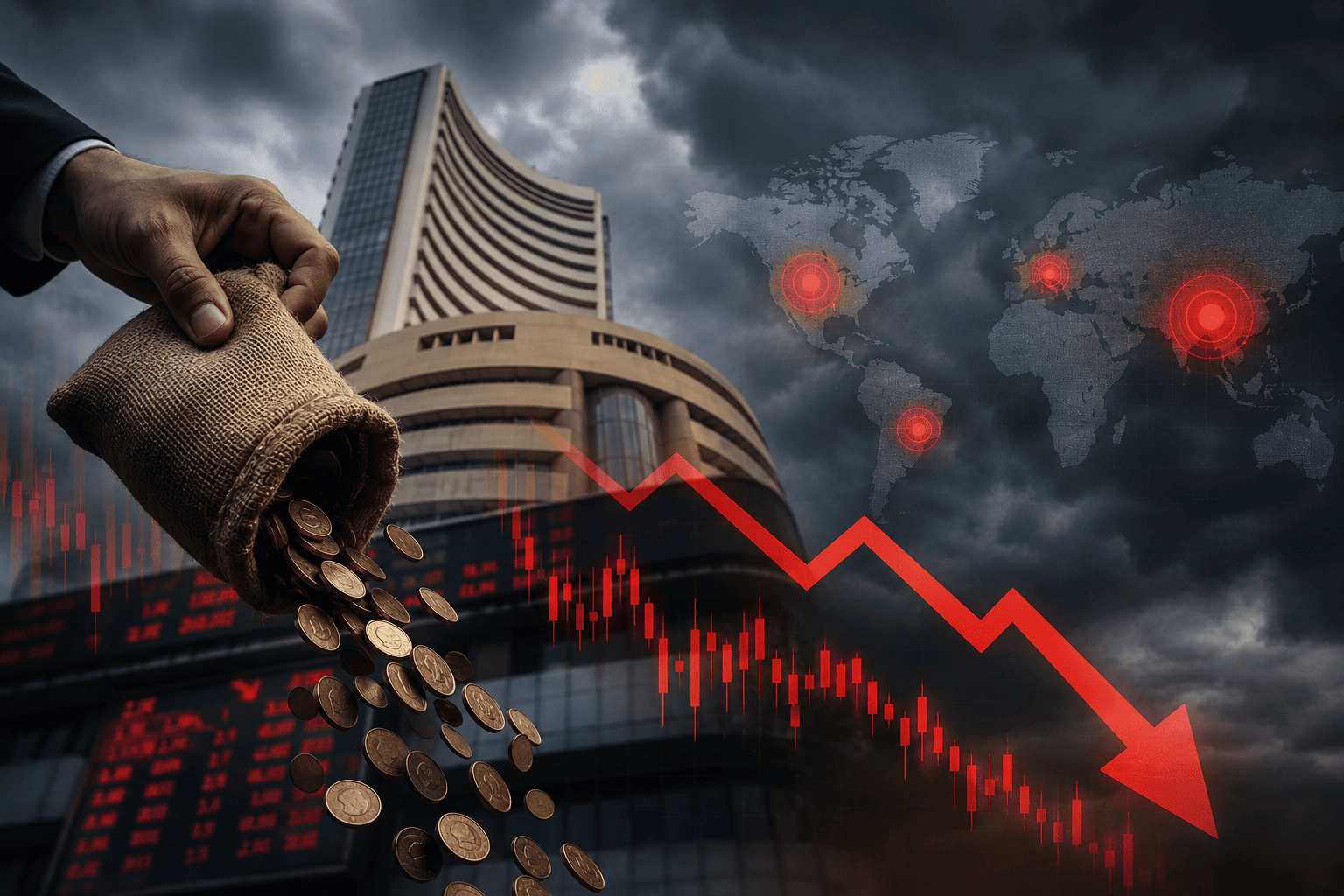
Foreign institutional investors have turned bearish on Indian equities, pulling out a massive ₹5,400 crore from local markets last week as global monetary policy concerns intensify and the US dollar strengthens against emerging market currencies.
What's driving the stock market today?
The sudden reversal in foreign investor sentiment stems from a cocktail of global headwinds that have made emerging markets less attractive. US Treasury yields have surged past 4.8% on the 10-year note, the highest level in six months, as markets reassess Federal Reserve policy expectations. This yield spike has strengthened the Dollar Index (DXY) to 105.2, making dollar-denominated assets more attractive than emerging market equities.
The timing couldn't be more challenging for Indian markets. While the Sensex managed to close Friday's session at 74,850, down just 0.8% for the week, the underlying pressure from foreign selling was evident across mid-cap and small-cap segments. The Nifty MidCap 100 index fell 2.3% during the same period, while the SmallCap 100 dropped 3.1%, highlighting how overseas investors are retreating from riskier segments of the Indian market.
Adding to the pressure, crude oil prices have climbed back above $85 per barrel on Middle East tensions, creating a double whammy for India's import-dependent economy. The Indian rupee has weakened to 83.15 against the dollar, its lowest level in two months, as foreign exchange outflows accelerate.
Impact on Indian markets
The ₹5,400 crore outflow represents the largest weekly FII selling spree since January 2024, when similar global uncertainties had triggered a brief correction in Indian equities. However, the impact has been cushioned by robust domestic institutional investor (DII) buying, which pumped in ₹3,800 crore during the same period.
Market breadth has deteriorated significantly, with the advance-decline ratio on NSE falling to 0.6:1 last week. This suggests that the selling pressure is broad-based rather than concentrated in a few heavyweight stocks. Banking stocks, which constitute nearly 35% of the Nifty 50, have shown resilience with HDFC Bank and ICICI Bank losing less than 1% each, thanks to their strong domestic franchise.
The rupee's weakness has created a mixed impact across sectors. While IT services companies like TCS and Infosys have seen mild gains due to currency tailwinds, import-heavy sectors like automobiles and consumer durables have faced margin pressure. Those looking to open demat account and participate in equity markets should be aware of these cross-currents affecting different sectors differently.
Stocks and sectors in focus
The selling pattern reveals clear preferences among foreign investors. Export-oriented mid-cap stocks, particularly in textiles, chemicals, and pharmaceuticals, have borne the brunt of the outflows. Stocks like Divi's Laboratories and Aurobindo Pharma have declined 4-6% as FIIs reassess valuations amid currency headwinds.
Conversely, defensive large-cap stocks with strong domestic demand drivers have shown relative outperformance. FMCG giants like Hindustan Unilever and Nestle India have held steady, while telecom leaders Bharti Airtel and Reliance Industries have seen only modest declines.
Market experts suggest that the current stock investment landscape favors companies with strong pricing power and domestic revenue visibility. Stocks like Asian Paints, Bajaj Finance, and Avenue Supermarts have demonstrated resilience during previous FII selling phases.
What should investors do?
Veteran market analysts recommend a cautious but opportunistic approach. "This is typical emerging market behavior during US rate uncertainty," says a senior equity strategist at a leading domestic brokerage. "Quality large-caps with domestic demand drivers should weather this storm better than export-dependent mid-caps."
For retail investors using any trading platform, the current volatility presents both risks and opportunities. Dollar-cost averaging into quality names during market dips has historically proven rewarding, but timing the market bottom remains challenging.
The key metric to watch is the sustainability of DII flows. If domestic institutions continue their buying spree, it could offset FII selling pressure. However, if crude oil prices spike further above $90 per barrel, it could trigger additional selling from price-sensitive foreign funds.
Investors should also monitor the upcoming RBI monetary policy meeting scheduled for early June. Any hawkish signals about interest rates could further impact market sentiment, while a dovish stance might attract some foreign flows back.
Key Takeaways
This article is for informational purposes only and does not constitute investment advice.