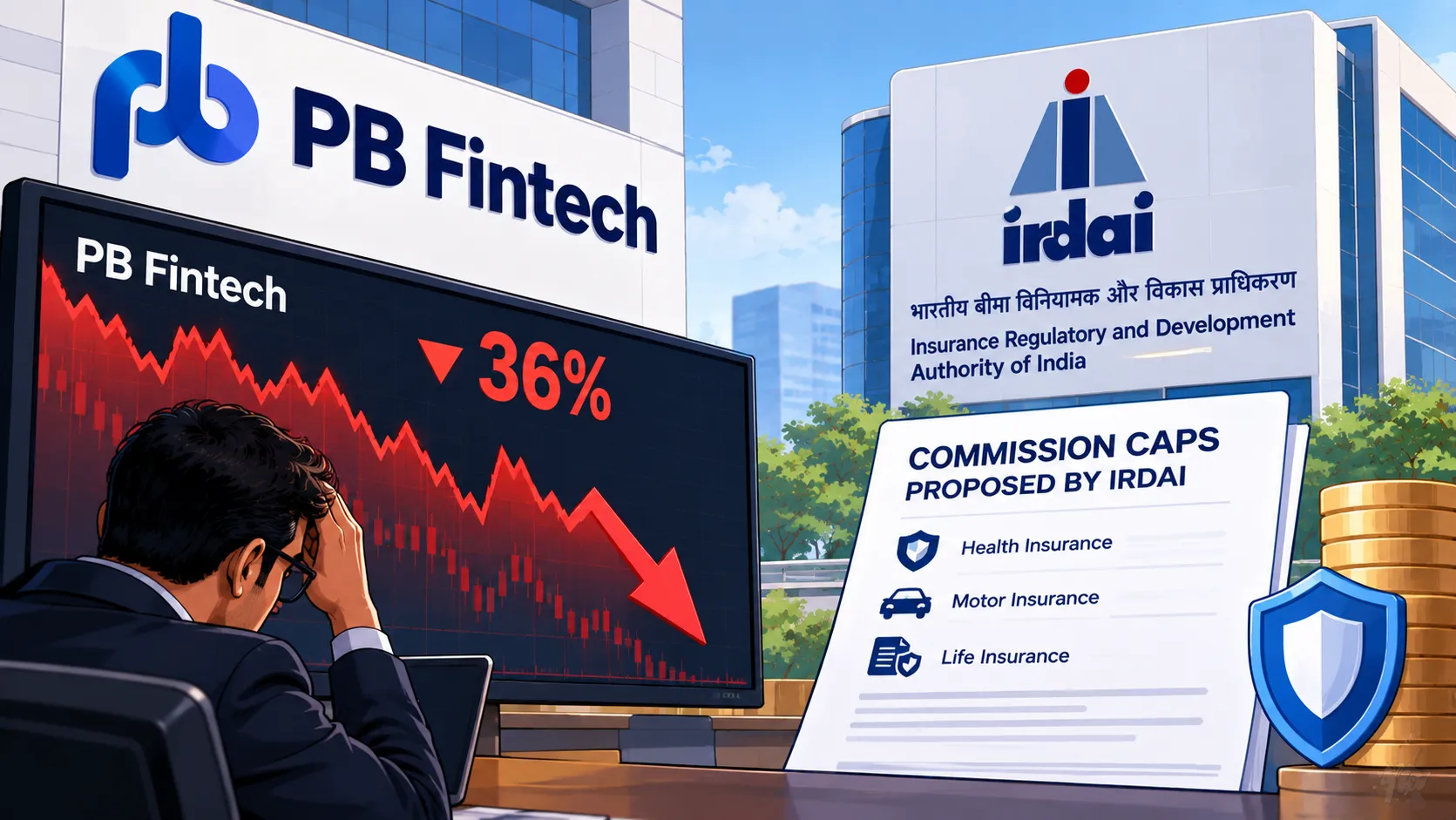
Insurance stocks fell sharply on September 24, 2026, after Irdai proposed lower expense limits and product-wise commission caps for insurers. PB Fintech, parent of Policybazaar, slumped as much as 36%, as investors weighed the hit to distribution economics.
Insurance Stocks Sell Off a Day After the Irdai Paper
The Insurance Regulatory and Development Authority of India (Irdai) released a consultation paper titled "Recalibrating Economics of Insurance Distribution" on Wednesday, September 23. By Thursday morning, listed insurers and insurance distributors were among the biggest losers on Dalal Street.
The sharpest falls came in companies that earn most of their revenue from selling insurance rather than underwriting it:
- PB Fintech fell as much as 36% during Thursday's session. It touched about ₹1,207 on NSE and a fresh 52-week low of ₹1,210 on BSE.
- Turtlemint Fintech Solutions hit its 20% lower circuit at about ₹109.
- Max Financial Services fell roughly 10 to 11% in intraday trade.
- HDFC Life Insurance declined more than 5%.
Other insurers also traded lower, including SBI Life, ICICI Prudential Life and Star Health. The fall was not uniform, though. Distribution platforms dropped far more than insurers, as investors separated companies by how heavily their revenue depends on commissions.
What Irdai Has Proposed on Expenses of Management
The first pillar of the Irdai paper targets expenses of management (EoM). EoM is the regulatory ceiling on how much an insurer can spend on commissions and operating costs as a share of premium.
| Insurer type | Proposed EoM limit in 2 years | Proposed EoM limit in 5 years |
| Life insurers | 15% of gross direct premium income | 12.5% |
| General insurers | 25% | 20% |
For general insurers, the current cap is 30% of gross written premium. Irdai has also proposed changing the base for this calculation to domestic gross direct premium income.
According to Irdai, lower EoM limits are meant to reduce the overall cost of insurance for buyers and improve the value policyholders receive, particularly in life insurance savings products. The regulator has proposed a phased timeline to balance these goals against insurers' financial sustainability.
New Commission Caps by Product and Channel
The second pillar is a fresh commission framework. Today, payouts are set largely by each insurer's board-approved policy. Irdai instead wants limits set according to five factors:
- The insurance segment
- The line of business
- The distribution channel
- Product complexity
- The effort involved in selling and servicing a policy
For individual linked and non-linked life insurance products, the proposed first-year commission range is 5% to 20% for distribution entities and 6.25% to 25% for agents, depending on the premium payment term. Longer payment terms attract the higher end of the range.
In general insurance, Irdai has proposed little or no commission for mandatory covers such as motor third-party insurance. For many digital and bank-led distribution models, this is a meaningful change.

Curbs on Mis-selling and Dark Patterns
Irdai's paper goes beyond payouts. It includes a set of conduct measures aimed at the way insurance is sold:
- A ban on compulsory bundling of insurance with loans or credit products
- A prohibition on "dark patterns", which are design tricks on insurance websites and apps that nudge buyers into choices
- Restrictions on volume-linked and reward-linked incentives for staff who sell insurance
- Mandatory disclosure of commission policies by insurers and large distribution entities in simple language
For policyholders, these measures are designed to reduce mis-selling and make the cost of cover more transparent at the point of sale.
Why Distributors Took the Biggest Hit
For an insurer, lower commission caps mean lower acquisition costs, which can partly offset the pressure from tighter EoM limits. For a distributor such as PB Fintech or Turtlemint, commission is the product. Any cap on the payout per policy feeds directly into revenue.
That difference explains why the distribution platforms fell far more than the insurers themselves. Lenders with large bancassurance businesses also came into focus. Bancassurance refers to banks selling insurance policies to their customers, typically in return for commission from the insurer.
Also Read: NSE Shares List at ₹1,800 on BSE After ₹22,562 Crore IPO
A Consultation Paper, Not a Final Rule
The Irdai proposals are open for stakeholder comments and are not yet binding regulations. The final framework could change after industry feedback, and Irdai has built phased transition timelines into the expense proposals.
For listed insurance companies, the areas to monitor as the final rules take shape include:
- Commission expenses
- New business margins
- Product mix
- Customer acquisition costs
For distributors, the key detail will be the final commission ceilings for each product and channel. Those ceilings will determine how much of the current business model survives the reset.