
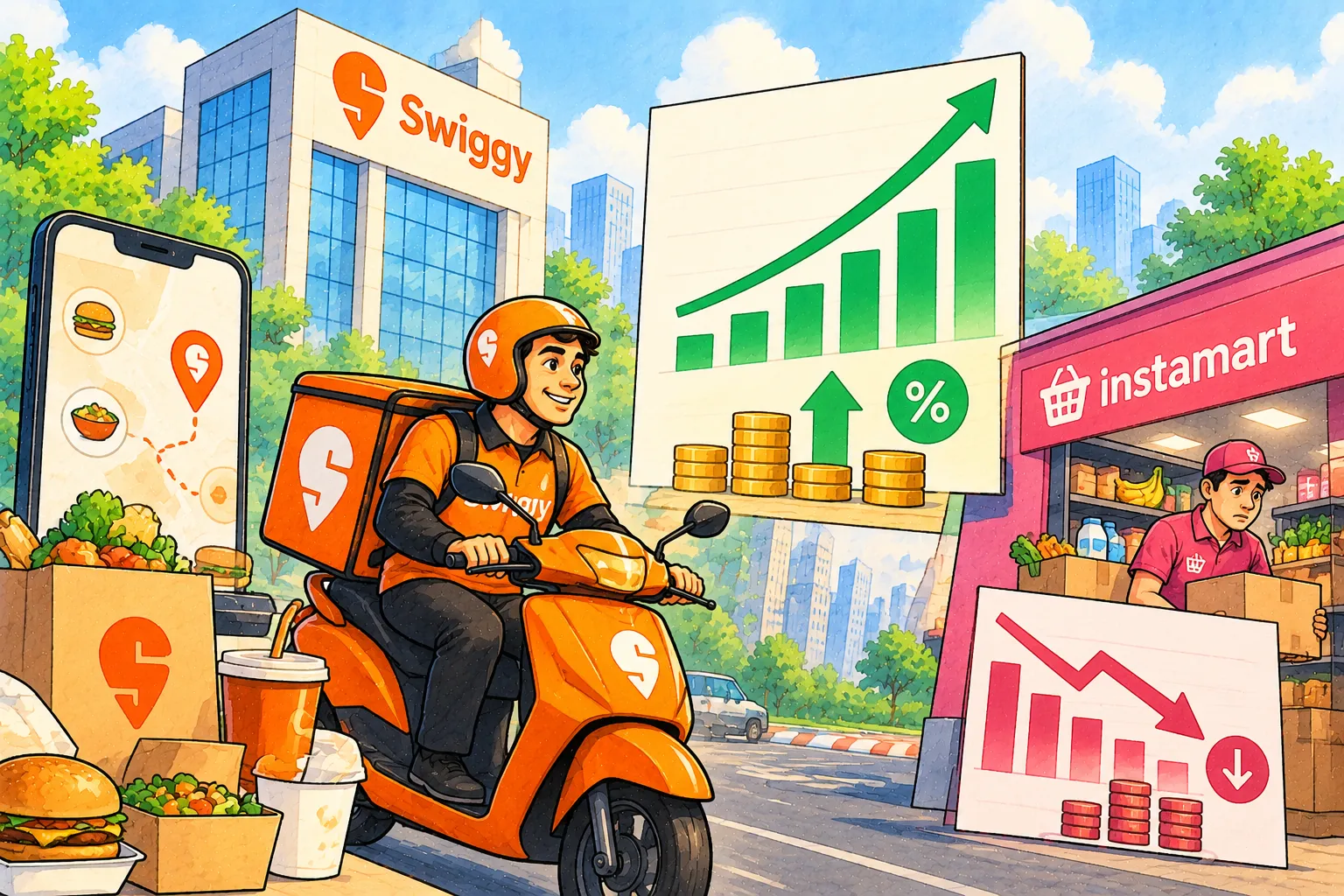
Swiggy reported a Q2 FY27 consolidated net loss of ₹922 crore on October 22, down from ₹1,092 crore a year earlier, as revenue rose 36% to ₹7,571 crore. Food delivery profit hit a record, but Instamart losses widened.
The Headline Numbers
Swiggy’s consolidated net loss for the July to September quarter of 2026-27 stood at ₹922 crore, a 15.6% improvement from the ₹1,092 crore loss in the same quarter last year. Revenue from operations rose 36.1% to ₹7,571 crore from ₹5,561 crore, according to the company’s regulatory filing reported on Thursday, October 22.
The year-on-year picture improved, but the quarter-on-quarter picture did not. The loss widened from ₹791 crore in the June quarter, while revenue grew from ₹6,812 crore.
| Metric | Q2 FY27 | Q2 FY26 |
| Revenue from operations | ₹7,571 crore | ₹5,561 crore |
| Total income | ₹7,783 crore | ₹5,620 crore |
| Total expenses | ₹8,703 crore | ₹6,711 crore |
| Consolidated net loss | ₹922 crore | ₹1,092 crore |
Total expenses climbed to ₹8,703 crore from ₹6,711 crore, which is the main reason the company stayed in the red even as the top line grew at more than a third. Swiggy’s consolidated adjusted EBITDA loss was ₹760 crore, which was ₹64 crore lower than a year earlier.
Food Delivery Posts Its Best Profit Yet
Swiggy’s food delivery business was the bright spot of the quarter. Its adjusted EBITDA rose by ₹101 crore year on year to a record ₹341 crore, up from ₹240 crore in the September quarter of last year. The company said its food delivery and out-of-home consumption businesses improved profitability during the period.
This matters because food delivery is the more mature of Swiggy’s two main platforms. Its rising profit shows that the older business is funding part of the heavy spending that quick commerce demands. Adjusted EBITDA is a measure that strips out certain non-cash and one-off items, so it is best read alongside the reported net loss rather than as a replacement for it.
Instamart Grows Faster but Loses More
Instamart, Swiggy’s quick-commerce arm, continued to expand quickly. Its gross order value rose 31.4% year on year to ₹9,230 crore, up 16.7% from the previous quarter. Net order value reached ₹6,594 crore, a 13.4% sequential increase.
The cost of that growth was visible in the losses. Instamart’s adjusted EBITDA loss rose to ₹895 crore, and the company added 69 dark stores during the quarter, taking its network to 1,240 stores. Dark stores are small fulfilment centres that serve only online orders, and each new one adds rent, staffing and delivery costs before it reaches steady volumes.

Swiggy also spent more on newer bets such as Toing, its budget food app, which contributed to the sequential widening of the loss.
What the Results Say About Swiggy’s Trade-Off
The quarter shows a company balancing two goals at once. On one side, Swiggy is trying to show that its core food delivery operation can earn a growing profit. On the other, it is spending heavily to build Instamart’s store network in a competitive quick-commerce market.
Swiggy had a market capitalisation of ₹58,353.03 crore on October 22, according to NSE data cited by Upstox. How the market reads the numbers will become clearer in the trading sessions ahead.
The key numbers to track in coming quarters, based on what Swiggy reported this time, are:
- Net loss trend: whether the quarterly loss narrows from ₹922 crore
- Food delivery adjusted EBITDA: whether it holds above the record ₹341 crore
- Instamart adjusted EBITDA loss: whether it eases from ₹895 crore as new stores mature
- Dark store count: growth beyond the current 1,240 stores
Also Read: Jio Platforms IPO Subscribed 5.57 Times on Day 2 as QIBs Bid 13.29x Ahead of Final Day Today
How This Compares With a Year Ago
A year earlier, Swiggy had reported a loss of ₹1,092 crore for the September 2025 quarter, with revenue up 54.42% to ₹5,561 crore. Instamart’s gross order value then grew 108% year on year to ₹7,022 crore. Revenue growth has therefore moderated from last year’s pace to 36%, while the loss has come down in absolute terms.
That contrast shows how the company has moved from very rapid expansion toward a slower but still strong growth rate. Whether the improving losses can continue while Instamart keeps adding stores is the central question the next set of results will begin to answer.