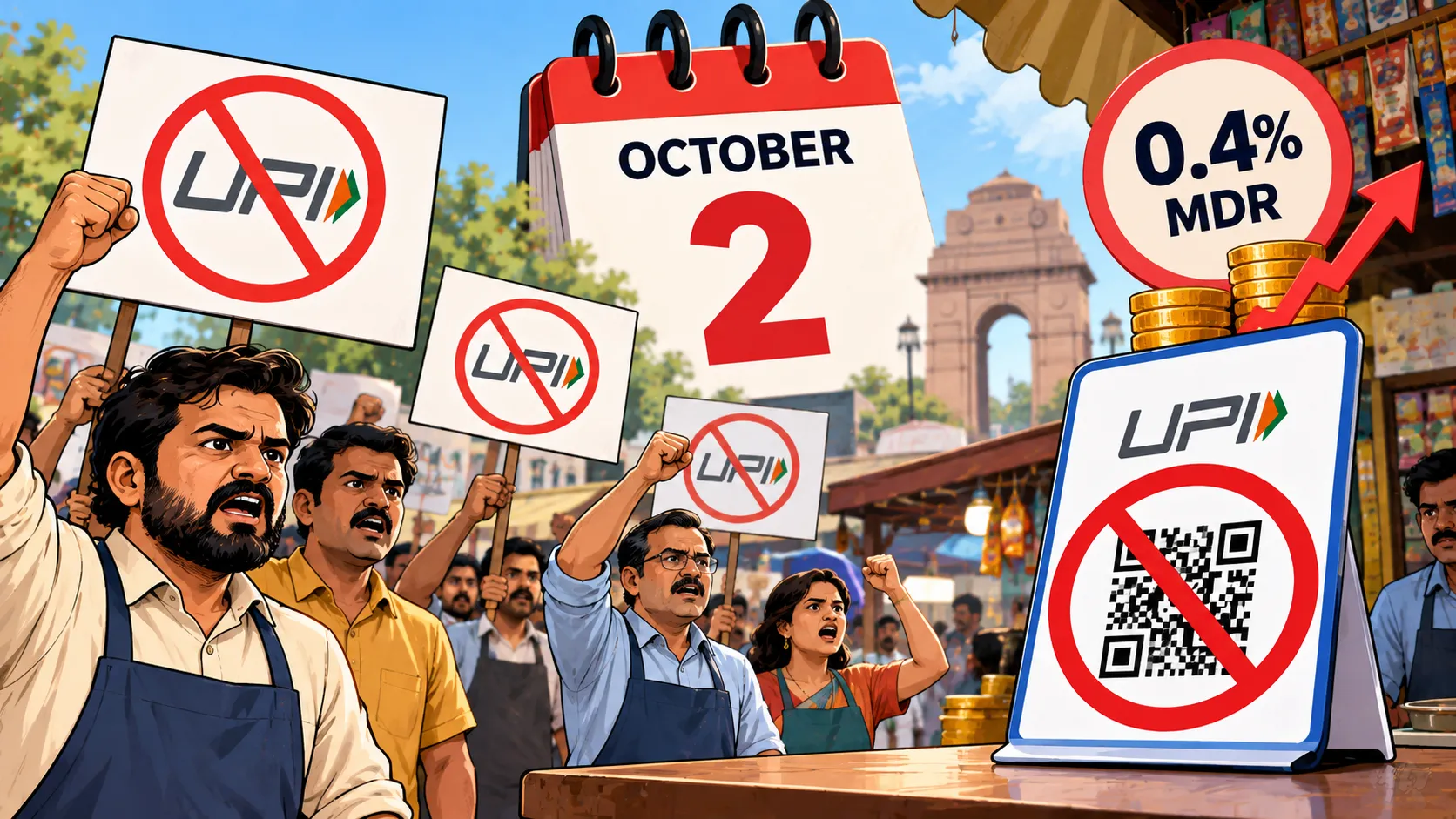
Trader and business associations plan to observe October 2 as a "No UPI Day" to protest a 0.4% merchant discount rate on UPI payments to merchants above ₹2,000. The charge is scheduled to take effect from October 15, 2026.
The October 2 Protest Plan
The Maharashtra Chamber of Commerce, Industry and Agriculture (MACCIA) has led the call for a No UPI Day. Its president, Ravindra Mangave, said the chamber had held discussions with trader associations beyond Maharashtra. He said the protest would be observed in other states as well.
As part of the protest, participating shopkeepers plan to cover UPI QR codes, scanners, sound boxes and other payment devices with black cloth. October 2 is Gandhi Jayanti, and the associations have framed the protest as a symbolic, non-violent form of dissent.
MACCIA and its affiliated associations also plan to meet the Maharashtra chief minister to place their demands. Trader groups have said further agitation could follow if the government does not address their concerns before the new charge comes into force.
What the New UPI MDR Covers
A merchant discount rate (MDR) is a fee that a merchant pays for accepting a digital payment. It is charged on the merchant's side of the transaction, not to the person paying. Until now, UPI payments have been free of MDR for merchants.
Under the framework scheduled to start on October 15, 2026, the fee applies only to a specific slice of UPI transactions:
| Type of UPI transaction | MDR from October 15 |
| Person-to-person (P2P) transfers, such as sending money to family or friends | Free |
| Person-to-merchant (P2M) payments up to ₹2,000 | Free |
| P2M payments above ₹2,000 | 0.4% of the transaction value, capped at ₹300 |
| Payments to small merchants in the person-to-person-merchant (P2PM) category, receiving up to ₹1 lakh a month through UPI | Free |
The ₹300 cap means the fee stops rising once a payment reaches ₹75,000, since 0.4% of ₹75,000 equals ₹300. The fee on a few sample purchases works out as follows:
| Purchase amount | MDR paid by the merchant |
| ₹5,000 | ₹20 |
| ₹50,000 | ₹200 |
| ₹75,000 or more | ₹300 (capped) |
The P2PM exemption is important for smaller businesses. Vendors whose monthly UPI receipts stay within ₹1 lakh remain outside the new charge, and this group includes many small shops in rural and semi-urban areas.
Why Traders Oppose the 0.4% Fee
Trade bodies argue that retailers and distributors operate on thin margins and cannot absorb a fresh cost on digital payments. Their core complaint is that merchants helped make UPI the default way to pay in India and are now being asked to bear a charge for it.

Traders also point to how UPI has made the retail supply chain more transparent. When a customer pays a retailer by UPI, and the retailer then pays a wholesaler digitally, every step leaves a record. Associations say a fee on this chain penalises businesses that have chosen recorded, transparent transactions over cash.
The cost adds up for any merchant whose typical bill crosses ₹2,000. A shop that receives ₹10 lakh a month through UPI in payments above that threshold would pay about ₹4,000 a month in MDR at 0.4%, assuming no single payment hits the ₹300 cap. Trade bodies argue that thin margins leave little room to absorb such a cost.
What It Means for Customers Paying by UPI
Consumers are not directly charged for UPI payments under the new framework. The MDR is levied on the merchant, and person-to-person transfers remain free regardless of the amount.
The immediate practical impact for customers falls on October 2. At shops that join the protest, QR codes may be covered and UPI may not be accepted for the day. Customers shopping at participating outlets that day may want to carry an alternative payment option, such as a debit card or cash.
After October 15, the fee is settled on the merchant's side of each eligible transaction, so the direct cost falls on the business rather than the buyer. Payments between individuals, including transfers to family and friends, continue without any charge.
Also Read: PB Fintech Falls Up to 36% as Irdai Proposes Commission Caps
The Next Two Weeks Are Crucial
The protest falls less than two weeks before the MDR is scheduled to begin. Trader bodies have said the scale of their agitation will depend on whether the government revisits the decision in that window.
For now, the October 15 start date and the 0.4% rate with a ₹300 cap stand as announced. Any change, such as an exemption for particular sectors or a revision to the threshold, would need to come before that date to stop the charge from taking effect as planned.