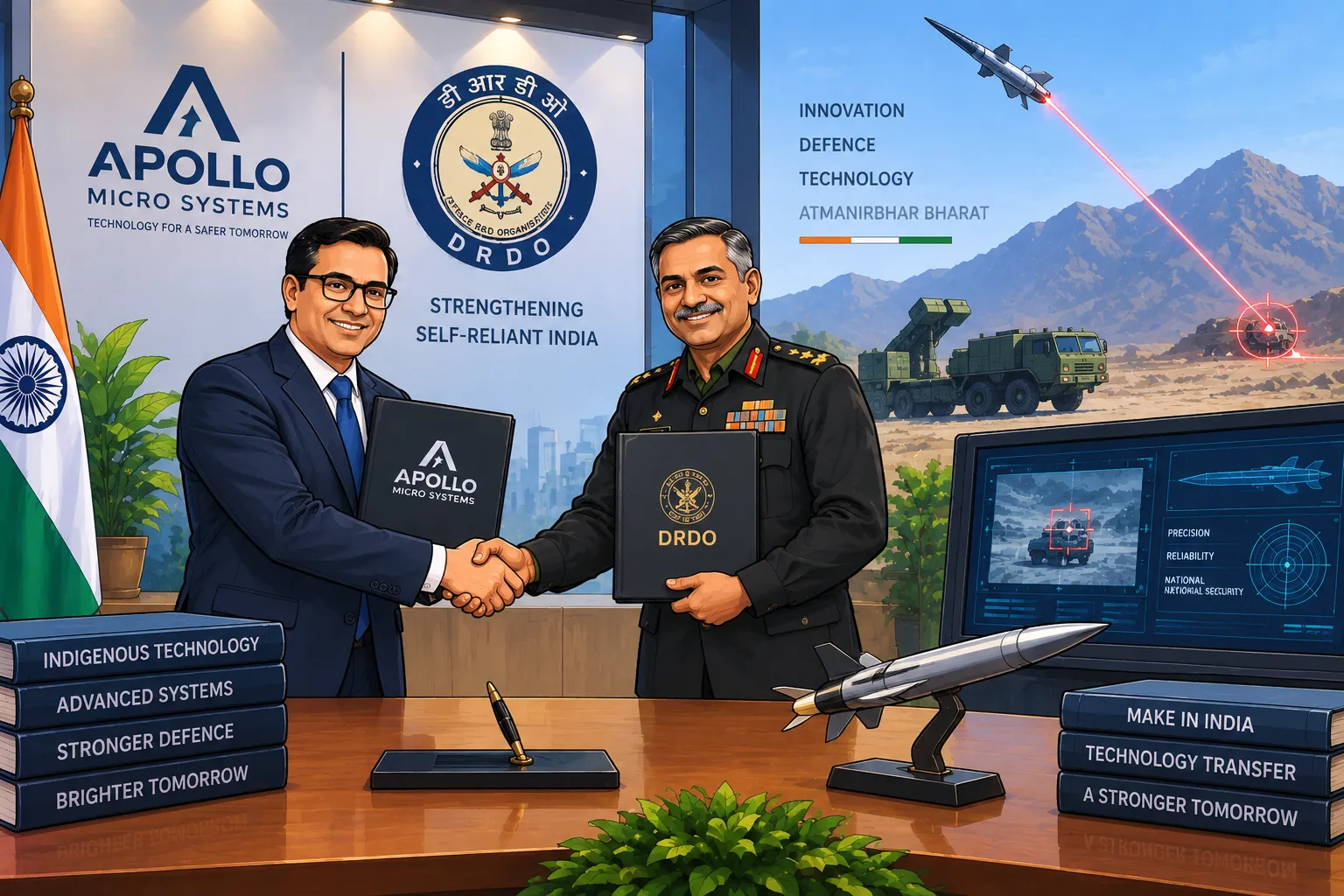
Apollo Micro Systems Ltd (NSE: APOLLO, BSE: 543882) has been awarded a Transfer of Technology (ToT) by the Defence Research and Development Organisation (DRDO) for the Semi Active Laser Homing System (SALHS), a precision-guidance package used in laser-designated munitions. The handover was formalised at the VIMARSH 2026 DRDO–industry synergy meet in New Delhi on 15–16 September 2026, in the presence of Defence Minister Rajnath Singh.
In the same announcement window, Apollo highlighted that its Multi-Influence Ground Mine (MIGM, also referred to as Vighana) has transitioned into the production phase after receiving Defence Acquisition Council (DAC) approval on 3 July 2026 and an Acceptance of Necessity (AoN) from the Ministry of Defence. The company is positioned as a DRDO-approved production agency under the Designated Centre for Precision Production (DcPP) framework, enabling in-house execution of critical components such as fibres, electronics and explosives.
Why this matters for investors
The SALHS award marks a strategic shift for Apollo from supplying subsystems and components to manufacturing high-barrier guidance packages that can be integrated across multiple platforms, including laser-guided bombs, missiles and artillery shells. SALHS works by detecting scattered or reflected laser radiation from a target and enabling in-flight course corrections, thereby improving strike accuracy.
For investors, this expands Apollo's addressable market within India's precision-guided munitions ecosystem. Combined with MIGM entering production, the company now has two distinct, defence-critical programmes that could provide near-to-mid-term revenue visibility—subject to execution timelines, trial outcomes and order flow.
Execution path: co-production, integration and scale-up
Media reports indicate that Bharat Dynamics Ltd (BDL) will co-produce the SALHS system with Apollo Micro Systems, suggesting a collaborative manufacturing model that leverages BDL's missile-production expertise alongside Apollo's electronics and systems integration capabilities. This co-production arrangement could accelerate qualification and integration timelines, though specific delivery schedules remain unconfirmed.
On the MIGM front, the programme's movement from DAC approval to production implies that the technical design and user requirements have been validated, and the focus now shifts to manufacturing scale-up, supply-chain readiness and sustained quality control under DRDO oversight. Apollo's in-house execution of fibres, electronics and explosives under the DcPP umbrella is intended to reduce dependency on external vendors and strengthen control over critical subsystems.
Financial context: Q1 FY27 growth and margin trajectory
Apollo's latest reported financials provide context for its capacity to absorb new programmes. In Q1 FY27, the company posted consolidated revenue of ₹251.3 crore, up 88% year-on-year, and profit after tax (PAT) of ₹25.2 crore, up 43% YoY. EBITDA stood at ₹48 crore with margins at 21.4%, reflecting operational leverage as order execution scales.

While these numbers do not directly quantify the SALHS or MIGM contribution, they underscore a growth phase where additional high-value defence programmes could further strengthen top-line momentum—if working-capital needs and production ramp-up are managed effectively. Investors will watch for commentary on capacity expansion, vendor development and margin trajectory as new lines come online.
Sector and policy backdrop: DRDO's wider tech-transfer push
Apollo's SALHS ToT is part of a broader DRDO initiative. At VIMARSH 2026, DRDO handed over nine Licensing Agreements for Transfer of Technology (LAToTs) to 13 manufacturing partners, covering areas such as naval mines, missile propulsion, precision guidance and escape gear. The event also unveiled measures to deepen MSME and start-up participation in defence R&D, including a framework for sharing DRDO-developed software source codes with licensees.
DRDO notes that, to date, over 2,300 technology transfers have been handed over to more than 1,100 industries, signalling a structural pipeline for domestic defence production. For the Indian market, this reinforces the policy thrust towards Aatmanirbhar Bharat in defence and supports a multi-year capex and manufacturing cycle that benefits listed defence electronics and systems integrators.
Market reaction and price context
Ahead of the announcement flow, Apollo's shares were under pressure on 15 September 2026, with intraday reports indicating a 5–7% decline, trading around ₹391–₹399 levels. The SALHS ToT and MIGM production update provide a fresh fundamental catalyst that could stabilise sentiment, though exact intraday price action on 16 September 2026 remains unverified at the time of writing.
Also Read: SEBI Keeps CAS, Reworks Derivatives Expiry Pricing
What investors should watch next
- Execution timelines: Trial schedules, platform integration milestones and first-delivery windows for SALHS and MIGM.
- Co-production dynamics: Role clarity with BDL, capacity allocation and qualification progress for the laser-homing system.
- Working capital and margins: Cash-flow needs as production scales; trajectory of EBITDA margins amid new product mix.
- Order visibility: Any follow-on announcements on quantities, contract values or multi-year supply arrangements.
- Sector cue: Broader impact on defence stocks as DRDO continues technology transfers and domestic production corridors expand.
Bottom line for defence-stock watchers
Apollo Micro Systems' SALHS technology transfer and MIGM production shift represent a meaningful upgrade in its defence portfolio—from components to high-value guidance and mine systems. For Indian investors tracking defence manufacturing, the key is now execution: how quickly these programmes translate into sustained orders, revenue contribution and margin resilience as the DRDO-led tech-transfer wave widens.