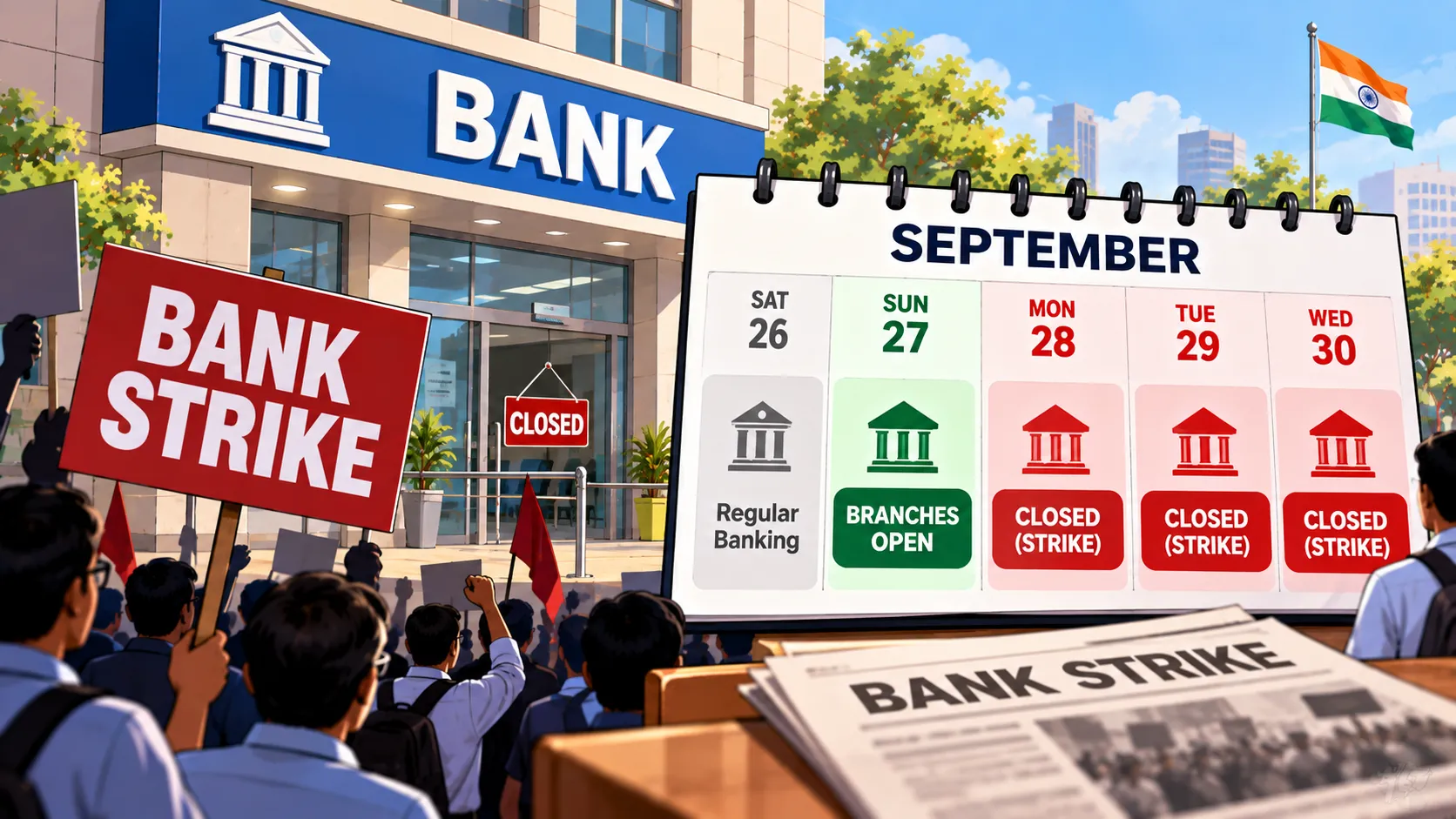

The finance ministry meets public sector bank chiefs on Monday to review contingency plans for a three-day nationwide bank strike from September 28, called by the United Forum of Bank Unions over a five-day banking week and pension demands.
Today's Meeting and Who Is in the Room
The Department of Financial Services has called chief executives of public sector banks, regional rural banks, the Indian Banks' Association and NABARD to a meeting on Monday, September 21. The meeting is chaired by the Secretary, Department of Financial Services, and is intended to take stock of preparations before the strike begins.
According to a communication sent to banks, the agenda is contingency measures to keep banking operations running and essential customer services available through the strike period. That framing matters for customers: the government is planning for disruption rather than expecting the strike to be called off.
Why the Calendar Makes This Strike Bigger Than Three Days
The strike is scheduled for three days from September 28, but the practical impact runs longer. September 26 and 27 fall on a weekend, so normal branch operations could be affected for up to five consecutive days, from September 26 through September 30.
That stretch matters most for services that still depend on a staffed branch. Cheque processing, cash transactions and other branch-dependent work are the areas where a five-day gap is felt, particularly by businesses and by customers who have time-bound payments in that window.
The timing carries a second complication. The strike overlaps with the half-yearly closing of bank accounts, a period when banks are already working through reconciliation and reporting. That overlap is part of the reason the finance ministry has asked for contingency arrangements to be reviewed in advance.
What the Unions Are Demanding
The United Forum of Bank Unions is an umbrella body of seven bank employee and officer unions. UFBU has said it represents around 90 per cent of the country's banking workforce.
The demands on the table include:
- Implementation of a five-day banking week, which the unions have made the central issue
- Pension updation and improvement for retired bank staff
- A uniform dearness allowance formula for pensioners
- An option for employees covered under the National Pension System to switch to the old pension scheme
The five-day week demand is the one that has repeatedly stalled. Under the current arrangement, bank branches work six days a week with the second and fourth Saturdays off.

How the Dispute Reached This Point
The unions served a strike notice on August 26. Conciliation proceedings involving union representatives, the Indian Banks' Association and government officials were held after that notice, but the five-day banking week remained unresolved.
UFBU has said it will proceed with the strike unless there is a concrete development on that demand. The unions had also observed a nationwide strike on September 11 over the same issue, so the September 28 action is an escalation of a dispute that is already several weeks old rather than a fresh flashpoint.
What This Means for Bank Customers
For retail customers, the exposure depends on how much of their banking is branch-based. Digital channels such as net banking, mobile banking and card payments are operated through systems rather than by branch staff, while cash withdrawal at a branch counter, cheque clearing, passbook and locker services, and in-person account work are the functions most likely to be interrupted.
Anyone with a cheque expected to clear, a cash requirement, a fixed deposit maturing, or paperwork that needs a branch visit between September 26 and September 30 would be dealing with a compressed window either side of that stretch. Banks typically issue their own customer advisories closer to a strike date, and those notices are the specific guide to which branches and services are affected.
Also Read: Six Mainboard IPOs Worth ₹3,825 Crore Open This Week
Why Markets Watch a Bank Strike
For investors, a three-day strike is not by itself a material event for bank earnings. Its relevance is narrower and mostly operational. Public sector banks carry the bulk of India's branch network, so a strike falling on a half-yearly closing raises questions about the mechanics of reporting and reconciliation rather than about underlying business performance.
The more durable market question is the cost side of the demands. A five-day banking week, pension updation and a shift of National Pension System employees to the old pension scheme all carry recurring financial implications for banks and, in the case of pension changes, for the government. No settlement on those items has been reached, and the finance ministry meeting on Monday is about managing the strike rather than about resolving them.
Public sector banks are separately dealing with an interest-rate cycle question. Their high exposure to repo-linked retail, agriculture and MSME loans means asset repricing can move faster than deposit repricing if the Reserve Bank of India raises rates, which is the margin issue bank managements are focused on well beyond the strike dates.