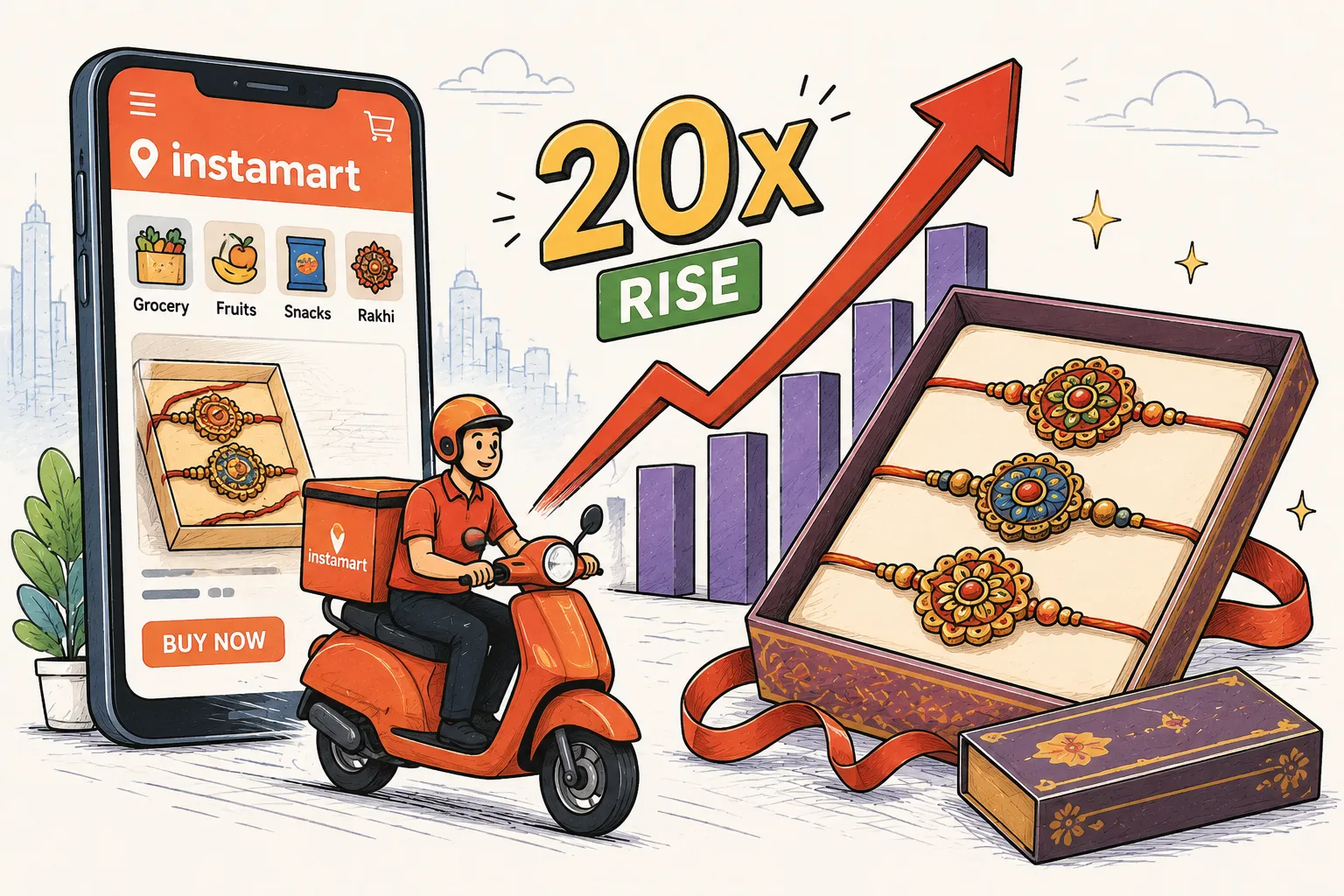
Swiggy Instamart says premium-Rakhi demand is 20 times higher than last year ahead of Raksha Bandhan on 28 August. The company’s update points to premium festive gifting on quick-commerce platforms, but does not quantify any revenue or earnings effect.
Swiggy Instamart has reported a sharp increase in demand for premium, jewellery-style and silver-based Rakhis as shoppers prepare for Raksha Bandhan, which falls on Friday, 28 August 2026.
According to the quick-commerce platform, demand for premium Rakhis is 20 times higher than in the corresponding period last year. Instamart has also projected that its broader Rakhi gifting category could grow about threefold during the current festive period.
The figures are company-reported seasonal metrics, not audited financial results or exchange-filed operating data. They offer a fresh view of a changing festive basket on quick-commerce platforms, but do not establish an industry-wide rise in jewellery or premium-gifting demand.
Premium Rakhis move beyond traditional gifting
Instamart said customers are showing stronger interest in silver designs, jewellery-inspired Rakhis and branded festive products. Its Rakhi assortment is priced from ₹9 to ₹999, covering low-value purchases as well as more premium gift options.
The platform’s festive selection includes products from brands such as Kalyan Jewellers, Palmonas, GIVA, Swarovski and Nestasia. This indicates that quick-commerce platforms are using festival occasions to extend their assortment into branded and higher-value categories that sit beyond their traditional essentials-led offering.
For consumers, the appeal is the combination of immediate availability and a wider product choice. For the platform, premium Rakhis and associated gifting items can add a different type of demand to the festival basket, alongside sweets, chocolates and hampers.
However, Instamart has not disclosed gross merchandise value, order volumes, average order value, commissions, discounting, fulfilment expenses or category-level profitability from the Rakhi campaign. The reported rise in demand should therefore not be interpreted as evidence of a material near-term impact on Swiggy Ltd’s revenue, margins or earnings.
Four cities feature in Instamart’s demand update
Lucknow, Ahmedabad, Bhubaneswar and Chandigarh are among the fastest-growing markets for premium Rakhis on Instamart, according to the company.
The named cities add a geographic dimension to the update, suggesting that higher-value festive purchases on the platform are not confined to the largest metropolitan markets. Still, the information reflects Instamart’s own customer activity and does not measure demand across India’s wider jewellery, gifting or e-commerce sectors.
The wider consumer signal is one of selective premiumisation: shoppers may be choosing a more elaborate or branded Rakhi for a festival occasion while using quick commerce for convenience. That is a relevant trend for companies building digital distribution in discretionary categories, but the available data is too limited to quantify market size or sector-wide sales growth.

Last year’s platform data sets the backdrop
Instamart’s cited 2025 data showed Rakhi orders rising 3.5 times year-on-year, while Rakhi hampers increased eightfold. The platform also said that sweets and chocolates rose eightfold and fourfold, respectively, compared with regular-day demand during the prior festive period.
These figures provide context for the seasonal importance of Raksha Bandhan to the platform. They are internal operating indicators, however, and are not independently verified measures of the overall retail market.
The latest figure is more specific: the 20x increase relates to premium Rakhis rather than every Rakhi sold on the platform. Similarly, the expected threefold expansion is Instamart’s estimate for the broader Rakhi gifting category this season.
That distinction is important when assessing the update. A premium category can show a higher growth rate than an overall category, particularly where the starting base is comparatively small. Instamart has not disclosed the underlying order base or sales value, so the absolute financial scale of the increase cannot be determined.
Also Read: PhysicsWallah Sees ₹550 Crore Block Deal in 1.6% Equity
What the update means for listed companies
Swiggy’s Instamart business is the central entity in this update. Kalyan Jewellers is also relevant because products from the brand are included in Instamart’s premium festive assortment.
No verified share-price movement in Swiggy or Kalyan Jewellers has been linked specifically to the premium-Rakhi demand announcement. Nor has either company disclosed revenue, profit or sales-volume contribution from the Instamart Rakhi offering.
For investors tracking quick commerce, subsequent company disclosures will be more useful for assessing whether premium and occasion-led categories influence operating performance. Relevant indicators include order growth, average order value, contribution margins, fulfilment costs, customer-acquisition spending and inventory-model progress.
The Raksha Bandhan update is therefore a consumer-demand datapoint rather than a confirmed financial catalyst. It shows Instamart testing higher-value festive products and attracting interest in premium gifting, but it does not provide sufficient evidence to draw conclusions on Swiggy’s quarterly financial performance.
Readers who want to follow listed quick-commerce and consumer-sector companies can open demat account online after reviewing company disclosures, business risks and valuations. This seasonal demand update, on its own, should not be treated as a trigger for stock market trading decisions.