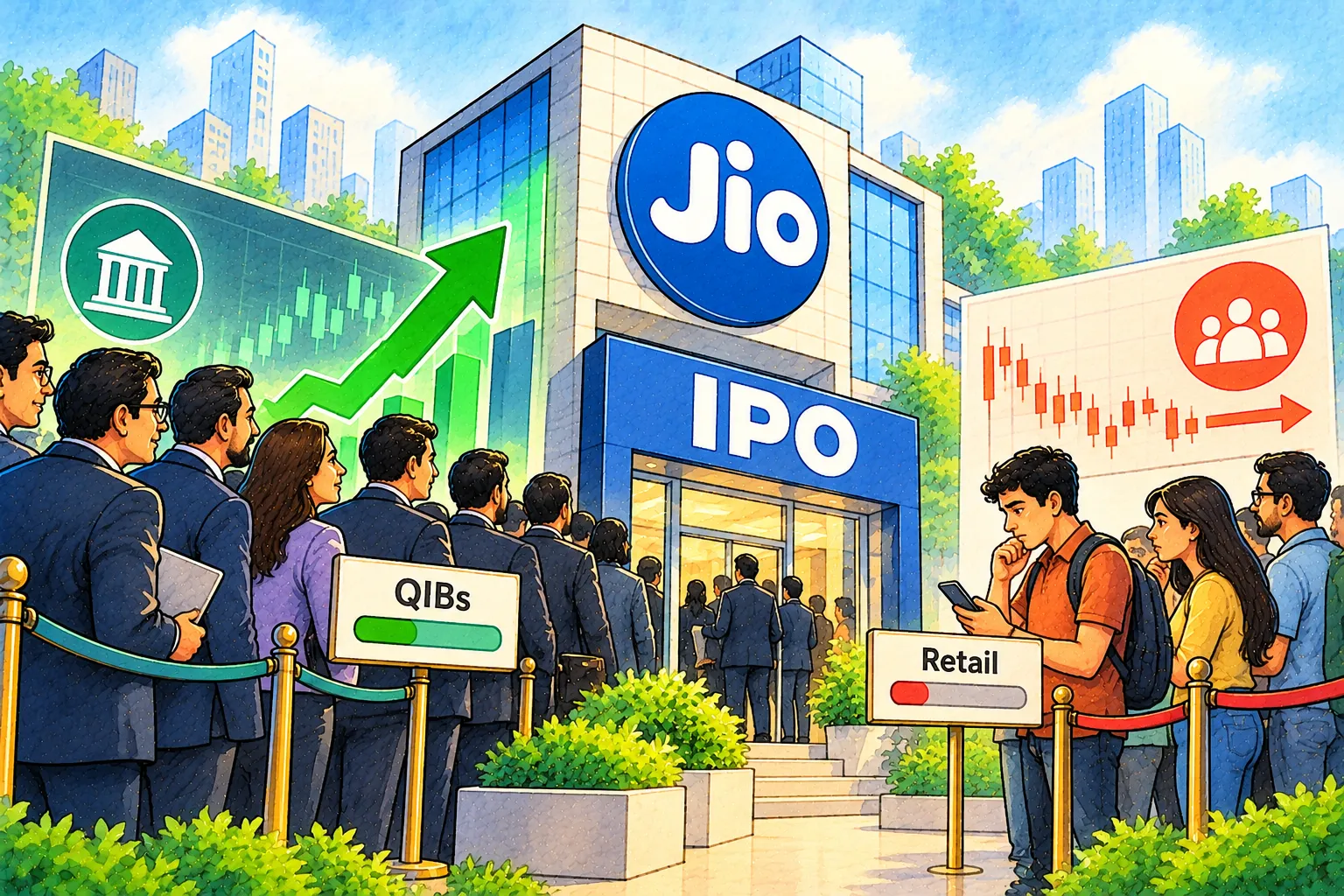
Jio Platforms’ ₹30,213 crore IPO was subscribed 3.16 times on its first day, October 21. Qualified institutional buyers bid 9.42 times their quota, while retail investors bid for 0.73 times theirs.
Day 1 Subscription by Category
Jio Platforms’ IPO opened at 9 am on Wednesday and crossed the full-subscription mark in less than 100 minutes, according to Business Standard. By 10:34 am the issue was subscribed 1.01 times, with bids for about 19.99 crore shares worth roughly ₹22,354 crore at the upper price band, against shares worth ₹22,078 crore on offer. By the end of the day, the overall subscription was 3.16 times.
| Category | Day 1 subscription |
| Qualified institutional buyers (QIBs) | 9.42 times |
| Retail investors | 0.73 times |
| Overall | 3.16 times |
Business Standard also reported, citing sources, that retail bids on the day came to a day-one record of ₹6,908 crore and that overall demand stood at ₹3.20 trillion. The QIB portion on offer was worth ₹5,484 crore. Retail investors can bid for a minimum of one lot of 12 shares and up to 14 lots, or about ₹1.88 lakh at the upper band, so 0.73 times means the retail portion still had unsold shares at the close of day one.
What the QIB Multiple Implies
QIBs include mutual funds, insurers, banks and foreign institutions. Multiplying the reported 9.42 times by the ₹5,484 crore QIB portion on offer gives implied day-one QIB bids of roughly ₹51,660 crore. That figure is a calculation from the two reported numbers and not a number reported by the exchange. It shows how large the institutional demand was relative to the quota, though bids may still change before the issue closes.
How the Morning Snapshot Compares
The early-morning figures show how quickly institutional demand built through the session. At 10:34 am, QIBs had bid 3.25 times their reserved portion, with bids worth ₹17,804 crore. Employees were at 0.57 times and the shareholder category at 0.43 times. The retail portion stood at 0.23 times and non-institutional investors at 0.26 times. The retail figure more than tripled by the close of day one, from 0.23 times to 0.73 times.
Business Standard noted that QIBs normally place bids toward the end of an IPO, often on the last day, and that heavy day-one commitment is unusual. It compared Jio with the NSE IPO, where QIB subscription was 0.08 times on day one and rose to 12.68 times by the final day.

Who Anchored the Issue
New details from the company’s filing with the exchanges add to the anchor round reported earlier. Jio Platforms raised ₹8,109.85 crore from 212 anchor investors on Monday, with about 7.25 crore shares allotted at ₹1,119 each.
- LIC: 44.68 lakh shares worth ₹499.98 crore, or 6.17% of the anchor portion
- New World Fund: ₹486.27 crore, or 6% of the anchor book
- Domestic mutual funds: ₹2,784.96 crore, or 34.34%, through 95 schemes of 25 fund houses
- Life insurers and pension funds: ₹1,089.95 crore, or 13.44%, from 22 institutions
Also Read: RBI Rejects All T-Bill Bids as 10-Year Yield Hits 7.44%
Reserved Quotas and What Comes Next
The IPO is entirely a fresh issue of 27 crore equity shares, with no offer for sale, so existing shareholders are not selling. The shares are proposed to list on both NSE and BSE. Eligible Reliance Industries shareholders have a reservation worth up to ₹2,500 crore, and eligible employees have up to ₹500 crore, according to Free Press Journal.
The price band is ₹1,065 to ₹1,119 per share, and the minimum bid is one lot of 12 shares, or ₹13,428 at the upper band. The issue closes on Friday, October 23, and the exchanges will publish updated subscription figures for each category on day two and day three. Upstox lists the basis of allotment on October 26, refunds and credit of shares to demat accounts on October 27, and listing on October 28.
Day-one numbers are only a snapshot. IPO categories are measured against their own reserved portions, and the final subscription multiples will only be known after bidding closes on October 23. Anchor demand and day-one bids are different from final allotment, which depends on the final issue price and on how many shares each category receives.