
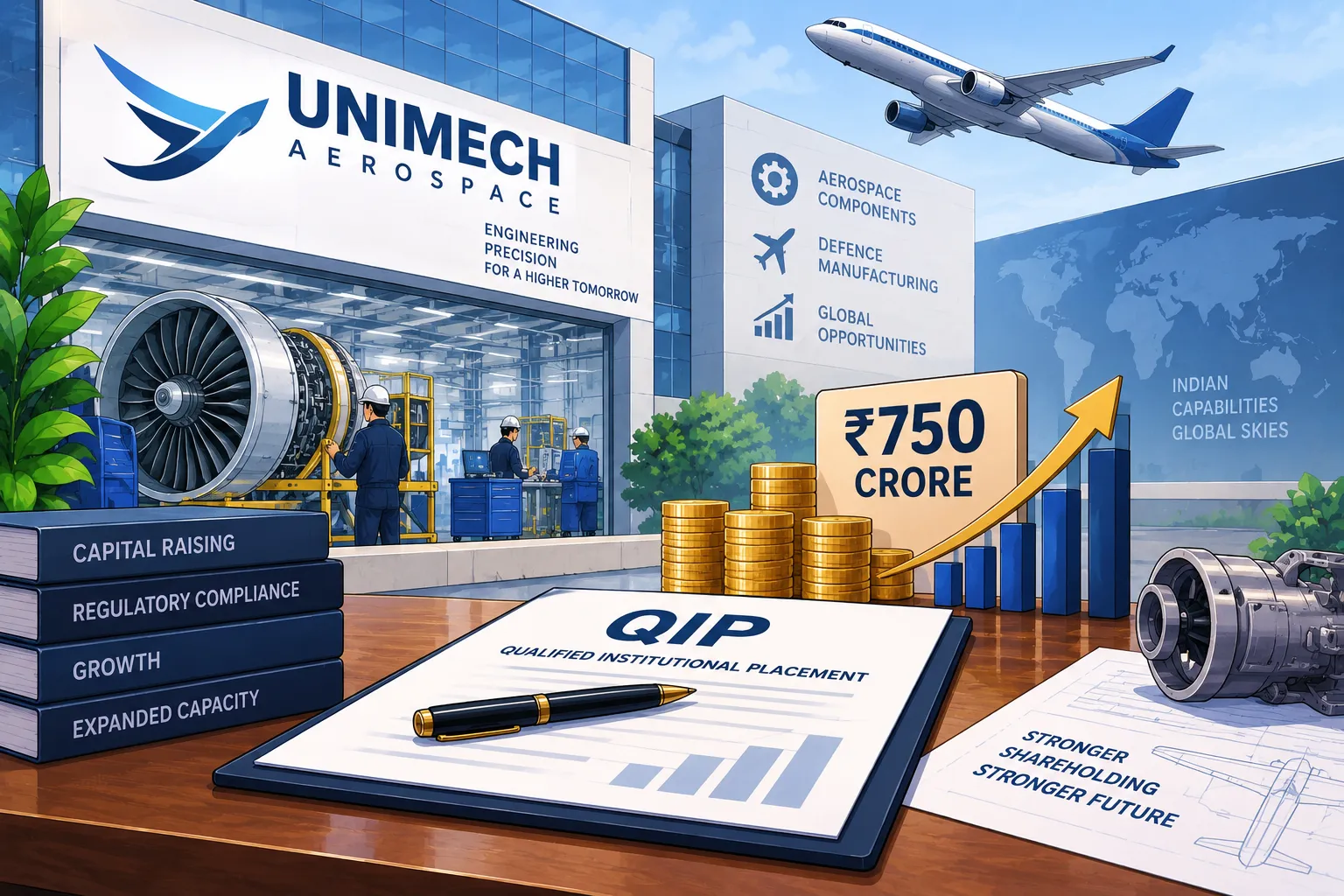
Unimech Aerospace is set to raise up to ₹750 crore via a qualified institutional placement. The move aims to meet SEBI's minimum public shareholding rule and fund capacity expansion after strong Q1 FY27 results.
QIP Launch Expected Mid-September 2026
Unimech Aerospace and Manufacturing Limited is preparing to launch a qualified institutional placement (QIP) to raise up to ₹750 crore, according to multiple financial news reports. The company secured shareholder approval for the enabling resolution at its 10th Annual General Meeting held on August 28, 2026, and is now working with lead managers Anand Rathi and Nuvama to time the actual issue in mid-September 2026, subject to market conditions.
This will be Unimech's first major equity fundraising since its December 2024 initial public offering, which raised ₹500 crore. The QIP is primarily intended to help the company comply with SEBI's minimum public shareholding (MPS) requirement of 25% for newly listed companies, which must be achieved within 18 months of listing.
Promoter Holding and MPS Compliance
Current promoter shareholding in Unimech Aerospace stands at 79.82%, significantly above the 25% public float mandated by SEBI for companies that have been listed for over a year. The QIP route allows listed companies to issue equity shares to qualified institutional buyers without requiring a public offer, making it an efficient method to increase public shareholding while raising growth capital.
By diluting promoter holding through institutional placement, Unimech will move closer to the regulatory requirement while simultaneously improving secondary market liquidity for retail and institutional investors. The company's December 2024 IPO listing means it must achieve the 25% threshold by mid-2026, adding urgency to the current fundraising effort.
Strong Q1 FY27 Performance Supports Fundraising
The timing of the QIP follows a robust first-quarter performance. For Q1 FY27 (ended June 30, 2026), Unimech reported revenue of ₹107.62 crore, up 71% year-on-year, while net profit climbed 45.86% to ₹27.86 crore. This marks a sharp turnaround from FY26, when full-year revenue declined approximately 1% to ₹240.5 crore and profit fell 24% to ₹63.3 crore due to higher depreciation and finance costs from capacity investments.
The company's order book stood at around ₹280 crore as of end-June 2026, providing revenue visibility for the coming quarters. Additionally, on September 15, 2026, CARE Ratings assigned Unimech a 'CARE A; Stable' issuer rating, reflecting investment-grade creditworthiness and strengthening the company's case for institutional investor participation.
Strategic Acquisitions and Capacity Build-Out
Unimech has been actively expanding its precision engineering platform through acquisitions. In April 2026, the company completed its ₹450 crore acquisition of Hobel Bellows, a move that contributed to the strong Q1 FY27 results. More recently, on September 7, 2026, Unimech increased its stake in associate company Dheya Engineering by 5.08% for ₹2.99 crore, taking total holding to 35.07%. Dheya Engineering manufactures gas turbine components, aligning with Unimech's focus on high-value aerospace and defence segments.
The company operates over 155 CNC machines with capabilities spanning machining, fabrication, assembly, and testing for aerospace, defence, energy, and semiconductor customers. It also holds a long-term supply agreement with Austria's FACC Operations GmbH, underscoring its export-oriented business model. The Hobel Bellows acquisition specifically strengthened Unimech's precision bellows and flexible piping capabilities for aerospace applications.

Defence Sector QIP Trend in 2026
Unimech's capital-raising move comes amid a broader trend of equity fundraising in India's manufacturing and defence sectors. In 2026 alone, several companies have tapped the QIP route: IdeaForge raised ₹500 crore in July, Belrise Industries raised ₹1,700 crore in July, Apar Industries raised ₹2,500 crore in August, and Ather Energy raised ₹1,300 crore in July. This reflects strong institutional appetite for growth capital in sectors aligned with India's indigenisation and export priorities.
Defence and aerospace manufacturing remain policy priority sectors under the government's push for domestic production and reduced import dependence. Unimech's focus on high-precision components positions it to benefit from both domestic defence modernisation and global aerospace supply chain diversification.
Share Price Performance and Investor Context
Unimech Aerospace shares closed at ₹1,538.50 on the NSE on September 15, 2026, with the stock up approximately 69% in calendar year 2026. During the week of September 7–11, 2026, the stock gained 6.93%, outperforming the broader market and hitting multiple 52-week and all-time highs.
For investors, the QIP presents both opportunities and considerations:
- Dilution impact: New equity issuance will reduce earnings per share in the short term, though proceeds are expected to fund capacity expansion and working capital for large OEM contracts.
- Liquidity improvement: Increased public float should enhance trading liquidity and potentially attract broader institutional coverage.
- Growth funding: Capital raised will support execution of the ₹280 crore order book and potential further acquisitions in the precision engineering value chain.
- Valuation context: Strong Q1 FY27 growth and the CARE A rating provide fundamental support, though investors should await official exchange filings for QIP pricing details.
Also Read: Apollo Micro Gets DRDO Tech Transfer for Laser-Guidance System
What Investors Should Monitor
The actual launch of the QIP will be confirmed through BSE and NSE filings, which will disclose the price band, issue size, and allotment timeline. Investors should watch for:
- Official exchange announcements on QIP launch date and pricing
- Institutional investor participation levels
- Use-of-proceeds details in the placement document
- Post-QIP promoter holding and public shareholding percentages
Unimech Aerospace's QIP represents a strategic step toward regulatory compliance and capacity scaling, backed by strong quarterly performance and sector tailwinds. The success of the placement will depend on market conditions and institutional investor appetite for defence and aerospace exposure at current valuations.