
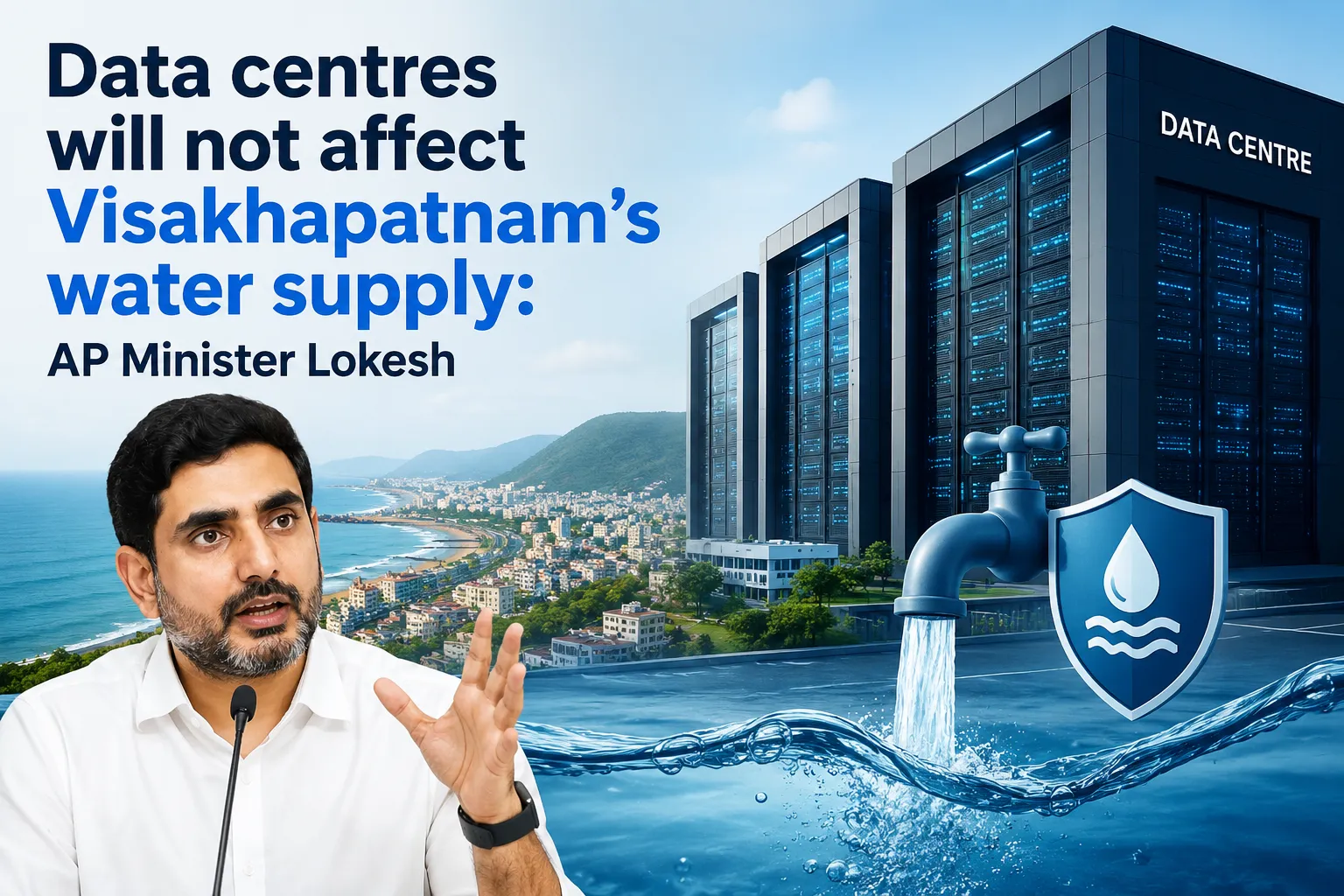
Andhra Pradesh IT Minister Nara Lokesh on Wednesday, August 19, 2026, assured the State Assembly that the upcoming data-centre ecosystem in Visakhapatnam will not affect the city's water supply in any way. He made this statement while responding to a question raised by Jana Sena MLA Lokam Naga Madhavi during the Assembly session held in Amaravati.
The Minister was clear and firm in his response. He stated that the State government would ensure that water allocated for the city's residents would not be diverted to data-centre projects under any circumstances. He said that dedicated industrial water allocations and separate pipelines would be provided specifically for the data-centre projects, keeping the two water systems entirely distinct from each other.
The assurance comes at a time when large-scale technology infrastructure projects in Visakhapatnam have been drawing attention, with residents and elected representatives raising questions about the potential impact on the city's water resources.
Minister Calls Out Misinformation on Data Centre Water Use
Minister Lokesh did not stop at giving assurances. He also pushed back strongly against what he described as misinformation being spread about the environmental and water requirements of data centres. He said the criticism directed at these projects did not reflect an accurate picture of how data centres compare to other large industrial facilities.
To make his point, Lokesh offered a direct comparison. He noted that a 1 GW thermal power plant consumes nearly 10 times more water annually than a data centre of equivalent capacity. He questioned why protests and public concern were focused specifically on data centres when other large industrial facilities operating in the country have significantly higher water requirements.
The Minister's remarks were aimed at putting the water consumption of data centres in proper context, arguing that the scale of concern being expressed was disproportionate to the actual impact of these projects compared to other forms of industrial activity.
Planned 6.5 GW Ecosystem Needs Around 3 TMC Water Per Year
Lokesh provided specific figures to give the Assembly a clearer picture of the water needs associated with the planned data-centre ecosystem in Visakhapatnam. He stated that once the ecosystem reaches the government's targeted capacity of 6.5 GW, it is estimated to require around 3 TMC of water annually using current technologies.
The Minister added that emerging cooling technologies were expected to reduce water consumption further in the future, suggesting that the 3 TMC figure could come down as technology improves. He also confirmed that the government had fixed 6.5 GW as the ceiling for data-centre capacity allocations, as directed by Chief Minister N. Chandrababu Naidu, and that this target had now been fully achieved.

By capping the total capacity and laying out clear figures for water use, the government appears to be signalling that the scale of the data-centre build-out has been planned with resource constraints in mind.
Polavaram Industrial Allocation to Be Water Source for Data Centres
On the critical question of where the water for the data centres would come from, Lokesh explained that it would be sourced from the industrial allocation of Polavaram water. This is a separate allocation from the water designated for Visakhapatnam's urban residents, which would also be sourced from Polavaram but through a different channel and a different system.
The Minister said a gravity-based water supply to the city is expected to be operational within 18 months. For the data centres, dedicated pipelines would be laid to ensure that there is no mixing or diversion of water meant for the city's residents. The government's position is that both the urban water supply and the industrial water supply for data centres are being handled through entirely separate systems and allocations, making it structurally impossible for one to encroach on the other.
Data Centres Tied to AI Economy and India's Data Sovereignty Goals
Beyond the immediate water supply debate, Minister Lokesh also spoke about the broader national importance of the data-centre projects being developed in Visakhapatnam. He said these data centres were essential to the emerging AI-driven digital economy and to India's data sovereignty.
He made this point particularly against the backdrop of changing geopolitical conditions, highlighting the strategic significance of building domestic data infrastructure within the country rather than depending on foreign systems and servers. The Minister's comments were carried through an official government release issued after the Assembly session concluded.
The Visakhapatnam data-centre ecosystem is being positioned as a major component of Andhra Pradesh's technology and infrastructure development plans under the current state government. The exchange in the Assembly between the MLA and the Minister brought into focus the ongoing public debate around large technology investments in the city and how they interact with existing civic resources and infrastructure.
Also Read: Indian Bonds Wobble on Oil Strain, RBI Swap Pullback